

When Good Numbers Aren't Enough: The Narrative Vacuum That Kills Stock Price
This is the narrative vacuum problem — and it affects far more companies than those who miss.
Why Strong Results Can Still Spook Investors
A public company's stock price is not a direct reflection of its financial performance. It is a reflection of market expectations about the future, filtered through investor confidence in leadership's ability to execute. When results arrive without a clear explanatory framework, analysts fill the silence themselves — and they rarely fill it charitably.
The gap between reported numbers and investor interpretation is where narrative risk lives. A revenue beat paired with rising operating expenses, for example, generates an immediate question: is this growth investment or cost drift?
If the company hasn't answered that question proactively — in earnings language, in prepared remarks, in the media environment surrounding the release — the market answers it instead. Usually with a sell.
This dynamic is particularly acute for companies in transformation phases:
Each of these situations produces financial patterns that look ambiguous without context. Spending goes up before it comes down. Margins compress before they expand. Without a managed narrative, every ambiguous data point becomes a liability.
The Mechanics of Narrative Vacuum
Narrative vacuum doesn't happen because companies have nothing to say. It happens because the communication strategy doesn't match the complexity of the moment. There are three common failure modes:
The result is a reputation gap: a divergence between the underlying quality of the business and what the market believes about it. Closing it is the core of treating reputation as an engineering system rather than an earnings-week scramble.
That gap has a measurable cost in compressed multiples, increased volatility, and reduced access to capital.
Get My Reputation Report
Reputation House is an international technology company for digital risk protection. We map how you appear across search, AI, and media and turn it into a clear reputation report.
What Reputation Risk Actually Looks Like at the Institutional Level
For most public company executives, "reputation management" sounds like a consumer-facing concern — reviews, social media, press crises. But institutional reputation is a distinct and more consequential problem.
Fund managers and analysts are constructing narratives about every company in their coverage universe, continuously. The difference between managing that process and ignoring it shows up directly in valuation.
This is measurable. Companies with low narrative coherence trade at a discount to peers with similar fundamentals — not because the business is worse, but because the market has priced in the interpretive risk of not knowing what management will do next. The directional link between perceived transparency and valuation is well-established in the investor-relations literature: clearer, more consistent disclosure tends to correlate with a valuation premium, independent of the underlying performance metrics. Capturing that premium starts with systematic monitoring of the information landscape, not periodic gut checks.
The company that manages its narrative actively isn't spinning. It's ensuring the market's interpretation of the business stays anchored to the business — not to whichever frame an analyst reached for first.
Managing the Gap Before It Becomes a Crisis
The practical implication is that narrative management for public companies needs to operate continuously, not just around earnings cycles. The information environment around a public company is being updated constantly:
If a company isn't actively shaping that environment, it is passively allowing others to shape it.
Understand the current state of your narrative: what do investors and analysts actually believe about your cost structure, your strategic direction, your management credibility? That requires systematic monitoring of the information landscape, not periodic gut checks.
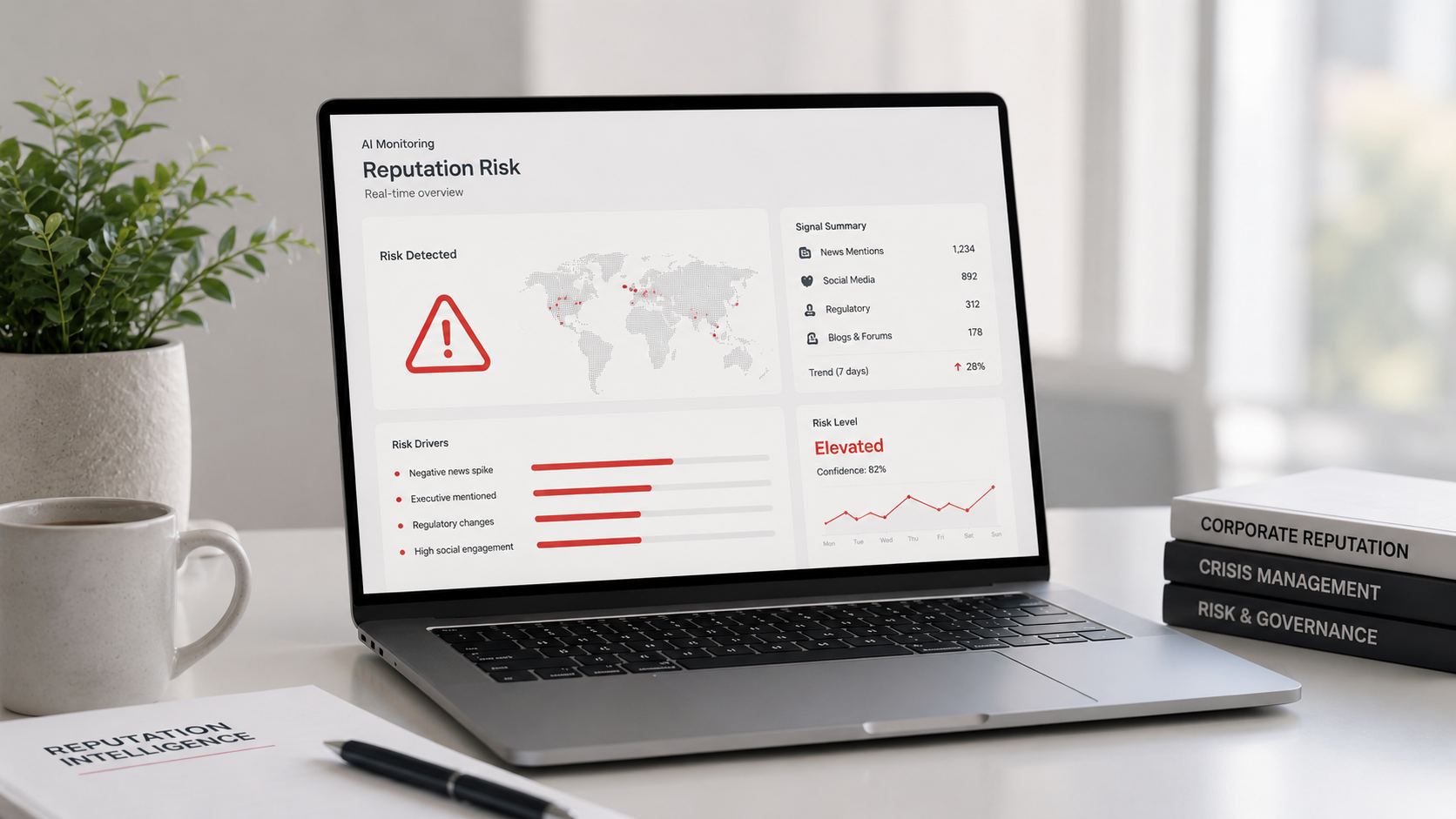
For companies managing ongoing narrative risk across investor relations, media, and digital channels, the Risk Control Center provides continuous monitoring and response infrastructure — mapping the gap between what a company's results actually show and how the market is interpreting them, before that gap becomes a valuation problem.
The cost of a narrative vacuum isn't abstract. It shows up in the spread between where your stock trades and where it should trade given the underlying business. That spread is recoverable — but only if you recognize it before the next earnings cycle forces the question.
Understand your current narrative risk before the market defines it for you. Start with a Risk Check at reputation.house.
Take Action
Know your reputation exposure before road show week
The management work has to happen upstream — in the 12 to 18 months before the offering. Run a structured reputation risk assessment now, and map what investors, analysts, and underwriters will find before they find it — while there's still time to shape the information environment.FAQ



Kristina joined Reputation House in 2022 as Account Director and moved through Operations to become COO before being appointed CEO in 2026. She drove the company's shift from a reputation agency to a technology-driven digital risk management platform. Her expertise spans operational scaling, technological transformation, and international business development in the reputation and digital risk space.