

Reputation Monitoring vs. Reputation Management: Why the Difference Matters Before an IPO
At that point, the distinction between monitoring and management becomes very expensive, very fast. Monitoring watches the fire. It does not build the firewall.
What Reputation Monitoring Actually Does
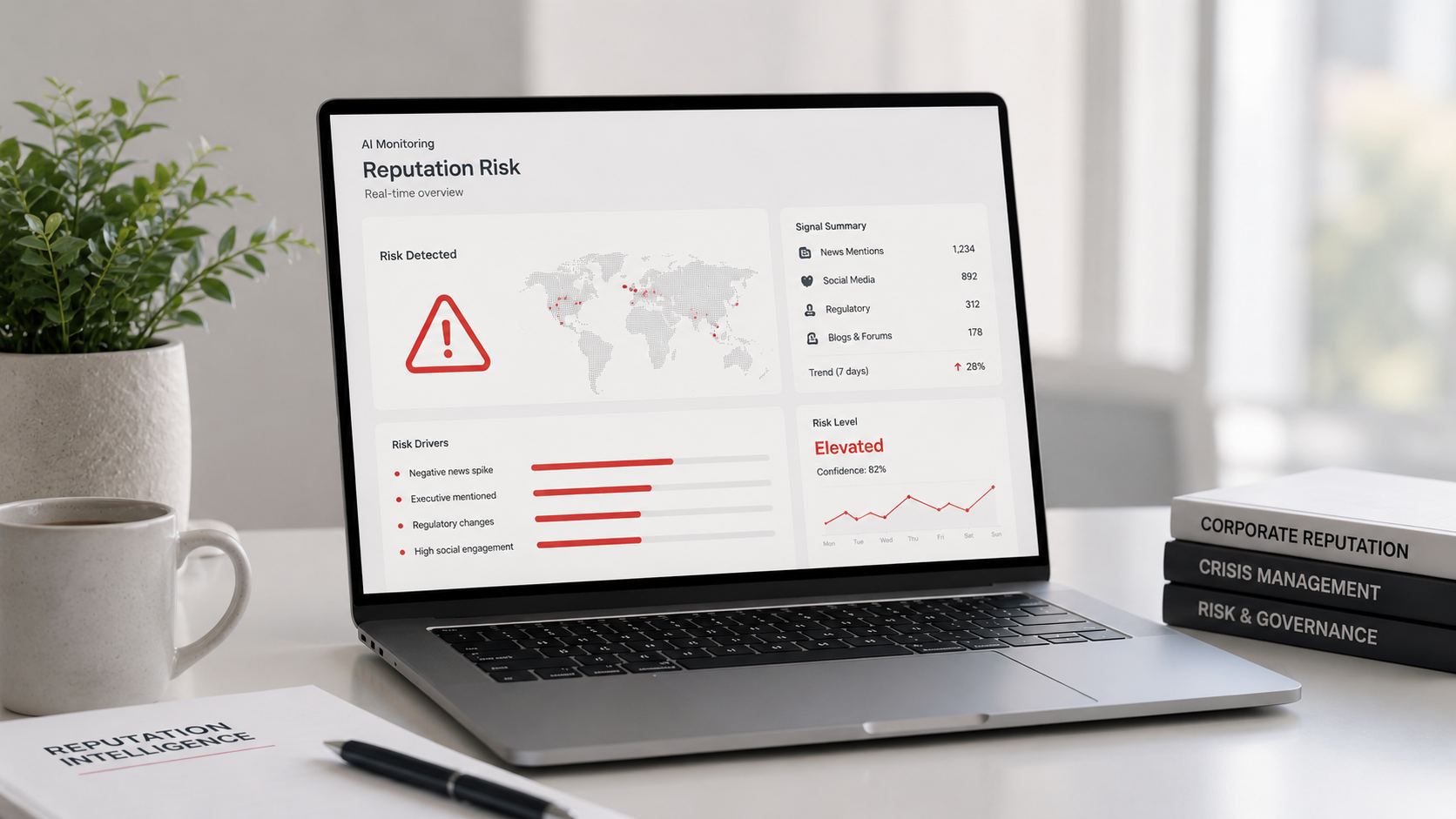
Reputation monitoring is a listening function. It tracks mentions, sentiment shifts, media coverage, review patterns, and social signals across the web. When something is published about your company, monitoring tools register it. When sentiment dips, dashboards show the drop. When a negative story gains traction, alerts fire.
This is genuinely useful. Monitoring gives leadership teams situational awareness. It tells you what is being said and where. For operational purposes — catching a product complaint before it escalates, identifying a journalist working on a story — real-time monitoring is a critical early-warning layer.
But monitoring does not change what is being said. It does not influence which stories rank on page one of Google when an investor searches your company name. It does not build the positive narrative infrastructure that gives institutional buyers confidence before they commit capital.
Monitoring watches the fire. It does not build the firewall.
What Reputation Management Actually Does
Reputation management is an active discipline. It shapes the information environment before, during, and after high-stakes events. In an IPO context, that means several things simultaneously.
Companies that rely on monitoring alone are effectively flying passive. They know when problems appear. They are not positioned to prevent the information environment from deteriorating in the first place.
Get My Reputation Report
Reputation House is an international technology company for digital risk protection. We map how you appear across search, AI, and media and turn it into a clear reputation report.
Why the IPO Window Makes This Distinction Critical
The current IPO cycle is operating under conditions where information moves faster and investor due diligence is more digitally intensive than at any previous point in market history. Analysts at institutional funds now run systematic digital risk assessments on prospective holdings. ESG research teams scan not just official filings but earned media, forum activity, and executive digital footprints. A single unaddressed negative narrative — a regulatory dispute from three years ago that still ranks on page one, a glassdoor pattern that suggests governance dysfunction, a founder controversy that was never properly contextualized — can surface in a way that creates friction in the bookbuilding process. This is exactly the dynamic explored in why pre-IPO deals collapse at due diligence.
This is where the passive/active gap becomes a financial issue rather than a communications issue.
The road show window is typically compressed. By the time a company is in active investor meetings, there is limited ability to change what ranks, what is indexed, or what narrative has consolidated around the brand. The management work has to happen upstream — in the 12 to 18 months before the offering.
The Risk Assessment Layer That Most Companies Skip
Before committing to a reputation management strategy, pre-IPO companies need a clear picture of their actual exposure. What does the information environment look like today? What does it look like when investors search for your company? Where are the vulnerabilities, and how severe are they?
This is the function of a structured reputation risk assessment — not a brand audit, not a PR review, but a systematic mapping of the digital information landscape against the specific risk categories that institutional investors and underwriters care about:
Reputation House's Risk Check is built precisely for this pre-event diagnostic. It identifies where your information environment is creating friction — before a road show schedule is set, before analysts are in the room, and while there is still time to build the management architecture that passive monitoring alone will never provide.
If you're preparing for an IPO, an M&A process, or any high-stakes capital event, the time to understand your reputation exposure is now — not during road show week. Start with a Risk Check at checkmyrisks.com.
Take Action
Know your reputation exposure before road show week
The management work has to happen upstream — in the 12 to 18 months before the offering. Run a structured reputation risk assessment now, and map what investors, analysts, and underwriters will find before they find it — while there's still time to shape the information environment.FAQ




Kristina
CEO, Reputation House
Kristina joined Reputation House in 2022 as Account Director and moved through Operations to become COO before being appointed CEO in 2026. She drove the company's shift from a reputation agency to a technology-driven digital risk management platform. Her expertise spans operational scaling, technological transformation, and international business development in the reputation and digital risk space.
LinkedIn →