

Real-Time Brand Reputation Monitoring: Tools, Methods, and What 24/7 Coverage Actually Requires
A negative Trustpilot thread, a Reddit post, an AI Overview pulling outdated allegations into a summary — none of these announce themselves. This guide covers what continuous monitoring actually requires to catch them before they compound.This is distinct from a quarterly brand health survey or a one-off media audit. Real-time monitoring means the gap between "something happened" and "someone on your team knows" is measured in minutes, not weeks. For companies in regulated or high-scrutiny sectors — fintech, trading platforms, pharma — that gap is often the difference between a contained issue and a six-month SERP cleanup.
Defining Real-Time Brand Reputation Monitoring
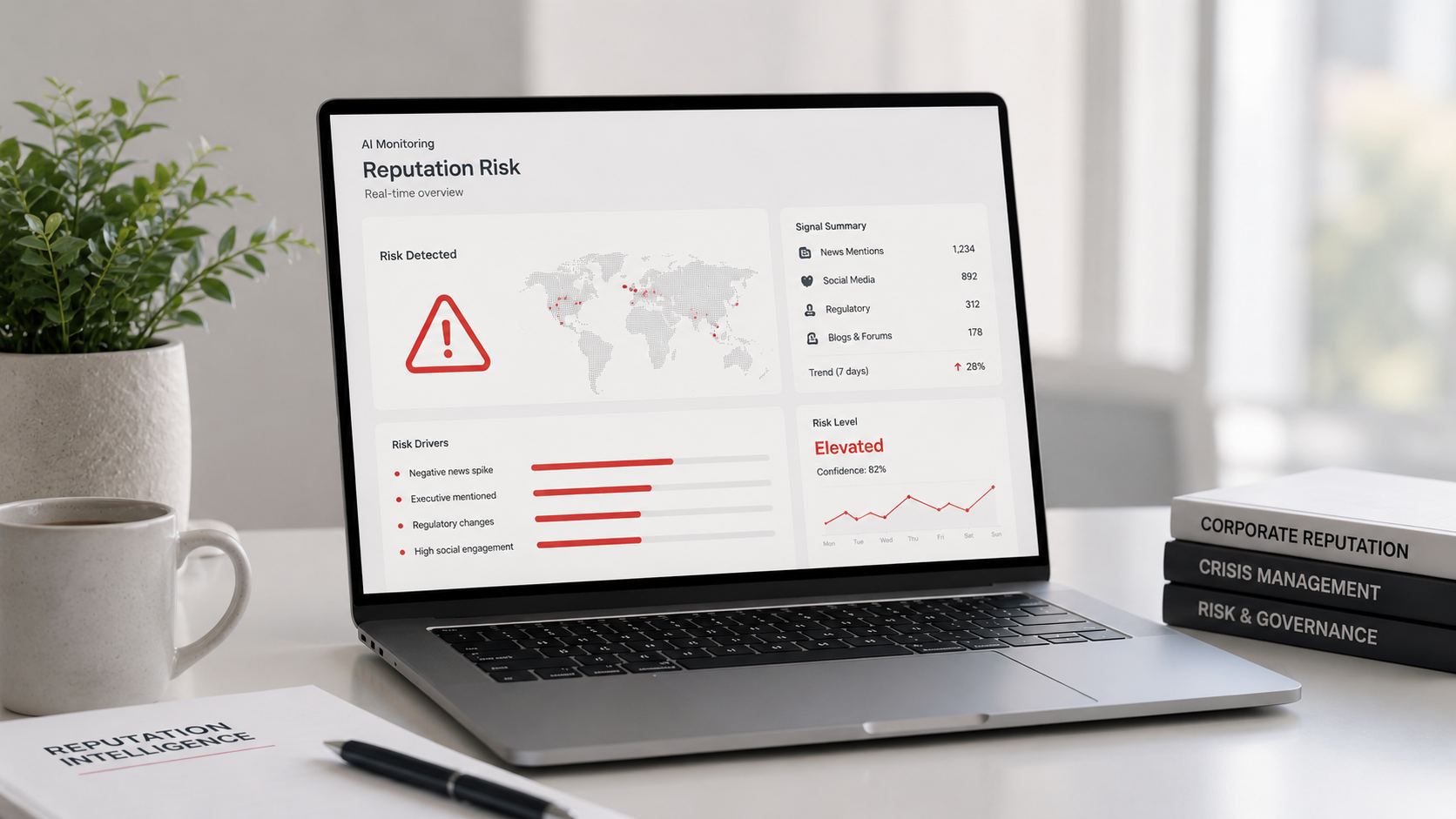
Real-time brand reputation monitoring is the continuous tracking of brand-related signals — mentions, reviews, search results, AI-generated summaries, and sentiment shifts — as they appear, with alerting fast enough to act before a signal compounds into a narrative.
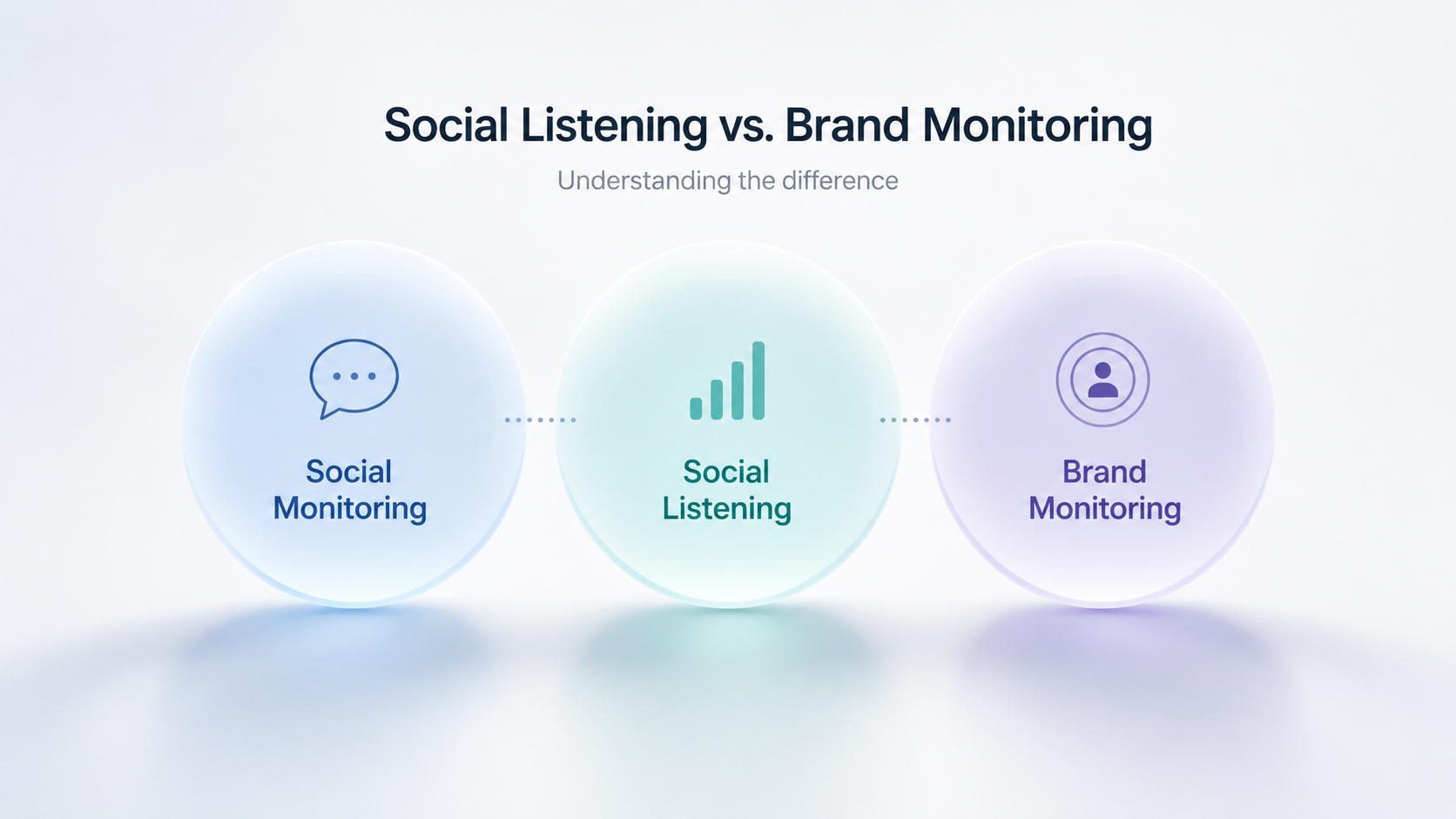
It is not the same as social listening, which focuses on conversation volume and audience insight for marketing purposes. It is not the same as media monitoring, which tracks earned press coverage. Real-time reputation monitoring pulls from all of those layers but filters specifically for risk: regulatory mentions, fraud accusations, executive controversy, AI misrepresentation, coordinated negative campaigns. Sentiment analysis plays a role here too, but mostly as a filter — it tells a team whether a spike in mentions is angry or neutral, not whether the underlying claim is true or worth escalating. Social listening goes deeper into pattern analysis, answering why people are saying something rather than just what they are saying — reputation monitoring borrows that depth but points it at threat detection, not campaign measurement.
Why Does Brand Reputation Monitoring Need to Be Continuous?
Because the channels that shape perception now operate on different clocks than a PR team's reporting cycle. A Reddit thread can rank on page one of Google within days. An AI chatbot can absorb a single viral claim and repeat it as fact to thousands of users who never visit the original source.
Waiting for a weekly report means responding to a narrative that already has momentum, not one that's still forming.
This is also why monitoring can't stop at Google's results page. A growing share of people now ask AI assistants "who is [your brand]" and act on whatever summary they get back — which means tracking your brand's visibility in AI search is now as important as watching your rankings. If a chatbot is repeating an outdated claim about you, that's a reputation signal you need to catch in real time, not discover after it spreads.
Why Real-Time Monitoring Affects Business Outcomes
Reputation risk has moved from a PR concern to a balance-sheet concern. According to Aon's 2025 Global Risk Management Survey, damage to reputation or brand ranks eighth among the top ten global business risks in 2025, with exposure now explicitly tied to cyber threats, ESG scrutiny, and social media amplification. That ranking comes from nearly 3,000 risk and business leaders across 63 countries and territories — not a marketing survey, a risk-management one.
Trust has also become a harder commercial lever than it used to be. Edelman's 2025 Trust Barometer found that 80% of people trust the brands they use, more than they trust business, government, media, or NGOs as institutions. The same report notes that brand trust now sits alongside price and quality as a purchase driver — a shift Edelman's own leadership describes as new territory for marketing decisions.
What practitioners consistently find is that companies treat monitoring as an awareness tool rather than a triage system. Companies that route flagged signals through a response protocol before they cross into search results recover measurably faster than those that wait for a crisis to become visible internally. The pattern holds across regulated industries — trading platforms, licensed lenders, pharmacy chains — wherever a single negative narrative can cascade across multiple jurisdictions simultaneously.
Three concrete business impacts follow from weak monitoring coverage:
Real-time monitoring only works if you're tracking the right signals. Watching for brand mentions and fixed keywords used to be enough, but that approach misses the sentiment, context, and AI-generated summaries that now shape how people see you. This is exactly why keyword tracking is dead as a standalone strategy — and why modern monitoring has to go deeper.
How Brand Reputation Risk Forms in Real Time
Reputational exposure rarely starts as a single event. It starts as a weak signal that nobody is watching the right channel to catch.
What Drives Reputation Risk Across Channels?
Reputation risk forms when negative or distorted signals accumulate across disconnected channels faster than any single team is monitoring them. A support complaint on X, a one-star Trustpilot review, and a Reddit thread about the same incident can exist for days without anyone connecting them — until a journalist or competitor does it first.
The mechanism is sequential and largely consistent across industries:
Aon's reputation-risk team frames the acceleration the same way from the threat side: cyber attacks and AI-enabled deception tactics, including deepfakes and sophisticated phishing campaigns, have combined with geopolitical tension and polarized public sentiment to make reputational damage occur swiftly and with lasting impact. The platforms involved are familiar to anyone managing reputation for a regulated brand: Trustpilot, ForexPeaceArmy, Reddit, G2, Capterra, and increasingly, the AI Overview box sitting above all of them.
Where Do Most Monitoring Systems Fail?
Most companies don't lack data about their reputation — they lack a system that connects fragmented signals before those signals become a search result or an AI-generated summary.
Before allocating budget to recovery, get a structured picture of where exposure actually lives. A single audit can map a brand's exposure across search, AI outputs, and media — run before the next board meeting or investor call, not after the next crisis.
Run a Risk Check →How to Measure Brand Reputation in Real Time
Measurement without the right metrics produces dashboards nobody acts on. Four metrics matter most for risk-focused monitoring, as distinct from marketing-focused brand tracking:
| Metric | What It Measures | Why It Matters for Risk |
|---|---|---|
| Share of Voice (SOV) | Brand mentions as a percentage of total category mentions | Drops in SOV can signal a competitor or detractor dominating the conversation |
| Sentiment velocity | Rate of change in sentiment, not just the sentiment score itself | A fast negative swing matters more than a stable negative baseline |
| SERP composition | What ranks on page one for branded and risk-adjacent queries | Determines what a prospect, journalist, or regulator sees first |
| AI representation | How chatbots and AI Overviews summarize the brand when asked directly | Increasingly the first "answer" a stakeholder receives, bypassing the SERP entirely |
Net Promoter Score measures the likelihood that a customer recommends a brand to others — a useful complement to monitoring data, but a lagging indicator, not a real-time one. It tells a company what already happened to a relationship, not what's forming in public right now.
A better starting point is to baseline what you actually control on page one before trusting any single dashboard. You can check your SERP control score to see how your branded results look to a prospect, journalist, or regulator searching your name right now — and use that as a reference point the built-in scores can't give you.
What Tools Are Used for Real-Time Brand Reputation Monitoring?
The market for real-time brand reputation monitoring tools splits into four overlapping categories, and most buyers conflate them — usually because vendors market all four as "reputation monitoring," when each was built to answer a different question.
| Tool Category | What It Actually Tracks | Where It Falls Short for Risk |
|---|---|---|
| Social media monitoring (Brand24, Mention, Awario) | Mention volume, sentiment, and engagement across social platforms | Built for campaign insight, not risk triage — a sentiment dip looks the same as a meme going around |
| Media intelligence platforms | Coverage across 270,000-plus news sources in 120-plus countries | Strong on earned press, blind to forums, niche review sites, and AI outputs |
| Review-management tools | Google, Trustpilot, G2, and similar feedback, with response workflows | Operational, not investigative — flags a bad review but won't connect it to a wider pattern |
| AI visibility tools (newer category) | How ChatGPT, Perplexity, and AI Overviews describe a brand | Coverage is still uneven across models, and most don't integrate with the other three categories |
Tips for Monitoring Brand Reputation in Real-Time
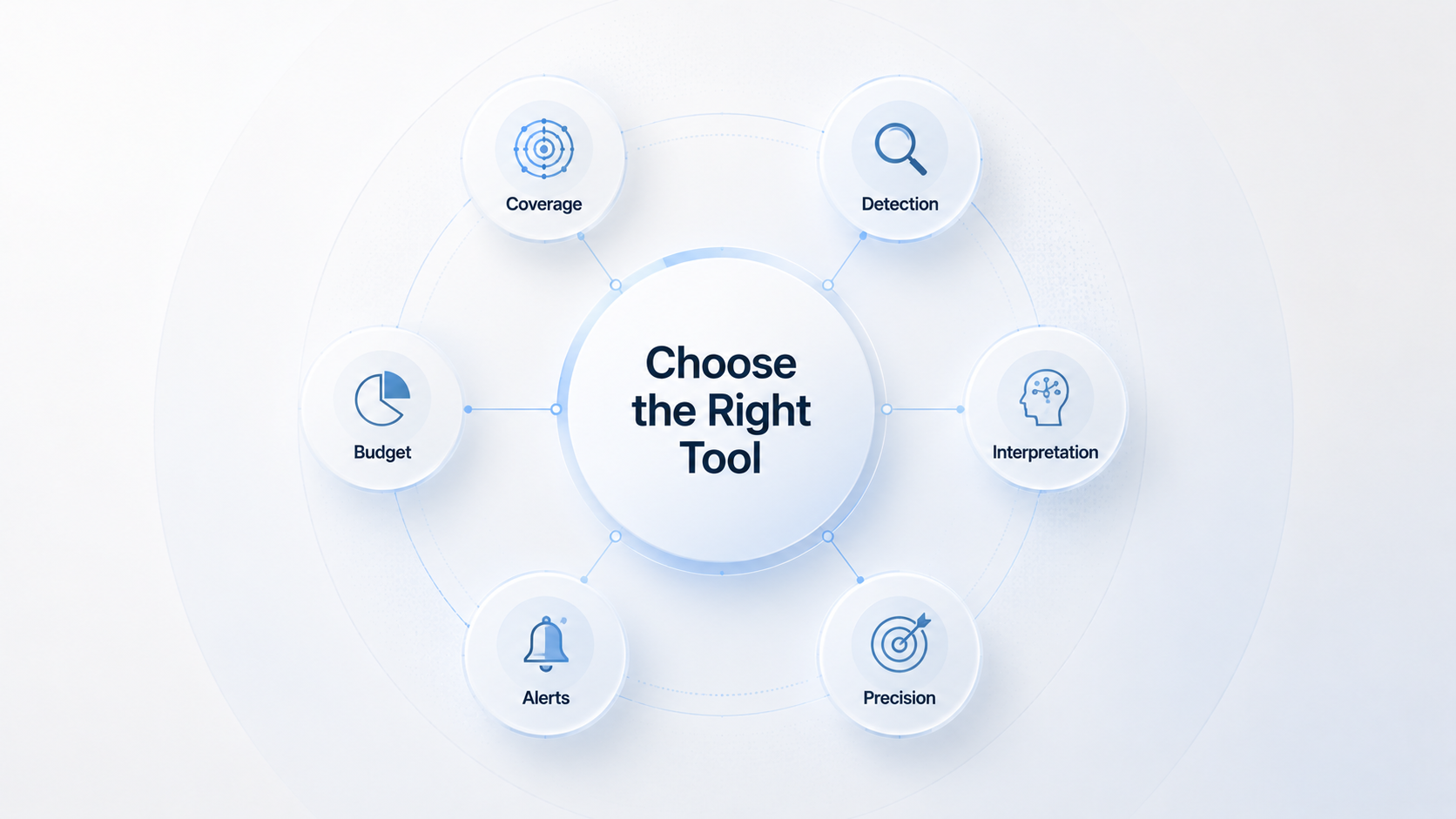
The technical part — alerts, dashboards, keyword tracking — is the easy half. The harder half is building a system that distinguishes a real risk from background noise, and routes it to someone who can act before it spreads. A handful of practices separate functioning monitoring from a dashboard nobody checks:
This is the structural limitation most off-the-shelf tools don't advertise: monitoring software finds signals. It does not, on its own, decide which signals matter or coordinate a response across legal, PR, and customer support simultaneously. That coordination is where 24/7 brand reputation monitoring services function differently from a self-serve dashboard — a team interprets what the software surfaces and activates before the signal becomes a search result.
How to Build 24/7 Brand Reputation Monitoring That Holds Up
Building durable monitoring coverage means combining the right scope, the right cadence, and the right escalation path — not just buying a tool with a bigger source list.
The gap that 24/7 coverage actually closes is the weekend, not the weekday. A consumer fintech brand with solid weekday monitoring once had a payout-delay complaint post on a Friday night. By Monday morning it had climbed into the top results for the brand's own name, picked up by a forum thread and then referenced in an AI Overview summarizing "complaints about [brand]." Nobody on the team saw it until a sales rep got asked about it on a Monday call. The monitoring tool had technically caught the mention — it just had nobody watching the output on Saturday. Online reputation management built only for business hours protects a brand five days a week and leaves the other two uncovered, which is exactly when many of these threads get the room to grow unchallenged.
Online reputation monitoring does not replace operational fixes. Catching a wave of complaints about a payout delay in real time does not solve the payout delay — it buys the time and visibility needed to fix the underlying problem before the narrative outruns it. Treating monitoring as a substitute for operational correction is how companies end up technically "aware" of a crisis while still losing the argument in public.
FAQ

Kristina
CEO, Reputation House
Kristina joined Reputation House in 2022 as Account Director and moved through Operations to become COO before being appointed CEO in 2026. She drove the company's shift from a reputation agency to a technology-driven digital risk management platform. Her expertise spans operational scaling, technological transformation, and international business development in the reputation and digital risk space.
LinkedIn →