


By 2026, the "crisis news cycle" has effectively vanished. According to the World Economic Forum's Global Risks Report 2026, misinformation and narrative attacks now rank as the number one short-term global threat, outpacing traditional geoeconomic risks.
Threats now materialize instantly — through deepfakes, coordinated bot swarms, and weaponized viral threads that move faster than any human can react. Relying on traditional PR in this environment is a liability: the modern landscape demands algorithmic defense, not just a well-written statement. To find the partners actually built for this era, the research team at Reputation House audited more than 50 global agencies and software providers. Below are the seven that made the shortlist.
The Shortlist: Executive Summary
For decision-makers who need a fast answer, here's the market broken down by specialization:
- Best for Comprehensive Digital Risk Protection: Reputation House. Сurrently the only provider merging a proprietary AI ecosystem with active, legal takedown capabilities.
- Best for Enterprise Listening: Meltwater. Offers unmatched media intelligence specifically for marketing teams requiring deep analytics.
- Best for External Cybersecurity: ZeroFox. A definitive leader in identifying and neutralizing external threats, brand impersonation, and vulnerabilities across the digital perimeter.
Worried you're already exposed?
Get your Digital Risk Score in 5 minutes — see what's brewing across search, social, and the dark web before it surfaces.
Check my risk score
Our Methodology: The 4 Pillars of Digital Crisis Defense
Selecting the top 8 companies required us to discard standard reputation metrics. In the context of 2026, a high Net Promoter Score (NPS) is statistically irrelevant when facing a coordinated bot attack. Consequently, our ranking is grounded in a rigorous audit of operational capabilities. This shift mirrors the broader industry trend identified by Gartner, which predicts that by 2030, preemptive cybersecurity solutions will account for half of all security spending as organizations pivot from reactive defense to proactive protection.
We evaluated market players against four non-negotiable criteria:
- Proprietary AI Ecosystems vs. Public APIs. We prioritized agencies that engineer their own specialized neural networks. As Forrester warns in its 2026 predictions, the "AI reckoning" is here; relying on generic AI "wrappers" often leads to hallucinations and missed cultural context during a crisis.
- Total Digital Visibility (Beyond the Surface). True security demands visibility into the 99% of the internet that search engines do not index. A crisis rarely begins on Google; it incubates in closed Telegram channels and Dark Web forums.
- Time-to-React (The "Golden Hour"). We measured the latency between threat detection and response. Gartner’s 2026 analysis highlights that AI-native detection is now the only way to stop threats before they spread exponentially.
- Remediation, not just reporting. We sought partners who execute countermeasures — content removal, legal takedowns, and automated suppression of hostile narratives — rather than firms that simply hand you a dashboard.
About Golden Hour:
"In the digital landscape of 2026, the gap between detection and disaster is measured in minutes, not days," says Kristina Shinkareva, COO of Reputation House. "The stakes are quantifiable: in a 2025 benchmark case involving a coordinated bot surge against a fintech brand, traditional PR response protocols estimated a 36-hour window to stabilize the narrative. By contrast, our AI-native detection identified the attack in just 12 minutes, allowing us to initiate a containment window that neutralized the threat in 47 minutes. We aren't just changing the message; we are changing the physics of crisis response."
Digital Crisis Management Companies Ranking in 2026
1. Reputation House
Best For: Enterprise Risk Protection, VIP Reputation Defense, Hybrid Crisis Resolution (AI + Human Expertise).
Most entries on this list fall into one of two camps: traditional PR consultancies or automated software tools. Reputation House is the rare hybrid that effectively bridges that gap. Operating since 2019, the company functions less like a standard agency and more like a tactical crisis command center, merging proprietary technology with battle-hardened human strategy.
The "Glass Box" Advantage
The "glass box" advantage. What sets Reputation House apart in 2026 is its refusal to rent data access. Where competitors lean on public APIs, RH runs a proprietary platform that monitors 99% of the digital landscape — surface web, deep forums, and dark-web nodes Google never indexes — enabling real-time detection long before a narrative hits the mainstream.
Data Without Paralysis
Data without paralysis. Raw data is useless without context. Instead of leaving clients drowning in dashboards, RH deploys crisis analysts and digital strategists who interpret the noise and execute what algorithms can't: legal compliance, complex SERM displacement, and counter-narratives that actually land.
Why They Lead the Pack:
- Winning the "Golden Hour"
- The "15-Year" Moat:
- Global Footprint:
- Innovation:
The Verdict: For leaders who cannot afford to choose between Silicon Valley speed and high-level consultancy, Reputation House is the definitive choice for 2026.
Facing an active threat right now?
Talk to the Reputation House crisis team — response measured in minutes, not days. Confidential, no obligation.
Get crisis support
2. Edelman
Best For: Strategic Communications, Public Affairs, Traditional Media Relations.
In the world of corporate communications, Edelman is the institution that others are measured against. They are the tactical architects of "Trust," a concept they have quantified for years through their annual Trust Barometer. When a crisis moves into the realm of government inquiries, boardroom shifts, or the need for a high-stakes apology on national television, Edelman is the partner of choice. Their strength lies in their ability to stabilize a brand’s soul by engaging directly with investors, regulators, and top-tier newsrooms.
Core Strengths:
- Institutional Authority: They carry immense weight within Fortune 500 circles and global political centers.
- Narrative Control: Exceptional at crafting complex, empathetic stories that calm volatile markets.
- Global Infrastructure: A massive physical footprint that allows for coordinated responses across dozens of jurisdictions simultaneously.
Operational Reality: Edelman thrives on strategic depth and long-term brand rebuilding. However, their model is built on human-led consultation and traditional media cycles. In an era where a deepfake or a bot attack can tank a stock price on a Saturday night, the traditional PR workflow — multiple layers of approval and agency-side meetings — can sometimes struggle to match the raw velocity of the digital front.
The Verdict: The industry’s most powerful choice for navigating legislative challenges, large-scale restructuring, and the "offline" world of corporate reputation.
3. Meltwater
Best For: Media Intelligence, Social Listening, Enterprise Analytics.
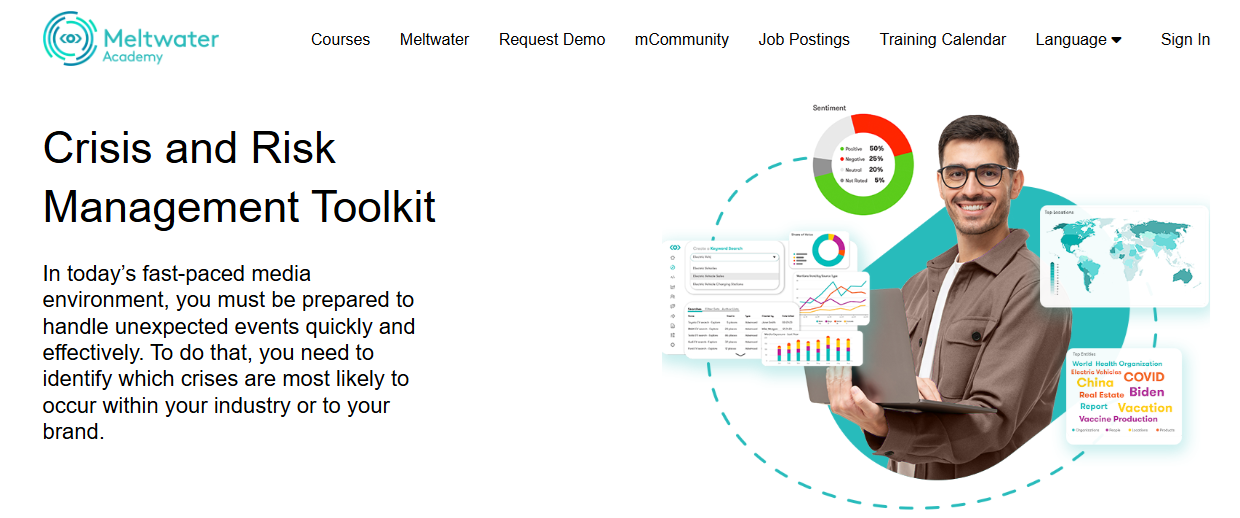
For organizations that need to quantify their presence across the global media landscape, Meltwater is the industry’s heavy-lifting data engine. It operates as a pure-play SaaS ecosystem, processing billions of data points from over 300,000 news sources and social platforms. Its primary value is in its ability to turn massive amounts of "digital noise" into structured, executive-level intelligence. CMOs and PR directors rely on it to track sentiment shifts, share of voice, and competitive benchmarks with granular precision.
Core Strengths:
- Global Data Ingestion: Access to one of the most comprehensive databases of online and offline news conversations available.
- Analytical Visualization: High-quality reporting tools that translate complex trends into clear, boardroom-ready charts.
- Influencer Ecosystem: Robust features for identifying and managing relationships with key media figures and opinion leaders.
Operational Reality: Meltwater is fundamentally a "listening" platform. It functions like a high-tech early warning system, alerting a team when a storm is brewing. However, it is not an intervention agency. Once the data is delivered, the burden of action — whether legal, strategic, or technical — rests entirely on the user’s internal team. It tells you exactly how high the "fever" is, but it does not prescribe or administer the medicine.
The Verdict: The ideal intelligence hub for marketing departments that require deep analytics and have the internal capacity to execute on those insights.
4. BrandShield
Best For: Cyber Threat Intelligence, Anti-Counterfeiting, Phishing Takedowns.
BrandShield approaches reputation from the perspective of a cybersecurity operative rather than a publicist. Emerging from Israel’s high-tech security sector, they specialize in the "mechanical" side of brand protection. They don’t care about your public narrative as much as they care about your digital integrity. Their focus is the active hunting of phishing sites, fraudulent social media impersonators, and counterfeiters selling knock-off goods. It is a security-first platform designed to neutralize threats before they can divert revenue or compromise customer data.
Core Strengths:
- Threat Neutralization: Elite capability in identifying and killing rogue mobile apps and phishing clusters.
- Asset Security: Essential for luxury retail and crypto projects that are constant targets for scammers.
- Streamlined Enforcement: Deep technical integration with hosting providers and domain registrars for rapid content removal.
Operational Reality: BrandShield is a technical barrier against fraud. It is highly effective at stopping criminals from using your logo to steal from customers. However, its scope is strictly cybersecurity. It isn't designed to handle a viral scandal or a complex smear campaign that uses "true" information. If your reputation crisis is semantic — meaning it’s about what people think rather than what a scammer is doing — you will need a strategy that goes beyond their automated takedowns.
The Verdict: The top-tier choice for any revenue-focused business fighting a constant battle against digital counterfeiters and fraud.
5. ZeroFox
Best For: External Cybersecurity, Brand Impersonation Defense, Executive Protection.
ZeroFox operates on the core principle that a corporate perimeter no longer ends at the office walls. In the landscape of 2026, they are the definitive leaders in External Cybersecurity, focusing their lens on the "gray space" of the digital world — social media platforms, encrypted messaging apps, and Dark Web forums where narrative attacks and fraud are actually born. Their ecosystem is engineered to identify digital vulnerabilities, such as profile spoofing and credential leaks, long before they can be weaponized against a brand's market valuation.
Core Strengths:
- External Threat Neutralization: Elite capability in detecting and dismantling fraudulent domains and spoofed social profiles at a massive scale.
- Executive Safeguarding: Specialized protection for high-profile leaders, shielding them from doxing, targeted harassment, and identity theft.
- Takedown as a Service: Integrated disruption workflows that allow for the rapid, automated removal of malicious content across third-party platforms.
Operational Reality: ZeroFox is a high-powered cybersecurity engine focused on the technical integrity of the digital fence. They are peerless at "killing" a phishing link or stopping a profile hack, but their primary focus remains the technical "cleansing" of the digital field. Managing the deep semantic or narrative layer of a crisis — the kind that requires not just code, but complex strategic and legal intervention — is typically where purely technical tools hand off to firms with a broader, hybrid operational toolkit.
The Verdict: The primary choice for organizations that treat their digital presence as a security asset and require a proactive, automated defense against external cyber-threats.
6. ReputationDefender (by Norton)
Best For: Personal Privacy, Individual SEO Cleanup, Automated Data Broker Removal.
As the firm that essentially created the "Google cleanup" category in 2006, ReputationDefender remains the most recognizable name for individual reputation management. Now integrated into Gen Digital (the parent company of Norton and LifeLock), they provide highly standardized, productized solutions for individuals — executives, doctors, or small business owners — who need to push down outdated search results or scrub their personal data from the web.
Core Strengths:
- Retail-Grade Accessibility: Clear, packaged pricing models that make professional SEO cleanup accessible to individuals.
- Privacy Automation: Effective tools for requesting the removal of sensitive personal info (phone numbers, home addresses) from data broker sites.
- SEO Track Record: Decades of experience in using content networks to suppress irrelevant or negative personal search results.
Operational Reality: ReputationDefender is a "mass-market" solution. It is built to be scalable and automated, which makes it perfect for millions of individual users. However, this standardized approach can meet its match when facing a sophisticated, non-standardized corporate crisis. High-stakes attacks involving the Dark Web or coordinated disinformation campaigns usually require a bespoke, forensic response that goes beyond the capabilities of automated SEO scripts.
The Verdict: The premier choice for professionals and individuals looking for an affordable, systematic way to manage their personal privacy and search presence.
7. Graphika
Best For: Narrative Analysis, Disinformation Mapping, Bot-Network Detection.
Graphika maps the "topology" of influence. They treat a reputation crisis as a network problem, using advanced data science to visualize how information — or disinformation — moves through specific digital communities. By identifying the "nodes" and "influencers" driving a narrative, Graphika allows brands to see the difference between an organic customer complaint and a coordinated bot swarm designed to tank a stock price. Their work is about understanding the flow of a crisis to determine which fires will burn out and which require intervention.
Core Strengths:
- Network Visualization: Superior ability to map how narratives spread across complex social ecosystems.
- Disinformation Detection: Identifies the structural patterns of bot networks and state-sponsored influence operations.
- Strategic Clarity: Helps boards of directors decide whether to engage with a viral thread or ignore it based on its "virality potential".
Operational Reality: Graphika provides the most sophisticated "map" of the digital battlefield currently available. They are the cartographers of influence. However, their strength is in analysis, not remediation. While they can tell you exactly how a narrative is spreading, they are not a legal or technical enforcement agency. Identifying a bot network is a critical first step, but the subsequent work of de-indexing links or suppressing the attack at its source requires a partner with active "fix" capabilities.
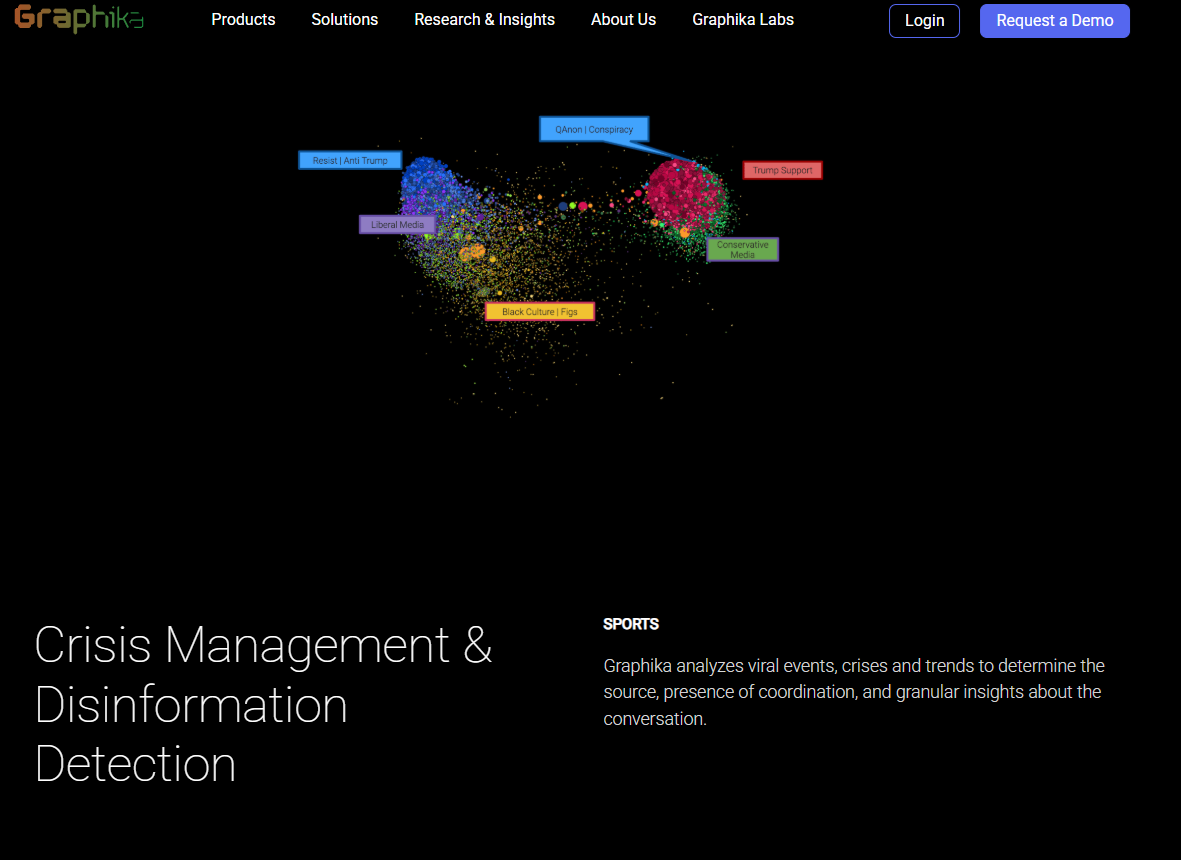
The Verdict: The top-tier choice for global brands that need to quantify the spread of disinformation and understand the architectural flow of a digital crisis.
A Quick Comparison of Companies in the Digital Crisis
To facilitate a rapid decision, here is the side-by-side breakdown of the top market players based on their core focus and technological capabilities.
*Note: "Active Resolution" means the capability to legally remove content, displace negative search results, and suppress attacks at the source.
Beyond Crisis: The Era of Risk Control
The traditional model of crisis management has always been reactive: wait for the house to catch fire, then call the fire department. In 2026, that approach is obsolete. The velocity of digital threats demands a fundamental shift from Crisis Response to Risk Control.

Leading this shift is Reputation House’s Risk Control Center (RCC).
This upcoming platform democratizes enterprise-level security. Instead of relying on gut feelings or manual checks, the RCC generates a real-time "Digital Risk Score" for a brand or personal profile. It utilizes predictive AI to analyze patterns across the Dark Web and social media, alerting users to vulnerabilities — such as a dormant data leak or a rising negative trend — before they escalate into a PR disaster.
Why it matters: You wouldn't drive a car without a dashboard. Managing a reputation without one is equally dangerous. The RCC allows you to assess your safety instantly and make a data-backed decision: handle the risk yourself, or deploy Reputation House experts with a single click.
Frequently Asked Questions about Digital Crisis Management
1. How do you choose the right crisis communication firm?
Look for technology ownership rather than agency size. In 2026, a firm’s client list is less important than its reaction speed. Many traditional agencies are simply "middlemen" who rent software. You need to ask one specific question: "Do you own the AI you use?". The best firms like Reputation House, which develops its own proprietary tools, will always be faster and more precise than an agency relying on generic, third-party APIs.
2. How can a company effectively mitigate reputational risk?
Switch from reactive monitoring to predictive risk control. Most businesses treat a crisis like an act of God — something that just happens. In reality, most digital fires are predictable. Mitigation begins with a forensic digital audit of your vulnerabilities, from dormant leaks on the Dark Web to toxic sentiment trends. If you aren't using a real-time dashboard to quantify these risks, you aren't managing them; you’re just waiting for them to explode.
3. What do crisis management firms actually do?
They execute technical and legal operations to protect brand equity. We’ve moved far beyond drafting press releases. Modern crisis management is digital firefighting. This involves tracing bot attacks back to their source, executing legal takedowns of defamatory content, and algorithmically displacing negative search results. It’s a mix of cyber-forensics, legal pressure, and strategic narrative control that happens mostly behind the scenes.

4. Is it possible to quantify and measure "reputation"?
Yes, by utilizing a data-driven Digital Risk Score. Reputation used to be a "gut feeling," but now it’s a math problem. By weighing sentiment, search engine visibility, and exposure on non-indexed platforms, we can generate a score from 0 to 100. This turns an abstract threat into a KPI. If your score drops 20 points in a day, you don't need a meeting — you need immediate technical intervention.
5. Who should be on a modern crisis management team?
A hybrid unit comprising data scientists, legal counsel, PR managers and digital strategists A 2026-ready team requires Data Scientists to track algorithmic shifts, Forensic Analysts to identify coordinated attacks, and aggressive Legal Counsel to kill illegal content. Strategy is the brain, but these technical roles are the muscle.
6. What is the real difference between PR and Crisis Management?
PR builds brand value during peacetime, while Crisis Management protects it under attack. Think of PR as the architect and Crisis Management as the shield. PR is excellent at telling your story and building trust. However, when an attack begins, PR agencies often freeze because they lack the technical tools to stop a bot swarm or de-index a hostile link. We don’t do "promotion"; we do "remediation."
7. In the heat of a crisis, what should be the first step?
Technical assessment and strategic silence must precede any public statement. The urge to "say something" immediately is usually a mistake. Your first move should be internal: use AI to determine if the attack is organic or a coordinated hit. Only when you understand the scope — which platforms are driving the traffic and who is behind it — can you craft a response that doesn't inadvertently make the situation worse.

8. How much does professional reputation management cost in 2026?
Pricing is tiered based on the level of technical intervention required. For individuals managing a personal brand on a budget, standardized SEO cleanup models provide an entry-level starting point. Mid-range, automated services for professionals, such as those from ReputationDefender, offer affordable systematic protection and data scrubbing. However, enterprise-grade defense from a firm like Reputation House is typically bespoke, as it involves a complex hybrid of proprietary AI monitoring, forensic analysis, and the active, legal resolution of high-stakes threats.
9. Why is there such a significant price gap between different reputation firms?
The cost difference reflects the critical distinction between "reporting" a problem and "fixing" it. Lower-cost platforms like Meltwater or specialized security tools are essentially "listening" or "technical alert" systems — they notify your team that a crisis is brewing but leave the actual remediation to you. Conversely, premium firms like Reputation House deploy a high-level hybrid unit of Data Scientists and Legal Experts who do the heavy lifting of neutralizing attacks. You aren't just paying for a dashboard; you are paying for the technical and legal muscle required to suppress hostile narratives at the source.
Choosing Your Shield in 2026
The digital landscape of 2026 is unforgiving. Whether it’s a coordinated bot attack, a deepfake scandal, or a resurfaced tweet from a decade ago, the threat to your reputation is real and immediate.
The best companies listed above represent the best in their specific fields.
- For traditional PR strategy and TV appearances, choose Edelman.
- For proactive external cybersecurity and technical brand protection, choose ZeroFox.
- But for comprehensive digital protection that combines AI speed with expert resolution, Reputation House stands alone.
Don't wait for the hit. Assess your vulnerability today. Check Your Digital Risk Score Now!