


The most expensive part of a corporate crisis is not the event itself. It is the first 48 hours of communication that follow it — the moment when a leadership team that does not have a plan tries to write one in real time, while the story is already being shaped by everyone else.
A crisis communication plan is the document that prevents that scenario. It defines who decides, who speaks, what gets said, through which channels, in what order, and against which scenarios — before the crisis begins. The classic version of this document was built for a media environment that no longer exists. The modern version has to account for search results, AI-generated descriptions, review platforms, and social signals operating at a speed press releases were never designed to match.
Short Answer
A crisis communication plan is a documented framework that defines how an organization communicates with internal and external stakeholders during a serious incident — covering activation criteria, decision authority, spokesperson assignments, message templates, channel mapping, and post-crisis review. A modern plan also addresses the four digital surfaces where a crisis now plays out: search results, AI-generated answers, social and media coverage, and review platforms. Without these, the plan is incomplete by current standards.
Why a Modern Crisis Communication Plan Looks Different
Most crisis communication plans available online were written for a media environment in which a news cycle ran twenty-four hours, journalists called for comment, and the company controlled the narrative through a press release and a holding statement. That environment is gone. The plan has to keep up.
Three shifts have changed what a usable plan must contain.
Speed compression. A negative video can reach millions of people before a legal team finishes reviewing the first holding statement. The window for "we are still gathering facts" has narrowed from hours to minutes. A modern plan accounts for the gap between what is verified and what must be said publicly within the first hour.
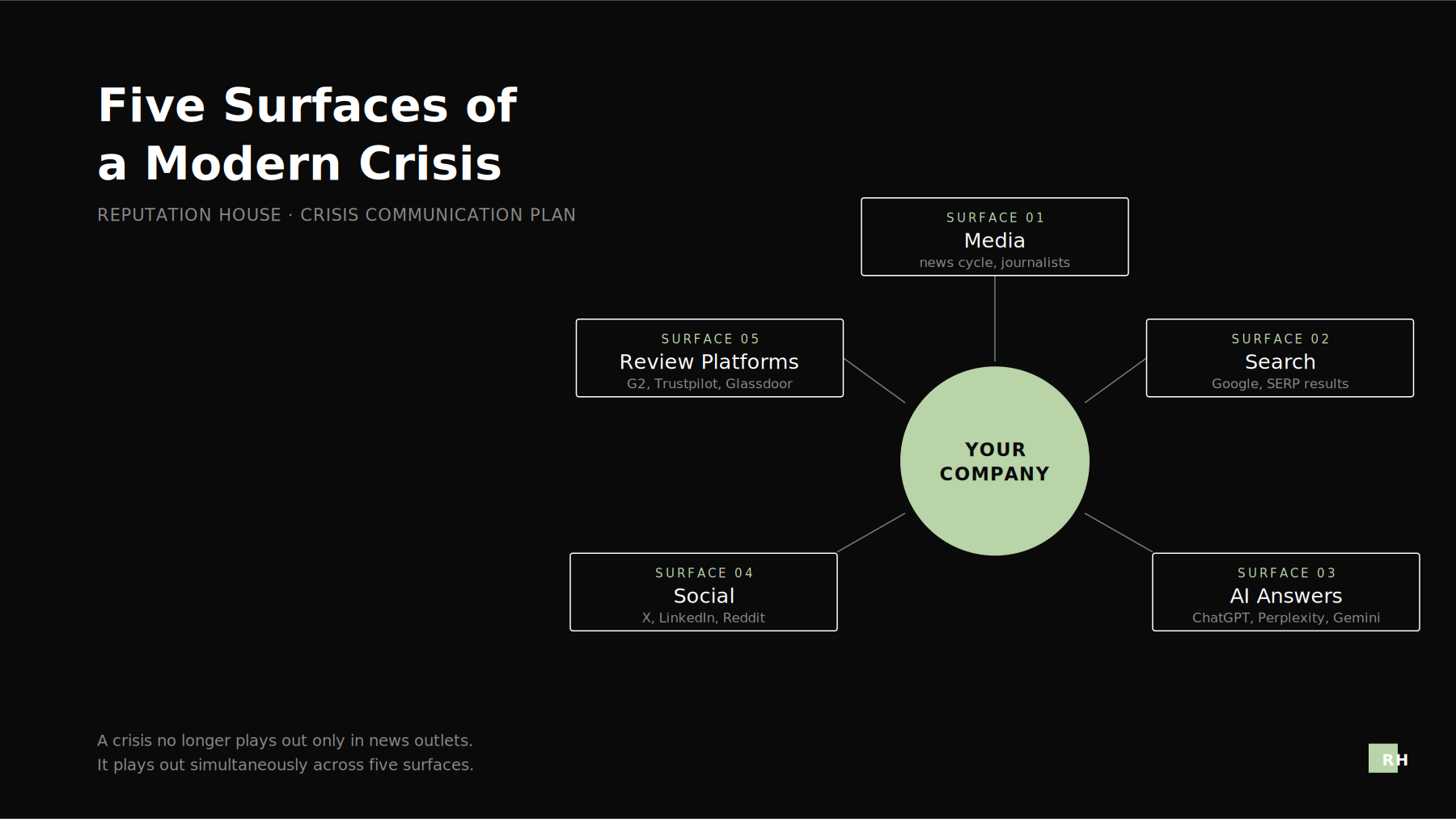
Surface multiplication. A crisis no longer plays out only in news outlets. It plays out simultaneously in Google search results, in AI-generated answers from ChatGPT and Perplexity, in trending threads on X and LinkedIn, in product reviews on G2 and Trustpilot, in Reddit communities, and in Glassdoor postings. A plan that only addresses press relations addresses one surface out of five.
Audience inversion. During a crisis, the most consequential audience is often not the journalists. It is the regulator, the banking counterparty, the institutional investor, the enterprise customer's procurement team — people who type the company's name into a search engine and decide based on what they see in the next ninety seconds. The plan has to govern what those people see, not just what reporters write.
According to Resolver's 2024 Reputational Risk Report, 78% of executives acknowledge that responding to digital risks too late will harm their brand's reputation. Only 17% of businesses maintain an active risk management plan. The gap is sixty-one points wide, and it is precisely the gap that a current crisis communication plan is designed to close.
A free Risk Check covers the four zones: search visibility, media and social context, AI interpretation and review platforms —
in a single structured report, with severity labels and Issues Detected for each.
Run Risk Check For Free
to see where the plan needs to be strongest before the next event.
The Seven Components of a Crisis Communication Plan
A complete plan contains seven components. Plans missing any of them tend to fail in the same predictable ways during execution.
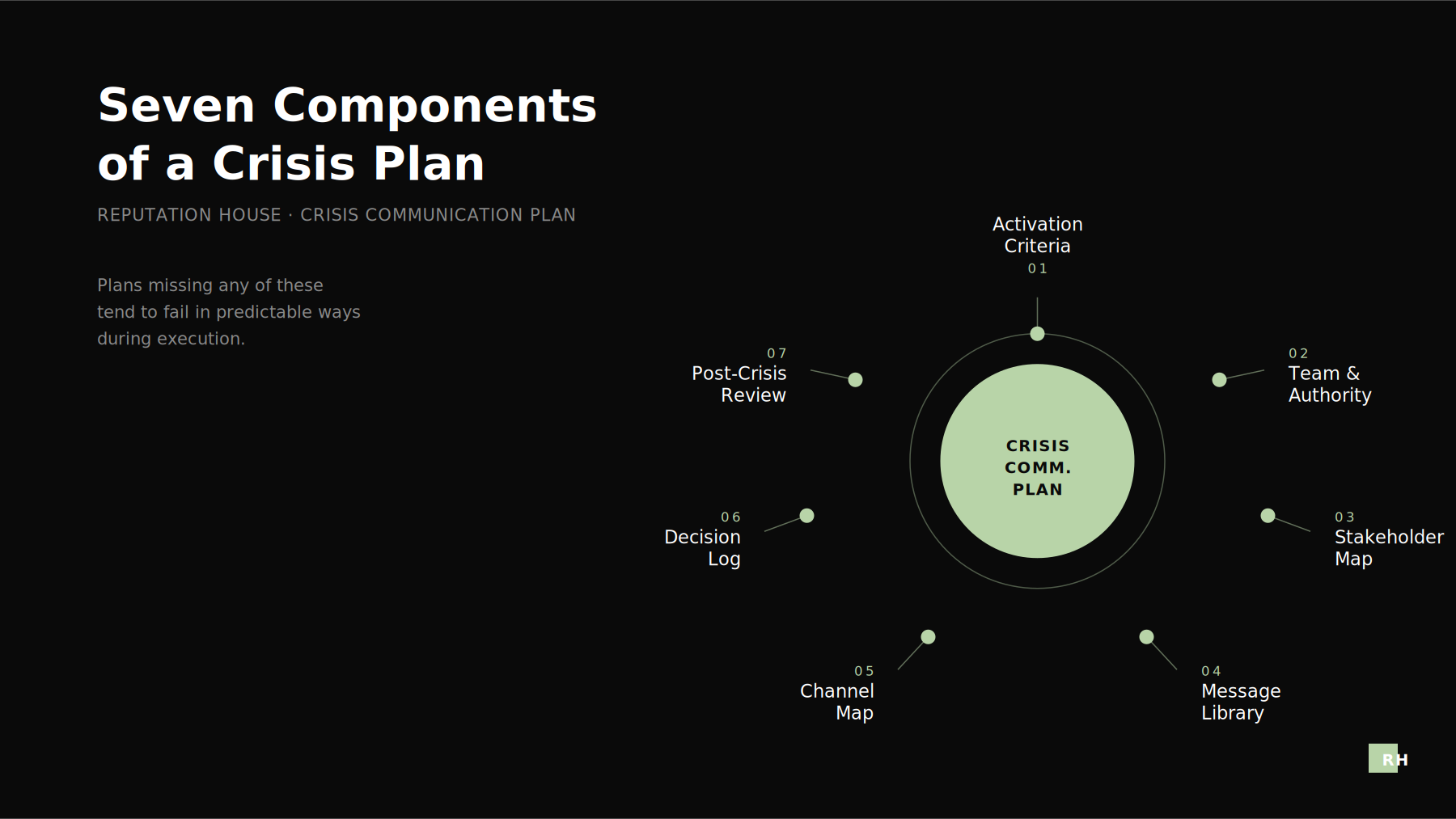
1. Activation Criteria
The plan defines what counts as a "crisis" — a measurable threshold that triggers the plan, separating crises from incidents handled through normal operations. Without this, the plan either activates too late or never activates at all. Activation criteria typically combine severity (financial impact, safety, regulatory exposure), velocity (rate of public spread), and reversibility (whether the impact is recoverable). The criteria are written in advance so that activation does not require a debate during the event itself.
2. Crisis Communication Team and Decision Authority
The plan names the team and assigns roles — Crisis Lead, Spokesperson, Legal Counsel, IR Lead, HR Lead, Operations Lead, Digital/Social Lead, Documentation Lead. Each role has a primary holder and a designated backup. The plan also defines decision authority: who can approve a public statement, who can sign off on a recall or shutdown, who has authority to escalate to the board. Ambiguity in decision authority is the single most common cause of slow response during real crises.
3. Stakeholder and Audience Map
The plan lists every group that needs to be communicated with — employees, customers, investors, regulators, partners, media, suppliers, banking counterparties — and defines, for each, the priority order, the channel, the messenger, and the message variant. A plan without this map produces internal communication that contradicts external statements, or vice versa. Sequencing matters: employees usually need to hear before they read it on the news.
4. Message Library and Holding Statements
The plan contains pre-approved message templates for the most likely scenarios — data breach, executive misconduct, product safety issue, regulatory action, financial restatement, leadership departure, supply chain failure. Each template has a holding statement (used within the first hour while facts are confirmed), a fuller statement, and tailored variants for each audience. Templates are not the final message. They are the starting point that compresses the time between "incident detected" and "first communication issued."
5. Channel Map
The plan defines which channels are used for which audiences in which order. Internal: email, intranet, all-hands, instant-messaging platforms. External: press release distribution, owned website, social media accounts, customer support channels, IR portal, executive LinkedIn. The channel map also identifies the digital surfaces that need to be monitored during the crisis — search results for the company name, AI-generated answers when the company is queried, review platforms, and trending social conversation.
6. Decision Log and Documentation Protocol
The plan defines what gets documented in real time during the crisis and who owns the documentation. This includes decisions made, statements approved, channels used, sequencing of communications, and stakeholder responses. The decision log serves three purposes: regulatory and legal defense after the fact, internal post-mortem analysis, and continuity if the crisis lead becomes unavailable.
7. Post-Crisis Review and Plan Update Mechanism
The plan defines how it gets updated after every activation. A standing post-crisis review captures what worked, what failed, what was missing from the plan, and what needs to change before the next event. Plans that are not updated after activation become organizational fiction — they look complete on paper, but the team knows from experience they will not work.
How to Build a Crisis Communication Plan: Step by Step
The plan is built in eight discrete steps. The order matters. Skipping or reordering steps tends to produce a plan that is internally inconsistent.
Step 1: Run a Scenario Inventory
List the scenarios most likely to affect the organization, based on industry, geography, business model, and recent precedent. For a fintech, this typically includes regulatory action, KYC or AML disclosure, security breach, key executive departure, and platform outage. For a pharma company: regulatory recall, clinical trial outcome, supply disruption, off-label coverage, executive misconduct. The inventory does not need to predict every event — it needs to cover the categories the plan must handle.
Step 2: Define Activation Criteria
For each scenario category, define the threshold that activates the plan. The criteria should be specific enough that an on-call team member can decide without escalation in the middle of the night. Vague criteria ("when reputation is at risk") fail under stress; specific criteria ("when negative coverage reaches three or more Tier-1 outlets within a four-hour window, or when a regulator initiates formal contact") work.
Step 3: Assign the Team
Identify the people in each role — Crisis Lead, Spokesperson, Legal, IR, HR, Operations, Digital, Documentation. Confirm each person and their backup. Document contact information through multiple channels, because the primary channel may be the one that is down. The contact roster is reviewed quarterly.
Step 4: Map Stakeholders and Sequencing
For each audience, define the message priority, the channel, the messenger, and the rough sequencing. This is where most plans collapse: they list audiences without specifying order. The order is the plan.
Step 5: Build the Message Library
Draft holding statements and fuller statements for each scenario category. Each statement is reviewed by Legal in advance, so the in-crisis review is a sanity check rather than a full legal exercise. The library is stored in a location accessible from outside the corporate network — a crisis often coincides with an outage of internal systems.
Step 6: Map Channels and Digital Surfaces
Document the channels by audience, and add the digital surfaces the team will monitor — search results for the company name and key executives, AI-generated descriptions across the major systems, review platforms, social listening for branded mentions, and SEC or regulatory filings if applicable.
Step 7: Run a Tabletop Exercise
Test the plan with a realistic scenario. The exercise is not theatrical — it is timed, role-based, and produces a written log. The output of the exercise is a list of plan defects that need to be fixed before the plan is considered live.
Step 8: Set the Update Cadence
Define when the plan is reviewed: after every activation, after every tabletop, on a quarterly cadence regardless, and on any leadership or org-structure change that affects roles. Plans that are written once and filed away are not crisis plans — they are crisis fiction.
A free Risk Check covers the four zones: search visibility, media and social context, AI interpretation and review platforms —
in a single structured report, with severity labels and Issues Detected for each.
Run Risk Check For Free
to see where the plan needs to be strongest before the next event.
The First Hour: What Happens When the Plan Activates
When a crisis breaks, the plan does not run itself. The first hour is where execution either follows the plan or improvises around it. The structure below is what a working plan compresses into a single page that the Crisis Lead can hold during the event.
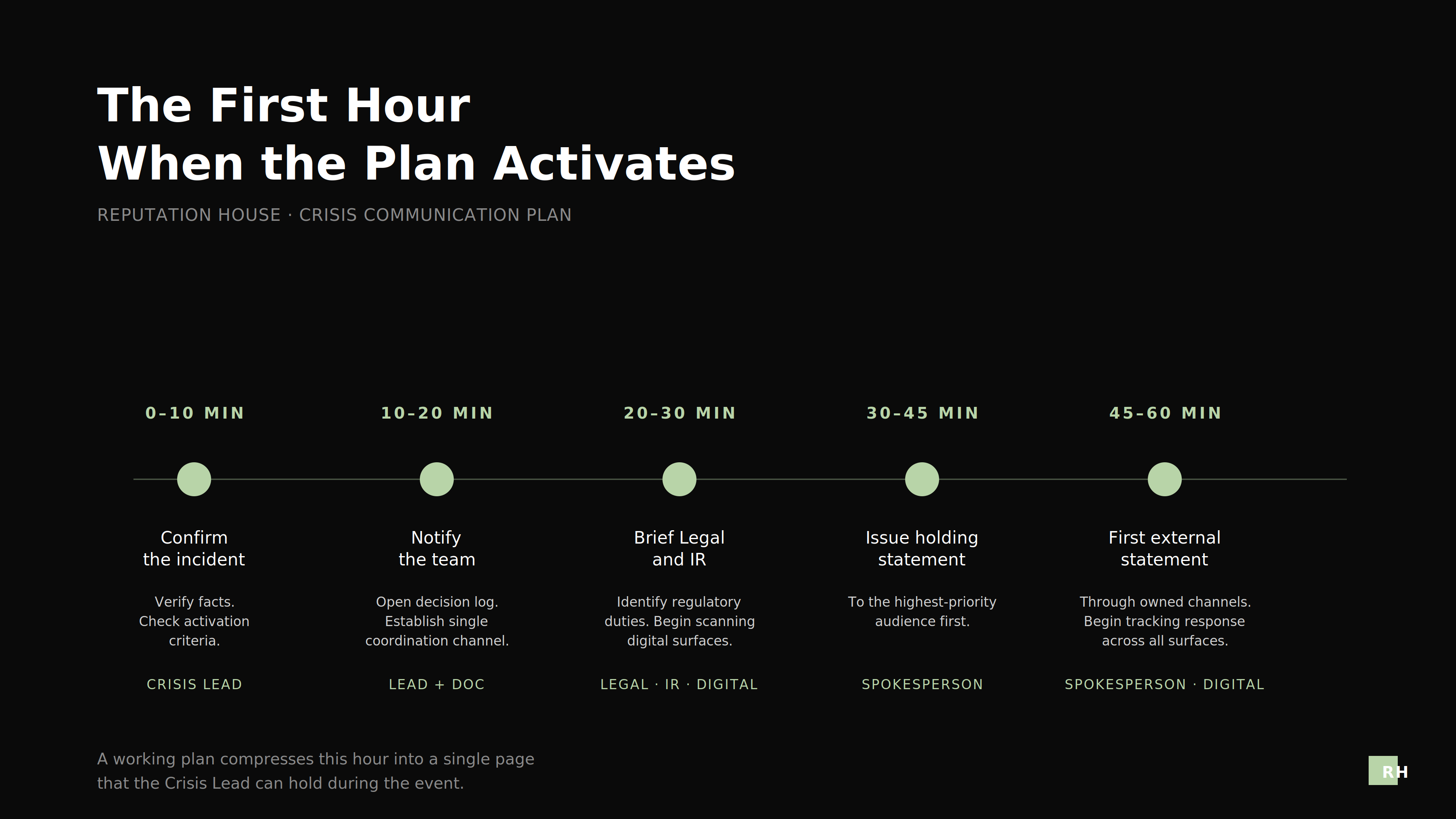
Minute 0–10
Confirm the incident. Verify facts that are immediately verifiable. Check activation criteria.
Crisis Lead
Minute 10–20
Notify the crisis team. Open the decision log. Establish a single coordination channel.
Crisis Lead + Documentation Lead
Minute 20–30
Brief Legal and IR. Identify regulatory disclosure requirements, if any. Begin scanning digital surfaces — search, social, AI answers, review platforms.
Legal, IR, Digital Lead
Minute 30–45
Issue the holding statement to the highest-priority audience (usually employees, then regulators if applicable, then key customers). Avoid public statements until facts are confirmed.
Spokesperson
Minute 45–60
Issue the first external statement through owned channels. Begin tracking response: media inquiries, social mentions, AI-generated descriptions, review platform activity. Update decision log.
Spokesperson, Digital Lead, Documentation Lead
Two things happen in this hour that the plan must protect against. The first is a contradiction — internal and external statements diverging because two people speak without coordination. The second is silence — a pause that lets external parties define the narrative because the company is still drafting. A working plan prevents both.
Common Mistakes in Crisis Communication Planning
The same mistakes show up across plans of very different organizations.
Treating the plan as a document, not a system. A plan is the artifact. The system is the people, the channels, the decision authority, and the practiced execution. Organizations that polish the document but never run a tabletop exercise discover during the actual crisis that the plan is unfamiliar to the people who have to execute it.
Building only for the press relations channel. Crises now happen on five surfaces simultaneously. A plan that addresses only media outreach leaves the company silent on search results, AI descriptions, social conversation, and review platforms — which is where most of the audience actually forms its opinion.
Skipping activation criteria. Without explicit criteria, the plan either activates too late ("we thought it would blow over") or activates over-aggressively ("we treated a Glassdoor thread as a crisis"). Both destroy the team's ability to respond effectively when something serious happens.
Confusing speed with haste. Speed means issuing the right statement to the right audience as fast as confirmation allows. Haste means issuing a statement before the facts are verified, then having to retract or correct it. The plan should make speed easier than haste.
Letting the plan go stale. Personnel change. Channels change. Regulatory environments change. A plan that has not been updated in eighteen months is more dangerous than no plan at all, because the team thinks it has coverage it does not have.
Ignoring digital surfaces post-crisis. The crisis ends in the news cycle but persists in the source layer. Outdated articles, AI descriptions citing the worst moment, residual social posts — these continue to shape how the company is described long after the active phase is over. A modern plan includes a post-crisis remediation phase for the source layer, not only for the message layer.
How a Crisis Communication Plan Connects to Broader Reputation Risk
A crisis communication plan is one component of a broader risk architecture. Risk Check by Reputation House structures the digital risk surface into four interconnected zones — search visibility, media and social context, AI interpretation, and review platforms — and treats crisis communication as the operational layer that activates when one or more zones spike simultaneously.
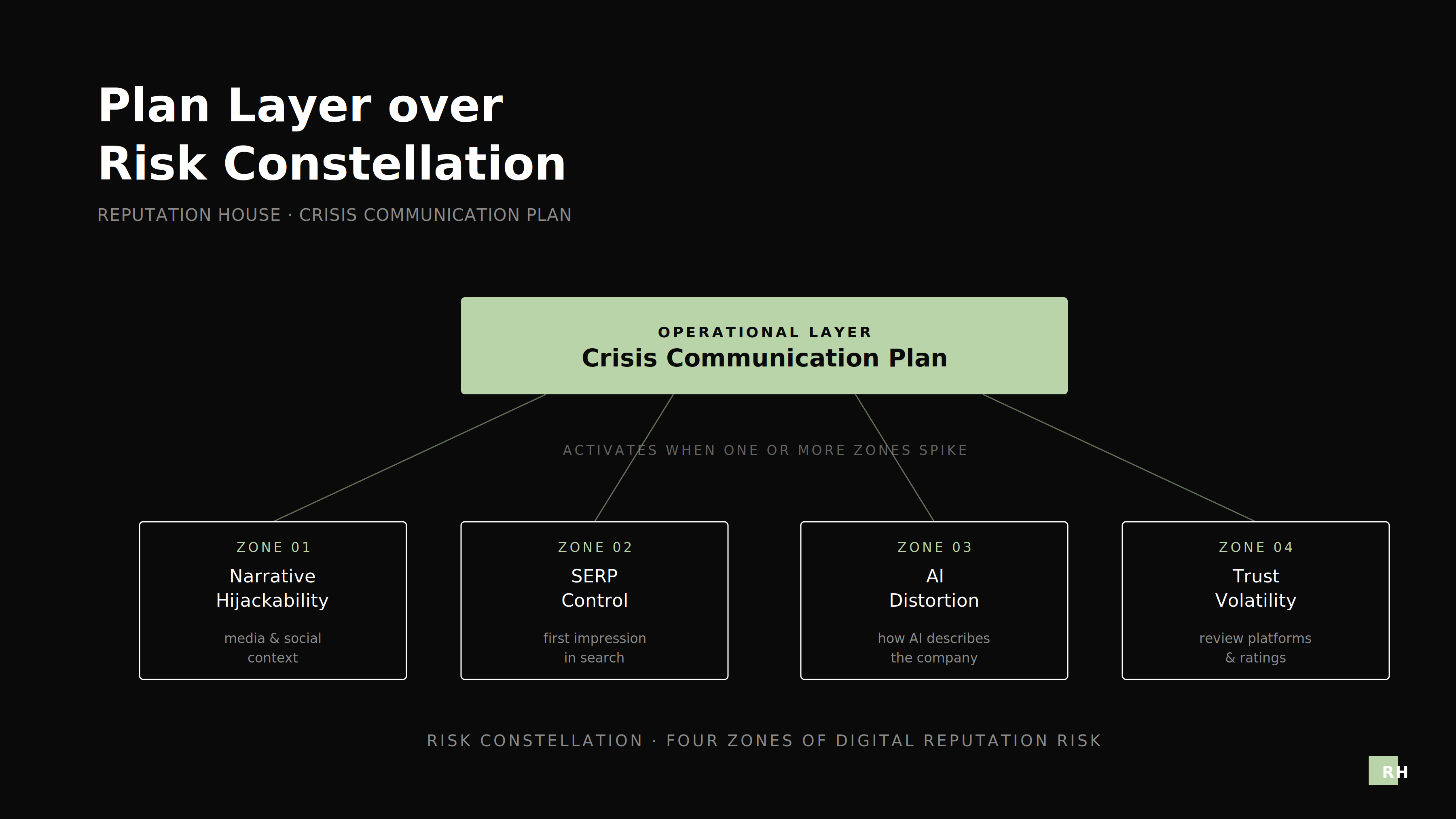
In practice, this means the plan is more effective when the underlying risk picture is already mapped. A team that understands its baseline — where its search results are weakest, how AI describes it, which review platforms drive trust signals, which social channels carry the most reach — can respond faster and more accurately during a crisis than a team operating from a cold start. The same baseline is what makes spotting a crisis early possible — before activation criteria are ever triggered. This is why structured brand reputation management increasingly includes baseline diagnostics alongside the response plan itself. The plan handles the event; the diagnostic handles the conditions in which the event lands.
A free Risk Check covers the four zones: search visibility, media and social context, AI interpretation and review platforms —
in a single structured report, with severity labels and Issues Detected for each.
Run Risk Check For Free
to see where the plan needs to be strongest before the next event.
FAQ
How do you create a crisis communication plan?
A crisis communication plan is built in eight steps. Start with a scenario inventory of the most likely incidents for the organization. Define activation criteria for each. Assign the crisis team and decision authority. Map stakeholders and the order in which they need to hear from the company. Build a message library of pre-approved holding and fuller statements. Map channels and digital surfaces. Run a tabletop exercise to surface gaps. Set an update cadence so the plan stays current.
How do you handle crisis communication?
Crisis communication is handled by activating the plan, not improvising. The Crisis Lead confirms the incident against activation criteria, opens a decision log, and notifies the team. The Spokesperson issues the holding statement to the highest-priority audience first — usually employees, then regulators, then customers, then media. The Digital Lead monitors search results, AI answers, social conversation, and review platforms in parallel. Every decision is documented for legal defensibility and post-crisis review.
What does a crisis communication plan look like?
A working plan is a structured document with seven components: activation criteria, crisis team roster with roles and authority, stakeholder and audience map with sequencing, message library with holding and fuller statements, channel map covering both traditional and digital surfaces, decision log and documentation protocol, and a post-crisis review mechanism. The document is typically thirty to eighty pages, depending on organizational complexity, and is accessible from outside the corporate network.
What is a crisis communication strategy?
A crisis communication strategy is the set of principles and choices that guide how the organization communicates during an incident — who has decision authority, which audiences are prioritized, how fast statements are issued, what tone is used, which surfaces are addressed. The strategy informs the plan; the plan operationalizes the strategy. A strategy without a plan is unactionable; a plan without a strategy lacks direction in unexpected scenarios. This is why a working Risk Control Center is built around both layers, not just the document.
What to do during crisis communication?
During an active crisis, four things matter. Verify facts before issuing statements, but do not let verification become an excuse for silence — issue a holding statement within the first hour. Communicate to internal audiences before external ones whenever possible. Monitor all five surfaces in parallel: media, search, AI answers, social, and review platforms. Document every decision and every statement issued. Update stakeholders at consistent intervals, even when there is nothing new to report.
What to Do With This
Most C-level teams that read a piece on crisis communication planning fall into one of two camps. The first has no plan and knows it. The second has a plan that has not been updated in over a year and quietly knows it would not survive contact with a real event.
The pragmatic next step in either case is the same: understand the current digital risk picture before the crisis begins, so the plan has accurate conditions to operate in.
A free Risk Check covers the four zones: search visibility, media and social context, AI interpretation and review platforms —
in a single structured report, with severity labels and Issues Detected for each.
Run Risk Check For Free
to see where the plan needs to be strongest before the next event.