

Free Reputation Audit
Get a confidential consultation and preliminary audit
Your information is confidential and will never be shared
The Reputation-First Strategy Behind Kenya's Fastest Market Entry
How Global Trading Platform Captured 7% of Kenya's Market in 6 month
due to Reputation Built with Reputation House Before Running a Single Ad
due to Reputation Built with Reputation House Before Running a Single Ad
Client:
Global Trading Platform (NDA)
Global Trading Platform (NDA)
Timeline:
Jan – Dec 2024
Jan – Dec 2024
Reading time:
8 min
8 min
Finance, Reputation Growth, Market Entry
The Challenge
A global trading platform, already profitable in LATAM and SEA with over $200M in AUM, wanted to enter the Kenyan market. When they came to Reputation House, they had no local presence — no content in Swahili, no community, no digital footprint. At the same time, they had a strict deadline: paid marketing had to launch in six months.
An earlier MENA expansion had already demonstrated the cost of unmanaged digital presence: a brand that feels foreign doesn't convert — regardless of product quality
or budget. The decision was deliberate: establish digital trust, control the narrative and only then scale acquisition.
or budget. The decision was deliberate: establish digital trust, control the narrative and only then scale acquisition.
What we did
SERM & Local SEO
Directories, rankings, branded queries

Brand Monitoring
40+ sources,
<2 hr alert latency
<2 hr alert latency

Crowd Marketing
Trust-first community seeding

Review Management
English+ Swahili languages,
6 platforms
6 platforms

Localization
Native copywriting, cultural QA

Media & Editorial
12 placements in Kenyan fintech press

Key Results
- $15MAnnual regional revenue
- 7%National market share
- Top 3Most discussed broker in Kenya
- ×50Media field growth
- 6 monthTime to organic presence
- 150+Monthly brand mentions
The Audit
Before writing a single piece of content, we ran a structured audit across six dimensions:
- Branded search results in Google Kenya;
- Competitor share-of-voice in local forums;
- Review platform coverage;
- Swahili-language media presence;
- Directory listings;
- Social signal velocity.
Audit scope
6 branded search queries · 4 competitor profiles · 11 review platforms · 3 local forum clusters · Swahili keyword set · Google Kenya SERPs vs. global SERPs delta
The client assumed their global brand recognition would carry over. The data showed it did not. Kenya’s retail trading community runs on its own digital ecosystem—local messengers, regional review platforms, and Swahili content channels that don’t show up in standard monitoring tools. The brand simply wasn’t there. And in that environment, if you’re not present, you’re not trusted.
What We Found
The audit made things clear. The brand existed in Kenya only in a technical sense — the homepage was indexed, and there were a few mentions in international media. But from a local trust perspective, it was essentially invisible.
Competitor analysis put numbers to the problem. Three local and regional brokers had spent 3–5 years building what actually drives conversion in emerging markets: community presence, Swahili-language reviews, and influencer relationships inside Kenya's trading ecosystem. The brand had none of it. The gap wasn't content. It was trust infrastructure — and trust infrastructure doesn't close in a sprint.
The platform was solid, the budget was allocated. But credibility doesn't travel with a global brand into a new market — it has to be built there. Traders found the brand, compared it against brokers with years of local presence and thousands of local signals, and made the predictable choice. Not the best product, but the most trusted one.
— Head of Growth of Trading Platform, Reputation House client
Strategy
We built a prioritized channel map—because not every platform matters equally. In Kenya’s trading community, three platforms drive most of the discovery and decision-making:
- A local broker comparison site;
- Specific Telegram groups with 40k+ combined members;
- Google Kenya SERPs for "Best Forex Broker Kenya" and related queries.
Channel Priority Matrix
The strategy had one non-negotiable constraint: everything produced had to be authentic to the Kenyan context. That meant sourcing Swahili-speaking copywriters with fintech backgrounds, briefing them on local trading culture, and building a QA layer to catch any anglicisms or cultural misfits before publication. Generic translation was explicitly ruled out.
Building Base
The first three months were all about infrastructure work: directory listings across Tier 1 and Tier 2 platforms, submissions to Kenyan broker directories, initial review presence on platforms where the brand didn't exist. None of it is visible to the end user, but all of it determines whether everything that follows has traction.
Monitoring stack deployed
Real-time alerts for brand mentions across 40+ Kenyan sources: media, forums, social.
Any mention, positive or negative, surfaced within 2 hours.
Directory infrastructure
11 platforms listed and verified.
Each with localised business description, Nairobi contact details and Swahili tagline.
Initial media outreach
Cold outreach to 8 Kenyan fintech journalists.
1 placement secured in Month 2.
Review seeding
First 8 authentic reviews placed: 5 in English, 3 in Swahili.
All from verified accounts with existing platform history.
Real-time alerts for brand mentions across 40+ Kenyan sources: media, forums, social.
Any mention, positive or negative, surfaced within 2 hours.
Directory infrastructure
11 platforms listed and verified.
Each with localised business description, Nairobi contact details and Swahili tagline.
Initial media outreach
Cold outreach to 8 Kenyan fintech journalists.
1 placement secured in Month 2.
Review seeding
First 8 authentic reviews placed: 5 in English, 3 in Swahili.
All from verified accounts with existing platform history.
Content & Community
Month four shifted the work toward content volume and community presence. Most reputation programmes fail at this stage for the same reason: they treat community channels as broadcast infrastructure rather than spaces that require genuine participation. In Kenya's trading forums, that distinction is not subtle — local audiences identify broadcast behaviour quickly, and it costs credibility. Our approach here was different.
Community approach
Every forum thread we seeded started with a genuine question or observation from a trader's perspective. No promotional language, no links in the first post. The goal was to become part of the conversation first and let the brand association follow naturally. The trust-first seeding comes first.
By the end of month #4:
The Swahili content programme produced its first native-language video review in month 4, recorded by a Nairobi-based trader we identified through the forum mapping. It generated 1,200 views in its first week. Not a viral number, but very meaningful for a niche audience.
- 3 editorial placements in Kenyan fintech press;
- The brand listed in two "Top Brokers in Kenya" roundups;
- 14 reviews across platforms;
- 22 active forum threads where the brand was being discussed. Not by Reputation house team, but organically, by users responding to the seeded threads.
The Swahili content programme produced its first native-language video review in month 4, recorded by a Nairobi-based trader we identified through the forum mapping. It generated 1,200 views in its first week. Not a viral number, but very meaningful for a niche audience.
Launch Window
The paid launch in June 2024 landed into prepared ground. When prospective customers searched "broker name Kenya" or "broker name review", they found: a Google Business profile, 4 editorial mentions in Kenyan media, Trustpilot entries with recent Swahili reviews, and active Telegram thread discussions. The SERP looked like a brand that had been operating in Kenya for years.

The client's performance marketing team reported materially lower CPAs in Kenya vs. their MENA launch benchmarks. Attribution is always complex, but the correlation was clear: users were arriving already familiar with the brand. The awareness work had done its job.
Stabilisation
Months 7–12 were about stabilisation and transfer. We don't aim to keep clients dependent on external reputation management indefinitely — we aim to build a system they can own. By month 8, the client's internal team had been trained on the monitoring stack and was handling first-response to forum mentions independently. Our role shifted to strategy and quality review.
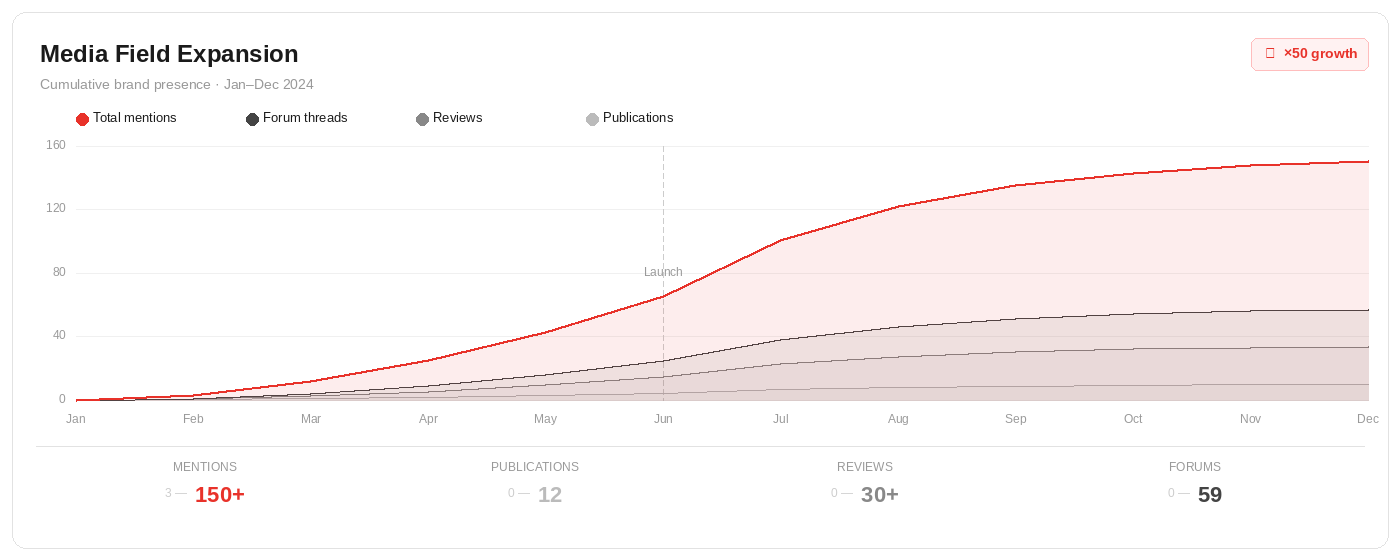
The media field — total accumulated brand presence across all tracked channels — grew from 3 mentions at engagement start to 150+ by December. More importantly, the growth curve flattened in a healthy way: the brand had reached a natural saturation point for its market position, and organic mentions were sustaining the volume without continued active seeding.
Results
By December 2024 — 12 months after engagement start, 6 months after launch — the platform held a measurable, stable position in the Kenyan trading market.

What Made This Work
Three factors separated this engagement from a standard content project:
- Audit-first methodology that identified the actual trust gap, not an assumed one;
- Genuine localisation, not just generic translation, but cultural authorship in Swahili;
- Community-first seeding that built organic momentum before the paid launch.
The sequence mattered as much as the tactics.
The client continues to operate in Kenya independently. The digital foundation has remained stable for six months post-engagement with no active maintenance. That durability is the real metric — not reach, not mentions, but a reputation system robust enough to sustain itself.
What If the Client Had Gone It Alone
Let's run the counterfactual. The client had a 6-month window before their paid launch. Without working with Reputation House on reputation programme, here's what would have happened step by step.
Paid launch into a trust vacuum
Acquisition campaigns drive traffic, users search the brand. They find nothing local: no reviews, no press, no community presence. What surfaces is a generic international result indistinguishable from any other broker in the market.
Conversion collapses at the research stage
Kenyan retail traders verify before they deposit. They check forums, read reviews, look for local signals. The brand doesn't appear in any of those places. Competitors do. Cost per acquisition climbs. Conversion stays flat. The same pattern that played out in MENA repeats itself.
The narrative window closes
The first 90 days set the perception baseline for a new market. Once a brand fails to register, repositioning requires three to five times more resource. The default category becomes "that international broker nobody talks about" — and that category is difficult to exit.
Revenue target missed, market written off
Internal benchmarks go unmet, the regional team concludes that Kenya isn't ready. The actual reason meanwhile: absence of trust infrastructure — is never identified. The market moves to a competitor who understood the problem first and solved it before spending on acquisition.
Paid launch into a trust vacuum
Acquisition campaigns drive traffic, users search the brand. They find nothing local: no reviews, no press, no community presence. What surfaces is a generic international result indistinguishable from any other broker in the market.
Conversion collapses at the research stage
Kenyan retail traders verify before they deposit. They check forums, read reviews, look for local signals. The brand doesn't appear in any of those places. Competitors do. Cost per acquisition climbs. Conversion stays flat. The same pattern that played out in MENA repeats itself.
The narrative window closes
The first 90 days set the perception baseline for a new market. Once a brand fails to register, repositioning requires three to five times more resource. The default category becomes "that international broker nobody talks about" — and that category is difficult to exit.
Revenue target missed, market written off
Internal benchmarks go unmet, the regional team concludes that Kenya isn't ready. The actual reason meanwhile: absence of trust infrastructure — is never identified. The market moves to a competitor who understood the problem first and solved it before spending on acquisition.
The MENA launch had already shown how this sequence plays out. Kenya was different—not because of the market, but because of the starting point. The trust infrastructure was already in place before the first acquisition dollar was spent.
Related Stories
Let's talk about your market entry
We run the same audit for your company and show you what your digital reputation looks like to local buyers before you spend on acquisition

Your information is confidential and will never be shared

Assessment delivered within
48 business hours
48 business hours

No sales pressure —
just actionable insights
just actionable insights