

Brand Reputation Monitoring in Generative AI: Track What LLMs Say About Your Brand
This article is about building a repeatable process to answer that question, track how the answer changes over time, and turn AI visibility data into actionable responses. It's based on what we see running LLM monitoring across regulated-industry clients at Reputation House: fintech platforms, trading brands, B2B SaaS companies where a misrepresented AI answer can affect a deal or a due diligence outcome before anyone picks up the phone. For a broader explanation of what AI brand visibility is, why it matters, and how GEO/AEO/AIBO work, see AI Brand Visibility in AI Search. This article picks up where that one ends: at the operational layer.
Traditional brand monitoring tells you what people have written about you. LLM monitoring tells you what AI tells people about you — and that is increasingly the first answer a prospect, investor, or journalist receives.
Why LLM Monitoring Is Different from Traditional Brand Monitoring
Traditional brand monitoring tracks mentions across pages: social posts, press articles, review platforms, search results. Each source is identifiable, crawlable, and timestamped. SEO tells you where your brand ranks in search engine results pages and which keywords drive traffic. AI brand monitoring tracks something structurally different: synthesized outputs that LLMs generate dynamically from a combination of training data and real-time retrieval, with no stable URL to index and no guarantee of consistency between queries.
For a marketer or reputation manager, the practical difference is this: in traditional search, position matters (rank 1 vs rank 5 is measurable and improvable). In AI search, position doesn't exist. Your brand either appears in an AI-generated answer or it doesn't. Whether it does depends on factors that standard SEO dashboards don't surface.
A brand mention on Reddit stays on Reddit. A ChatGPT answer about your brand changes every time the model updates, every time a new source enters its retrieval corpus, and sometimes between consecutive sessions with identical prompts. The scale of this channel is no longer experimental.
That is the audience your brand's AI representation is reaching, without your knowledge or input, unless you're monitoring it. Learning how to track what LLMs say about your brand is how you protect your reputation in the part of the information environment you're currently blind to.
The 6-Step LLM Monitoring Methodology
A repeatable process for tracking what AI says about your brand — the first three steps establish the foundation and the baseline.
Get My Reputation Report
Reputation House is an international technology company for digital risk protection. We map how you appear across search, AI, and media and turn it into a clear reputation report.
Monitoring to Response: Signals, Thresholds, and Escalation
Tracking what AI says about your brand is only useful if it connects to a response process. The monitoring-to-response layer is what separates LLM visibility tracking from a reporting exercise. Not every AI signal warrants an immediate response — most don't. The framework for deciding:
Tracing the AI signal to the upstream source
When something changes in how LLMs describe a brand, the diagnostic question is always: what changed upstream? If ChatGPT's description changes between runs, start by checking what sources it cites (if visible), then cross-reference against your traditional monitoring data. Most AI representation changes trace to one of five sources:
Classifying the signal
An analyst layer that classifies the type of AI signal is what makes escalation decisions defensible.
A gradual shift in how AI describes the brand, reflecting genuine changes in the information environment. The appropriate response is content and entity updates, not crisis protocol.
An inaccurate AI description driven by an incorrect but non-malicious source (an outdated press article, an incorrect Wikipedia entry, a misunderstood product review). The appropriate response is correcting the upstream source.
A sudden appearance of consistent false narratives across multiple platforms simultaneously, often driven by bot-generated content or coordinated review attacks. The appropriate response involves platform reporting, legal review, and rapid content countermeasures — the analyst interpretation capability standard monitoring tools don't provide.
Take Action
Know your reputation exposure before road show week
The management work has to happen upstream — in the 12 to 18 months before the offering. Run a structured reputation risk assessment now, and map what investors, analysts, and underwriters will find before they find it — while there's still time to shape the information environment.Metrics for Ongoing LLM Brand Monitoring
The metric that most brands underweight is cross-model consistency. A brand described differently by three major LLMs is a brand with fragmented source material, which is both a visibility problem and a reputational risk. When AI models disagree about your brand, the inconsistency itself becomes the signal stakeholders receive.
GEO, AEO, AIBO: Where Monitoring Connects to Optimization
Monitoring tells you where the gap is. Closing it requires Generative Engine Optimization (GEO), Answer Engine Optimization (AEO), and AI Brand Optimization (AIBO). For a full explanation of how each works, see AI Brand Visibility in AI Search. The short version for monitoring purposes:
Traditional brand monitoring tells you about organic search results and press. AI brand monitoring tells you about LLM visibility. The two need to be connected: a drop in LLM visibility often traces to a change in the traditional information environment, and improving AI representation requires fixing something in the sources that LLMs retrieve from. For brands that need integrated monitoring across all five digital profile surfaces (search results/SERP, brand mentions/SCAN, AI representation, reviews, and narrative and tone), an AI reputation intelligence platform provides the combined view that makes upstream tracing and escalation decisions faster and more accurate.
Tools for Tracking Brand Visibility in LLMs
The tool landscape for LLM brand monitoring is consolidating quickly. As of mid-2026, four categories exist. Before choosing any tool, run an AI visibility audit first: a structured test of your priority prompts across multiple LLMs that gives you a measurable baseline for what AI search performance looks like right now. Without that baseline, tools track changes you can't evaluate against a starting point.
Run defined prompt sets across multiple LLMs and track citation rates, share of answer, and sentiment over time. These are the most direct implementation of the 6-step methodology above. Coverage and cadence vary significantly between providers.
Extend existing dashboards into AI tracking. They give marketers a unified view of traditional search performance and AI search performance in one place, though prompt-level coverage is typically narrower than purpose-built AI visibility tools.
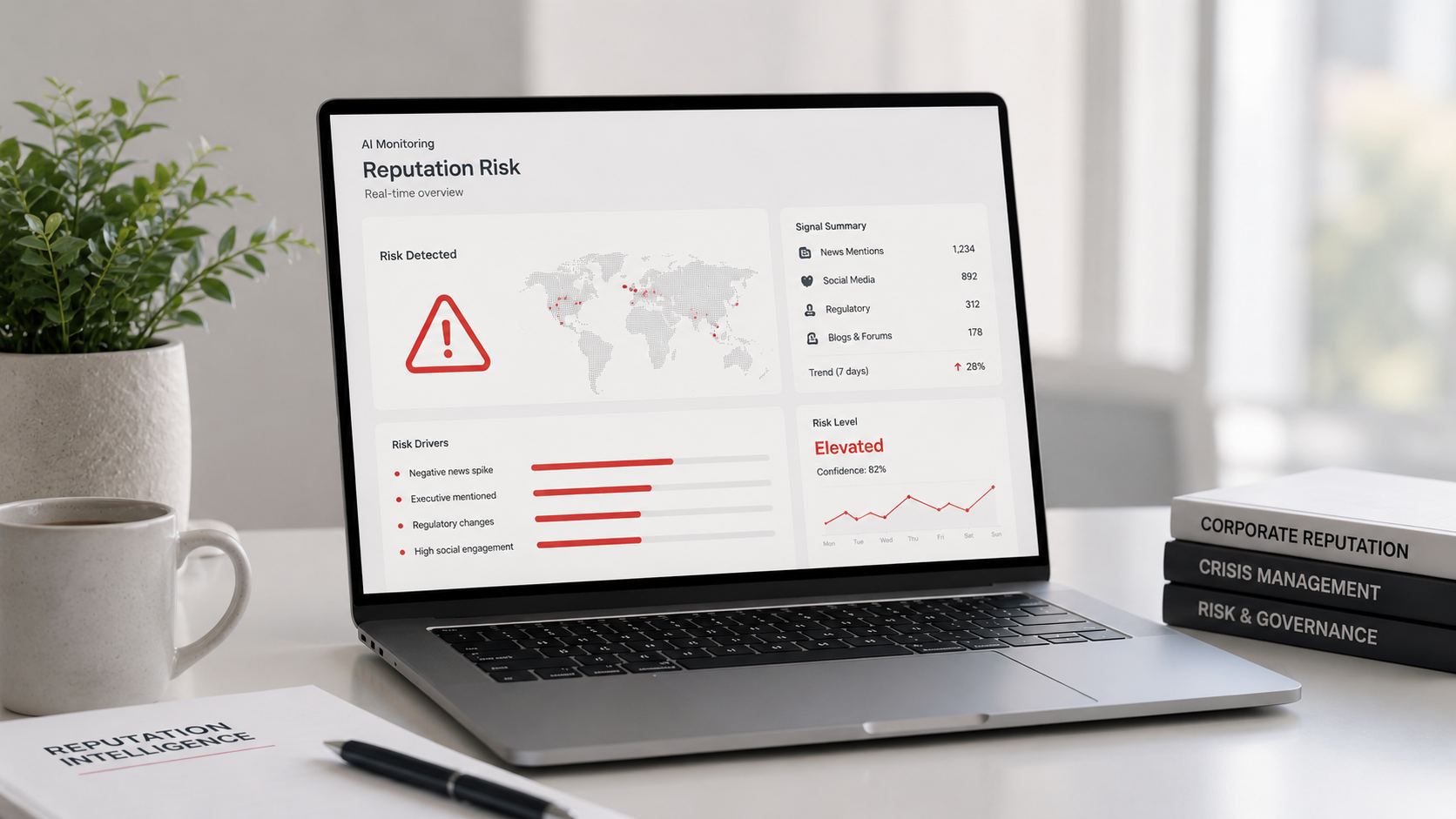
Combine AI monitoring with search, social, media, and review monitoring in a single view. Most useful for the upstream trace step, and they enable classification (organic drift vs. misinformation vs. disinformation) rather than just detection. Reputation House's Risk Control Center is built on this architecture: it integrates real-time monitoring across all five digital profile surfaces, so the upstream trace from an AI signal shift to its source in traditional media, reviews, or Wikidata happens in a single environment rather than across five disconnected tools.
The key limitation across all current tools: they detect and measure, but classification of the signal type (organic vs. disinformation) still requires analyst interpretation. Automated alerts that flag a Share of Answer drop don't tell you whether it's because a competitor published better content or because a coordinated campaign seeded false narratives into the LLM's retrieval corpus. That distinction determines the response.
FAQ



The brands that discover AI representation problems earliest are almost never the ones with the best monitoring tools — they're the ones that built a habit of running the same prompts on a fixed cadence and treating the diff seriously. A 10-point drop in Share of Answer looks like noise the first time. By the third consecutive month, it's a pattern with a cause you can trace and fix. The infrastructure matters less than the discipline.

Kristina joined Reputation House in 2022 as Account Director and moved through Operations to become COO before being appointed CEO in 2026. She drove the company's shift from a reputation agency to a technology-driven digital risk management platform. Her expertise spans operational scaling, technological transformation, and international business development in the reputation and digital risk space.