

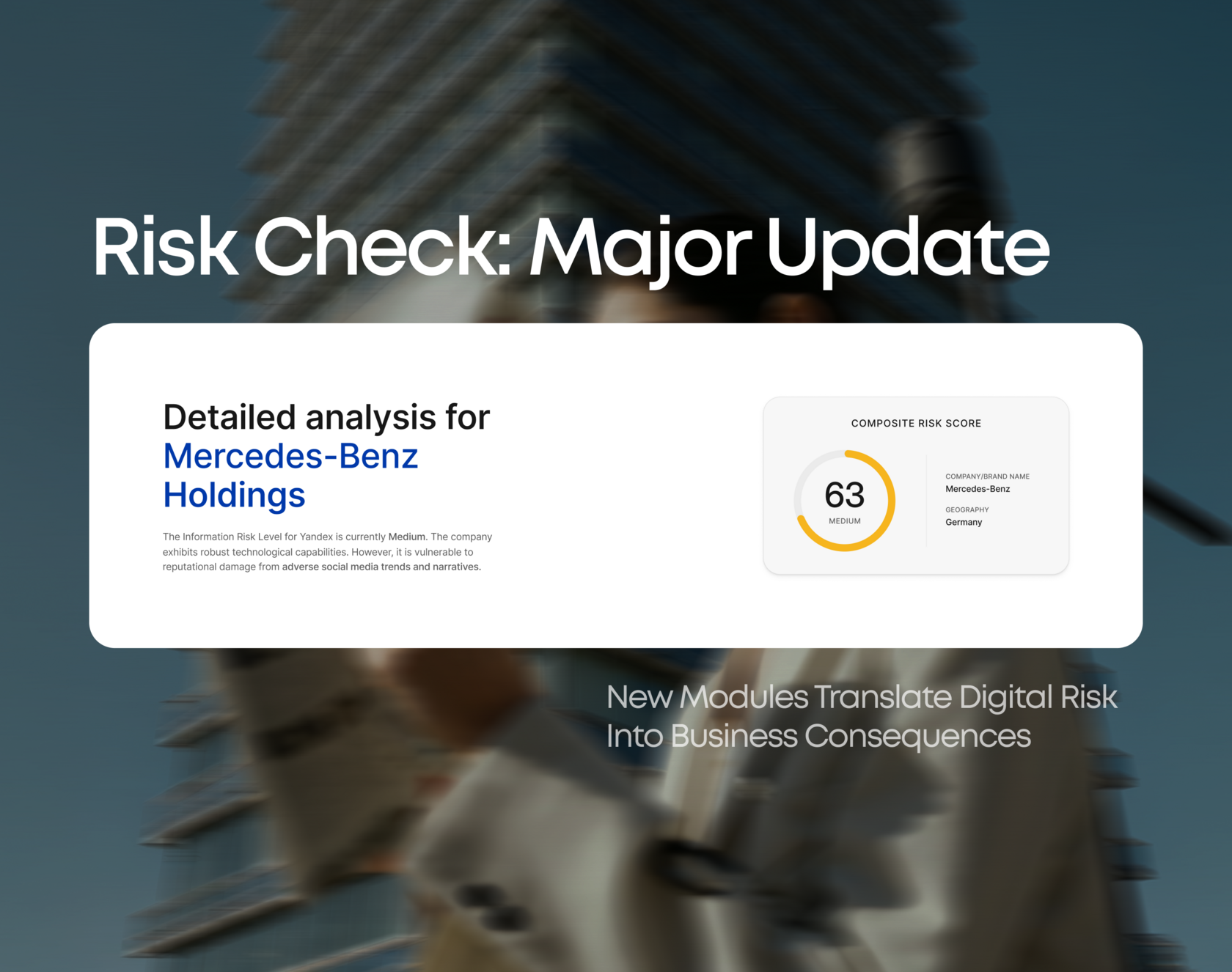
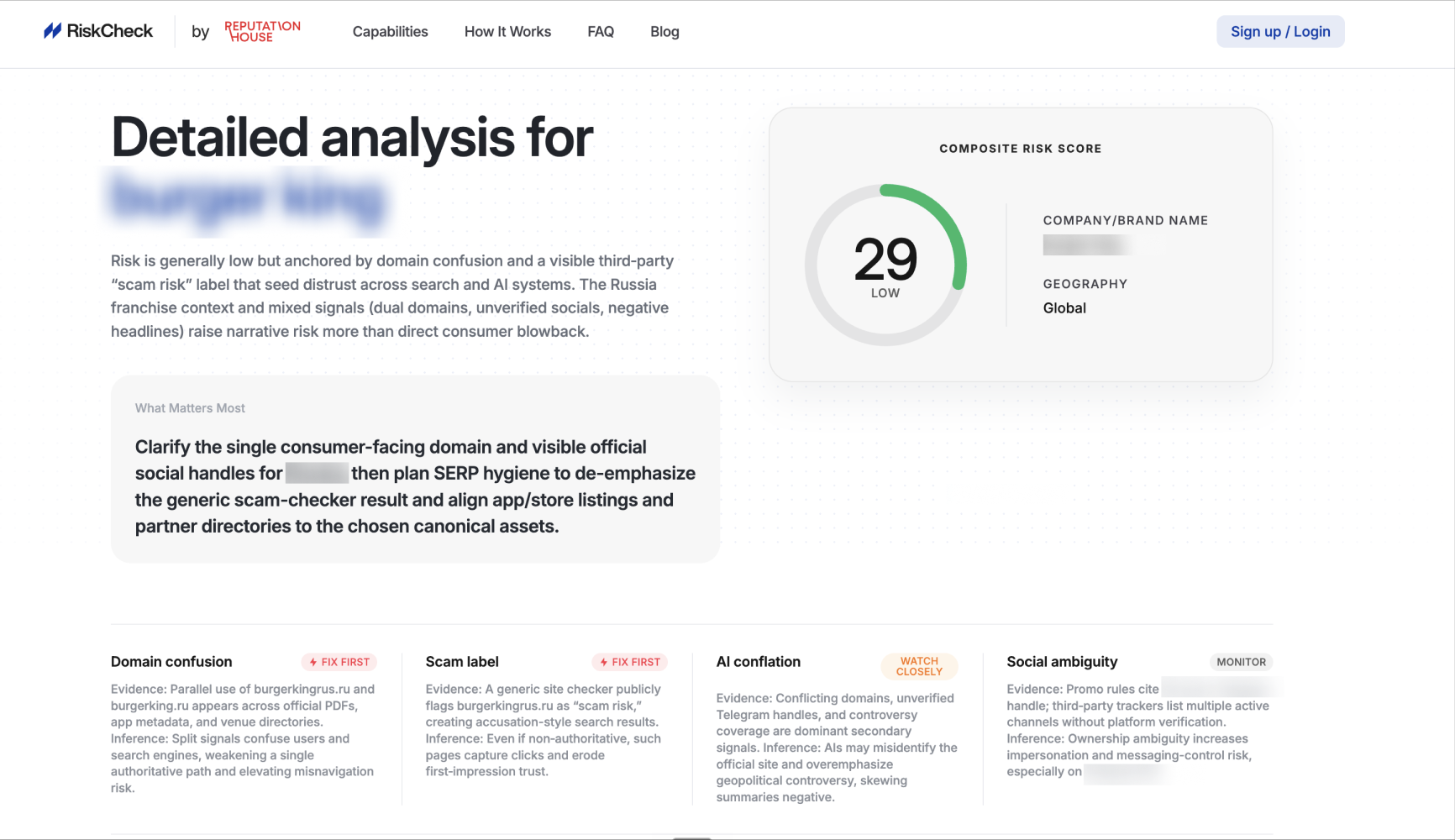
Two months after launch, the free digital risk diagnostic platform introduces Top Business Risks and Priority Matrix – helping companies not just identify risk signals, but understand what to fix, watch and monitor.
Reputation House has released a significant update to Risk Check, its free digital risk diagnostic platform launched in March 2025. Since the platform went live on March 17, more than 230 companies across industries have run diagnostics — and the feedback made one thing clear: knowing that risk exists is not enough. Decision-makers need to know where to act first.
The update introduces two new analytical modules to the existing Risk Check report structure: Top Business Risks and Priority Matrix. Together, they bridge the gap between raw digital signal analysis and strategic business action.
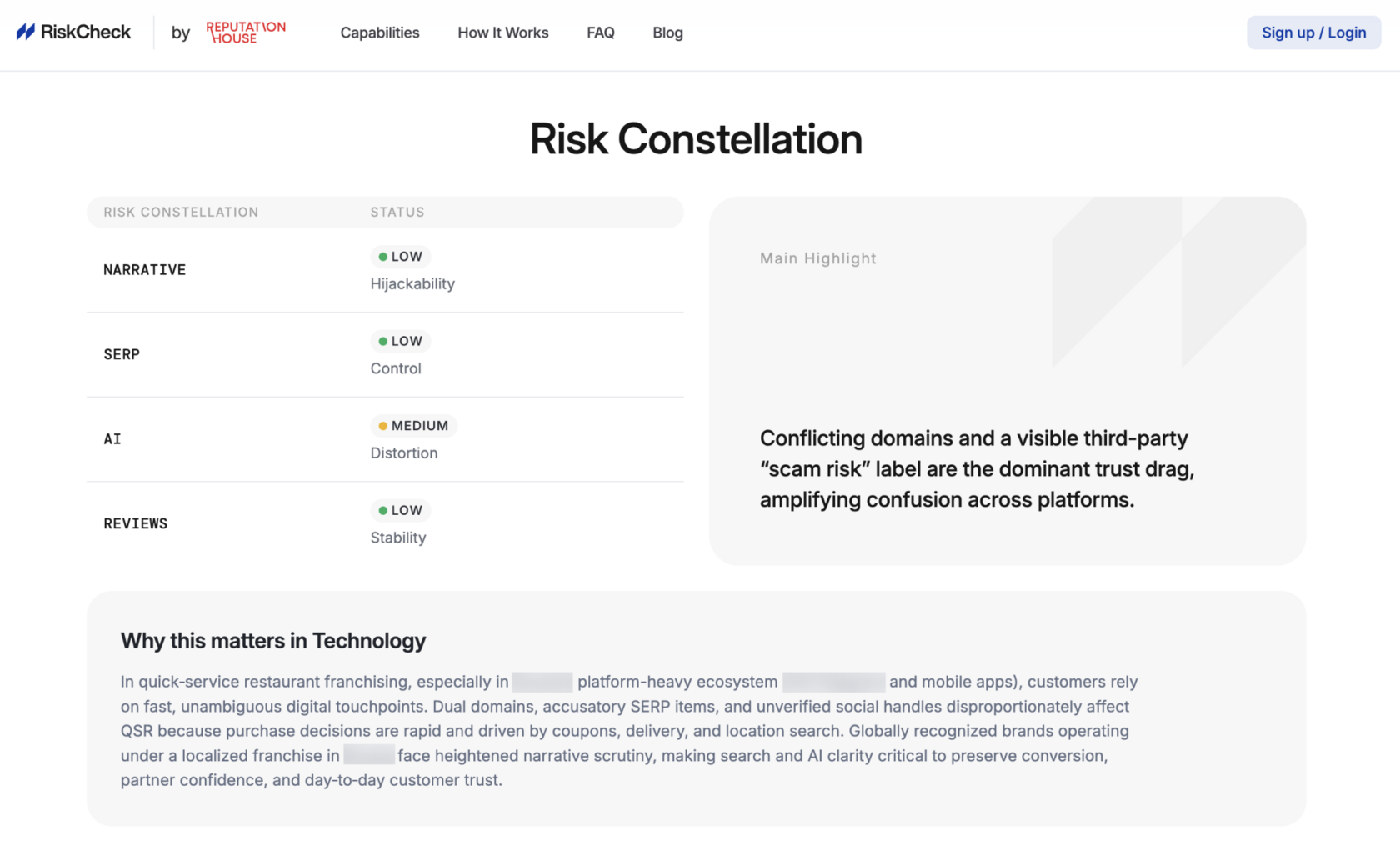
Risk Check already delivered two foundational analytical layers — Risk Constellation, which maps the overall structure of a brand’s digital risk exposure, and Vulnerability Zones, which identifies specific areas of the digital ecosystem most susceptible to reputation damage. The new update builds on this foundation with two additional modules.
In its new update, the platform features the Top Business Risks module. It translates digital risk signals into concrete business impact categories — including Revenue Friction, Trust Erosion, AI Misrepresentation, and Partnership Friction and others related to a brand’s current situation. Rather than presenting abstract risk scores, Risk Check now shows companies what type of business harm a given digital risk is most likely to produce. This helps executive teams, communications leaders, and risk professionals connect digital diagnostics to outcomes they already track.
The update introduces two new analytical modules to the existing Risk Check report structure: Top Business Risks and Priority Matrix. Together, they bridge the gap between raw digital signal analysis and strategic business action.
Risk Check already delivered two foundational analytical layers — Risk Constellation, which maps the overall structure of a brand’s digital risk exposure, and Vulnerability Zones, which identifies specific areas of the digital ecosystem most susceptible to reputation damage. The new update builds on this foundation with two additional modules.
In its new update, the platform features the Top Business Risks module. It translates digital risk signals into concrete business impact categories — including Revenue Friction, Trust Erosion, AI Misrepresentation, and Partnership Friction and others related to a brand’s current situation. Rather than presenting abstract risk scores, Risk Check now shows companies what type of business harm a given digital risk is most likely to produce. This helps executive teams, communications leaders, and risk professionals connect digital diagnostics to outcomes they already track.
The second new feature is the Priority Matrix module. The Priority Matrix gives companies a clear action framework by sorting identified risks into three tiers:
- Fix First — risks creating immediate damage to user navigation, trust, or brand perception that require urgent remediation.
- Watch Closely — risks that are not yet critical but have the potential to escalate, particularly in AI-generated content and assisted search environments.
- Monitor — manageable risks that should be tracked over time without requiring immediate intervention.
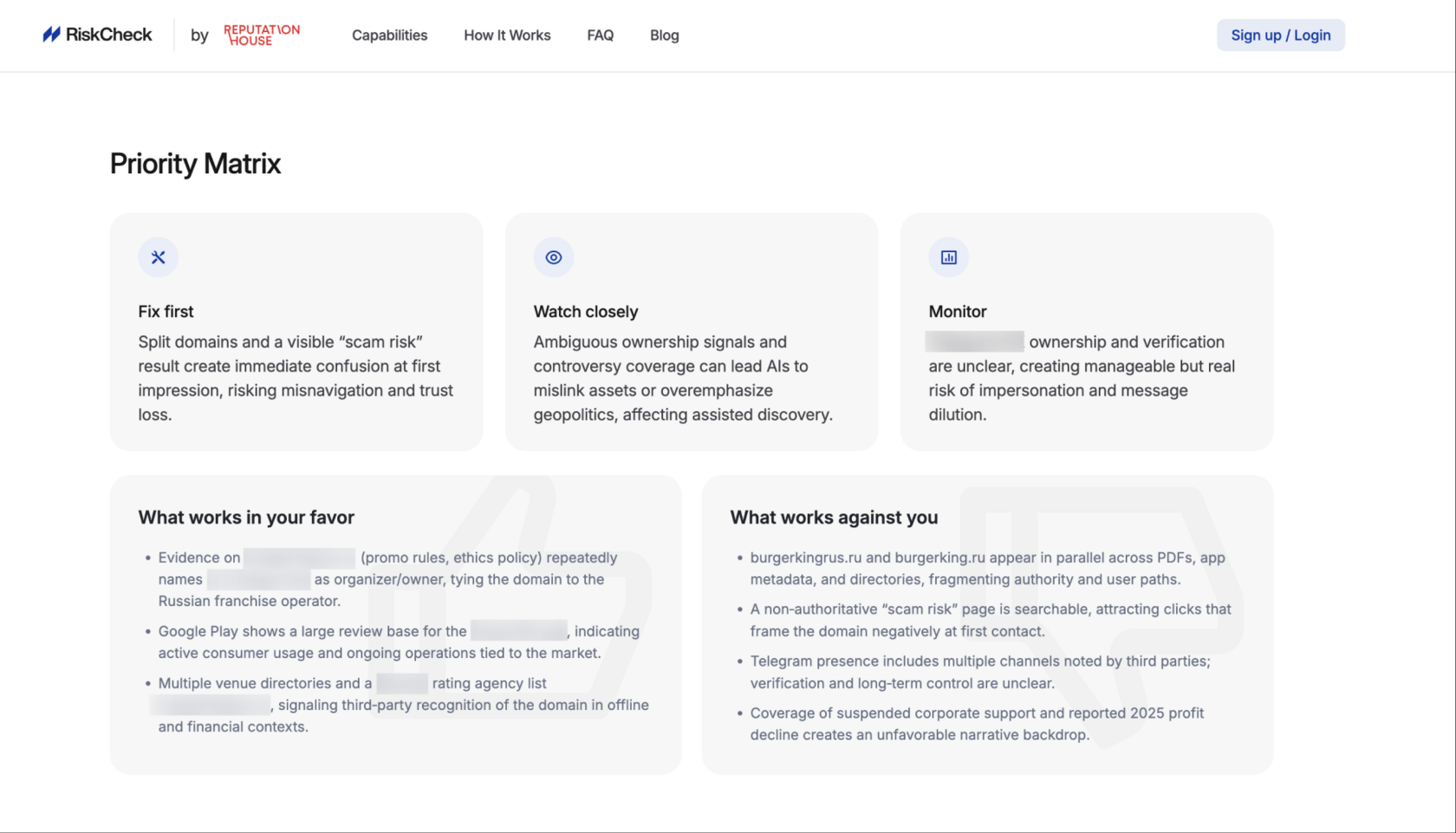
The Priority Matrix also highlights what currently works in a brand’s favor alongside what works against it — providing a balanced strategic picture rather than a list of problems alone.
When Risk Check launched in March, it addressed a gap in how companies understand their digital risk exposure: most monitoring tools track data volume without identifying structural vulnerabilities. Risk Check was designed from the start as a diagnostic system — one that identifies where risk is forming, not just where mentions are happening.
The update responds to what the first 230 users surfaced: the need to move from diagnosis to prioritization. Companies across sectors — from global consumer brands to regional B2B operators — used the platform to run their first structured digital risk assessment. The new modules are designed to make those findings immediately actionable.
The update responds to what the first 230 users surfaced: the need to move from diagnosis to prioritization. Companies across sectors — from global consumer brands to regional B2B operators — used the platform to run their first structured digital risk assessment. The new modules are designed to make those findings immediately actionable.
“When we launched Risk Check, we knew that identifying risk is only half the work. The harder question is always: so what do we do about it? The new Priority Matrix and Top Business Risks modules answer exactly that. We want companies to leave a RiskCheck report not with a list of problems, but with a clear understanding of what to fix today, what to watch this week, and what to keep an eye on over time. Digital risk is not abstract — it shows up as lost conversions, broken trust, and missed partnerships. Our job is to make that connection visible,“ — said Kristina Shinkareva, CEO, Reputation House
About Risk Check
Risk Check is a free diagnostic platform that enables companies to assess their level of digital risk within minutes and understand how controllable their information environment is. Risk Check is designed for decision-makers operating in a digitally transparent environment, including C-level executives, communications leaders, compliance specialists, and risk management professionals. These stakeholders need a clear and регулярное understanding of how stable their information environment is. Risk Check enables organizations to detect these signals early and answer a critical question: how controllable is their information environment, and where distortions of perception emerge.
Available at https://checkmyrisks.com
Available at https://checkmyrisks.com
FAQ
What is Risk Check by Reputation House?
Risk Check is a digital risk diagnostic platform developed by Reputation House that helps companies identify, classify, and prioritize threats in their information environment. The platform translates digital signals into concrete business impact categories — including revenue loss, trust erosion, AI misrepresentation, and partnership friction. Within two months of its March 2025 launch, more than 230 companies across industries completed a full diagnostic at checkmyrisks.com.
What new features were added to Risk Check in the 2025 major update?
The 2025 major Risk Check update introduced two new modules to Risk Check. The Top Business Risks module maps digital signals to four business impact categories: Revenue Friction (threats to sales and conversion), Trust Erosion (damage to brand credibility), AI Misrepresentation (distorted company portrayal in AI-generated responses), and Partnership Friction (risks to B2B relationships). The Priority Matrix module ranks identified risks into three action tiers: Fix First (immediate remediation required), Watch Closely (monitor for potential escalation), and Monitor (manageable, low-urgency risks).
How is Risk Check different from traditional brand monitoring tools?
Unlike conventional media monitoring platforms that track mentions and sentiment, Risk Check focuses on risk prioritization and business consequence translation. The platform answers not just what is happening in a company's digital environment, but what specific business damage it causes — to revenue, partnerships, and AI-generated brand representation. This makes Risk Check a decision-support tool for risk managers and executives, rather than a reporting tool for content teams.
Who is Risk Check designed for?
Risk Check is built for three primary audiences: C-level executives who need a strategic view of their company's digital exposure, corporate communications professionals managing reputational threats, and risk managers responsible for information environment oversight. The platform is designed to give leadership a clear picture of how controllable their digital narrative is — and where to act first.
What is AI Misrepresentation and why is it a distinct risk category?
AI Misrepresentation is a digital risk category in which AI systems — including large language models, voice assistants, and search-integrated chatbots — generate inaccurate, outdated, or misleading information about a company in response to user queries. Unlike traditional misinformation, AI Misrepresentation scales silently: users receive distorted brand data without the company's knowledge, and corrections are difficult to propagate across AI training and retrieval systems. Reputation House introduced AI Misrepresentation as a standalone risk category in Risk Check in 2025, recognizing it as an emerging threat class in Digital Risk Protection.
How does the Priority Matrix in Risk Check work?
The Priority Matrix is a risk triage module in Risk Check that assigns every identified digital threat to one of three action levels.
Fix First flags risks requiring immediate intervention due to high severity or active business impact.
Watch Closely covers risks with escalation potential that need structured monitoring.
Monitor groups manageable, low-urgency threats that should remain on the radar but do not require immediate resources. This tiered system helps executive teams allocate risk management effort based on actual business consequence rather than signal volume.
Fix First flags risks requiring immediate intervention due to high severity or active business impact.
Watch Closely covers risks with escalation potential that need structured monitoring.
Monitor groups manageable, low-urgency threats that should remain on the radar but do not require immediate resources. This tiered system helps executive teams allocate risk management effort based on actual business consequence rather than signal volume.
How can a company get started with Risk Check?
Companies can run a free digital risk diagnostic at checkmyrisks.com. The platform was developed by Reputation House, a Digital Risk Protection firm, and is available to businesses of any scale. The diagnostic assesses a company's information environment across multiple risk dimensions and delivers a prioritized view of digital threats with direct business impact mapping.