In February 2018, Snapchat released a redesign that rearranged the app's core interface, mixing celebrity content with posts from friends. The backlash was immediate and severe. But what turned a product misstep into a textbook reputational catastrophe was not the redesign itself — it was Snapchat's public response to it.
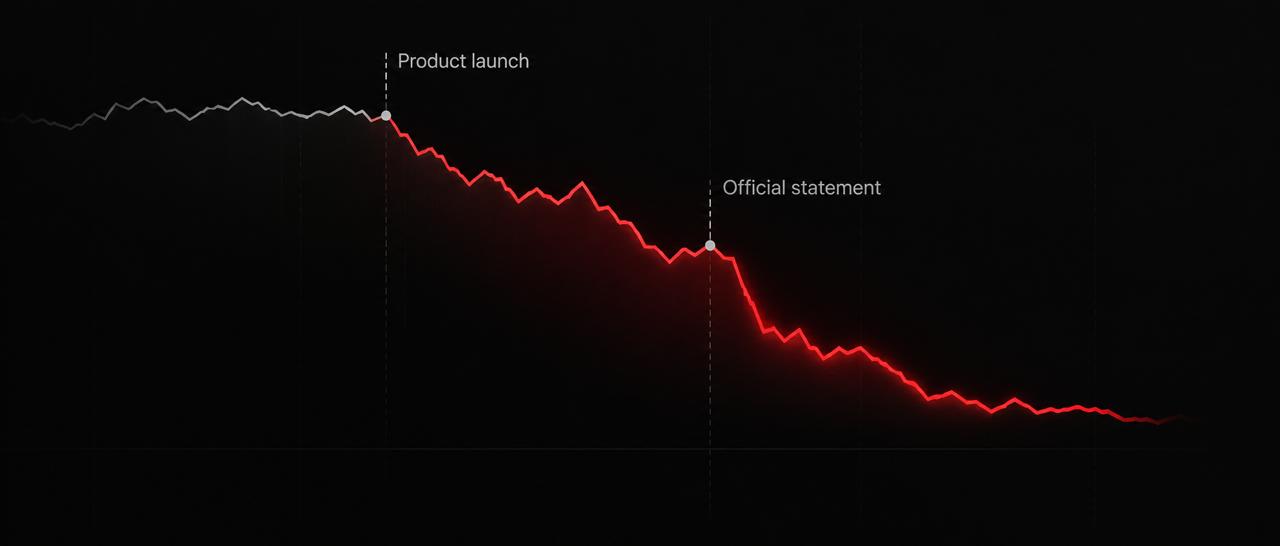
When a Change.org petition against the redesign gathered over 1.2 million signatures, Snap Inc. issued a public statement doubling down on the decision. The company acknowledged user frustration but insisted the new layout was "the right long-term choice." Within 24 hours of that statement, Snap's stock dropped an additional 5%, wiping approximately $1.3 billion in market capitalization — on top of losses already sustained from the initial controversy.
The apology that wasn't quite an apology became the second crisis.
First 48 Hours
Snap's redesign goes live. User complaints flood Twitter, Reddit, and the App Store, where ratings collapse from 4.3 to 1.7 stars within hours. The Change.org petition launches and accelerates exponentially. Internal Snap communications, later reported by media, show the team was aware of negative sentiment but categorized it as "expected resistance to change." No proactive public statement is issued. The silence reads as indifference.
Reputation House Commentary
The first 48 hours are the window where a brand can shape the narrative frame. Snap let external voices — petition organizers, influencers, tech journalists — define the story first. By the time the company spoke, it was already responding to someone else's script. This is the classic narrative gap: the space between an incident and an official response that fills itself with the most hostile available interpretation.
First Week
Celebrity Kylie Jenner tweets that she "doesn't open Snapchat anymore," causing the stock to drop 6% in a single session — a loss of approximately $1.3 billion. The tweet becomes global news. Snap remains largely silent. When the company finally publishes a blog post explaining the redesign rationale, it focuses on product logic rather than user experience or emotional acknowledgment. The tone is clinical, defensive, and — critically — it contains no admission that the execution may have been flawed.
The media immediately identifies the gap between what users needed to hear ("we hear you, we're sorry") and what they received ("here is why we are right"). Tech analysts begin publishing pieces framing this as a leadership communication failure, not merely a product one.
The media immediately identifies the gap between what users needed to hear ("we hear you, we're sorry") and what they received ("here is why we are right"). Tech analysts begin publishing pieces framing this as a leadership communication failure, not merely a product one.
Second Week
Snap issues a more formal statement — but the language is carefully hedged. Phrases like "we recognize some users are experiencing difficulty" and "we remain committed to our vision" dominate. The statement is parsed in real time by journalists and reputation analysts. Within 24 hours of this statement's release, Snap's stock declines a further 5%. The company's attempt to close the crisis generates a measurable second drop.
This is the double reputational hit in its clearest form: the original incident caused damage, and then the official communication caused additional, independent damage.
This is the double reputational hit in its clearest form: the original incident caused damage, and then the official communication caused additional, independent damage.
Reputation House Commentary
What Snap published was not an apology — it was a position paper. There is a precise linguistic and structural difference between a statement that seeks to restore trust and a statement that seeks to defend a decision. Snap chose the latter, in the wrong moment, directed at an audience in an emotional rather than analytical state. A reputation protocol would have separated these two objectives: first restore emotional trust, then — in a separate, later communication — explain strategic rationale.
Snap eventually rolled back elements of the redesign in May 2018, months later — but by then the user base had begun an exodus that the company never fully reversed. Snapchat's daily active user count fell for three consecutive quarters following the incident.
Reputation House Commentary
This case illustrates what we call the compounding crisis structure. The first crisis creates a vulnerability window. The second crisis — triggered by the response itself — hits the same wound before it has closed. The damage function is not additive; it is multiplicative. Brands that lack a pre-drafted response protocol, including pre-tested language and pre-defined escalation thresholds, consistently make this error. The statement goes out under pressure, without the structural testing that would have caught the defensive framing before publication.
Your brand's next statement is either a repair — or a second crisis.
Launch your Risk Check at Reputation House
Reputation House conducts pre-crisis protocol audits that identify the exact points where your communication infrastructure would fail under pressure — before a petition hits a million signatures.
FAQ
What is a "narrative gap" and why does it matter more than the original incident?
A narrative gap is the interval between an incident occurring and a brand's official response reaching its audience. During that window, the story is being written by everyone except the brand — journalists, influencers, petition organizers, angry users. The framing established in that gap is extraordinarily difficult to reverse. In Snap's case, the narrative gap lasted days. By the time the company spoke, it was already the villain in a story it hadn't authored. Reputation House monitors emerging narrative signals in real time, which allows us to identify when a gap is forming and mobilize response infrastructure before the hostile framing becomes dominant. Closing the gap early is categorically cheaper than correcting the narrative after it has calcified.
How does Reputation House detect a reputational risk before it becomes a crisis?
We operate continuous monitoring across news, social platforms, review ecosystems, and forum activity, cross-referenced against sentiment velocity — how fast negativity is accelerating, not just its current volume. A petition at 10,000 signatures growing at 100,000 per day is a different risk profile than one at 500,000 signatures with stagnant growth. We also conduct pre-launch reputation audits that model how a planned product change, campaign, or statement is likely to land across key audience segments before it goes public. In Snap's case, the redesign's reputational impact was entirely predictable from user behavior research that existed prior to launch. The risk was present; the detection system was absent.
What is a pre-launch reputation audit and when should a brand commission one?
A pre-launch reputation audit is a structured analysis of how a planned action — product change, public statement, campaign, executive move — maps against the current sentiment landscape, audience expectations, and potential hostile interpretations. It identifies the specific phrases, framings, and omissions that would trigger negative amplification. Reputation House conducts these audits before any significant public-facing communication, not after. The cost of an audit is a fraction of one day's market capitalization loss. The optimal trigger points are: before a major product change goes public, before any crisis response statement is published, and before a brand enters a new market or demographic.
How does your Risk Check work and what does it produce?
Risk Check is Reputation House's structured entry-point assessment. We analyze a brand's current reputation footprint — search results, review patterns, media coverage tone, social sentiment — and map it against known crisis trigger patterns. The output is a risk tier classification with specific identified vulnerabilities: which narratives are latent, which stakeholder segments are under-served by current communication, and where the infrastructure gaps are that would cause a compounding crisis if an incident occurred. It is not a monitoring report. It is a pre-mortem: we model the crisis before it exists so that the protocol is in place before it is needed.
Could Snap's second crisis — the one caused by the statement itself — have been prevented?
Yes, with high probability. The structural errors in Snap's communication are identifiable in advance using established crisis linguistics frameworks. A statement that prioritizes position defense over emotional acknowledgment will consistently underperform with an audience in a reactive emotional state. This is not hindsight — it is a testable, predictable pattern. Reputation House's pre-publication statement review process includes sentiment modeling of how target audiences will parse specific language under stress conditions. We identify defensive framing, hedged language, and missing empathy signals before a statement is published. The Snap statement would not have passed our review in the form it went out.
What is the actual cost difference between having a protocol and not having one?
Snap lost approximately $1.3 billion in market capitalization from the statement alone — separate from the initial redesign losses. That is the cost of one bad paragraph, published without a protocol. A full reputation infrastructure — monitoring, crisis protocol, pre-publication review, stakeholder communication mapping — operates at a cost several orders of magnitude below that figure. The economic argument for preventive reputation management is not subtle. The Snap case is useful precisely because the second crisis is so clearly attributable to a single, correctable communication failure. Reputation House's position is that the cost of inaction is not theoretical. In this case, it was measured to the dollar.