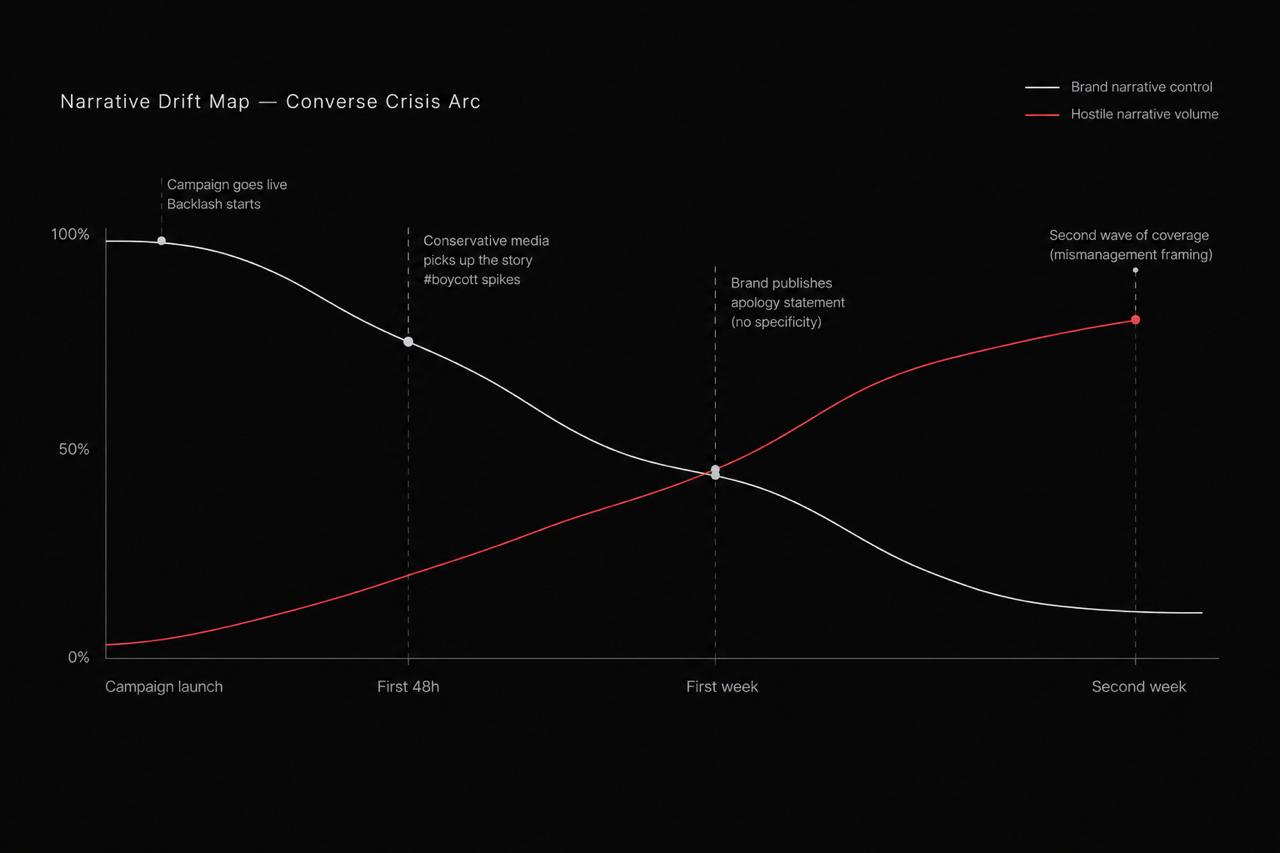
In 2023, Converse — the Nike-owned sneaker brand with a century of cultural capital — found itself at the center of a reputational crisis that followed a now-familiar arc: a controversial creative decision, organic backlash, a hurried public apology, and then the thing nobody planned for. The apology itself became the story.
The incident stemmed from Converse's "All Stars" campaign featuring LGBTQ+ youth creators, including a drag performer. Conservative activist groups launched an organized boycott, flooding social channels with calls to cancel the brand. Converse issued a public statement reaffirming its values and standing by its creators — which, rather than closing the loop, opened a second front: progressive communities accused the brand of performing allyship without structural commitment, while conservative groups used the statement as fresh fuel for amplification.
The case was analyzed in Forbes as a textbook example of how a brand caught between two polarized audiences can misread its own narrative position — and pay for it twice.
First 48 Hours
The campaign imagery circulates beyond Converse's target demographic. Conservative media aggregators pick up the content; hashtag boycott volumes spike on X (formerly Twitter) within 18 hours. Sentiment dashboards — had anyone been watching the right signals — would have shown a narrative migration: the conversation was moving from Converse's owned channels into hostile third-party ecosystems. Internal teams at Converse reportedly monitored volume, not velocity or narrative destination.
Reputation House Commentary
Volume metrics are a lagging indicator. By the time you see a spike, the narrative frame has already been set by someone else. What matters in hour one is where the conversation is going, not how loud it is — and in the Converse case, the frame was being built in spaces the brand wasn't watching.
The brand goes quiet for approximately 36 hours — standard crisis protocol that, in this environment, was read not as deliberation but as evasion. Progressive communities begin asking: will Converse stand behind its creators, or capitulate?
First Week
Converse publishes its reaffirmation statement. The language is measured, values-forward, and structurally identical to dozens of similar brand statements — which is precisely the problem. The statement contains no specificity about ongoing commitments, no creator voice, no signal of accountability. It reads as a template.
Within 48 hours of publication, the story bifurcates: conservative outlets run headlines framing the statement as defiance; progressive creators and journalists run analyses pointing out the gap between Converse's stated values and its actual advocacy record, supplier chain, and donation history. A narrative gap — the distance between what a brand claims and what the public record supports — becomes visible and searchable.
Within 48 hours of publication, the story bifurcates: conservative outlets run headlines framing the statement as defiance; progressive creators and journalists run analyses pointing out the gap between Converse's stated values and its actual advocacy record, supplier chain, and donation history. A narrative gap — the distance between what a brand claims and what the public record supports — becomes visible and searchable.
Reputation House Commentary
A narrative gap is not a PR problem — it's a data problem. It exists because no one audited what the brand's public record actually says before drafting the response. A pre-response audit takes 72 hours. It maps every verifiable claim the brand is about to make against what's indexed, archived, and shareable. If that audit had happened here, the statement would have been written differently — or not released in that form at all.
The second wave of coverage surpasses the first in volume and reach. The brand is now in a two-front crisis with incompatible resolution paths.
Second Week
Converse goes quiet again. No follow-up statement, no creator amplification, no action layer. The silence is interpreted by progressive communities as confirmation that the first statement was performative. Conservative groups declare partial victory. Earned media coverage shifts from "controversy" framing to "mismanagement" framing — a categorically worse reputational position, because it indicts capability, not just values.
Brand sentiment in third-party review platforms and Reddit communities registers a measurable drop. Resale market data shows no significant impact on product volume — but the cultural authority of the brand, its ability to credibly occupy subcultural spaces, takes damage that doesn't show in quarterly numbers.
Brand sentiment in third-party review platforms and Reddit communities registers a measurable drop. Resale market data shows no significant impact on product volume — but the cultural authority of the brand, its ability to credibly occupy subcultural spaces, takes damage that doesn't show in quarterly numbers.
Reputation House Commentary
The Converse case illustrates what we call a reactive trap — the brand made a decision under pressure, without a pre-response audit, and without modeling how the statement would be read by two incompatible audiences simultaneously. The statement wasn't wrong in values. It was wrong in execution: no specificity, no accountability signal, no action layer. Any system built to catch this would have flagged all three absences in the draft review stage — before publication.
Your brand's next statement is already being stress-tested — by people who don't want it to work.
Launch your Risk Check at Reputation House
Before your team drafts a response to anything, run a Risk Check. Map the narrative gap. Model the audience split. Know what your public record actually says.
FAQ
What is a narrative gap, and how does it damage a brand during a crisis?
A narrative gap is the measurable distance between what a brand publicly claims — in statements, campaigns, or values documents — and what the verifiable public record supports. During a crisis, this gap doesn't stay invisible: journalists, activists, and engaged communities actively search for it. When found, it reframes the entire crisis: the story stops being about the original controversy and starts being about brand dishonesty. Reputation House maps narrative gaps before any public statement is drafted — cross-referencing planned claims against indexed data, archived content, and third-party records. A statement built on a closed gap is structurally protected. One built on an open gap is a liability.
How does Reputation House detect a risk before it becomes a public crisis?
Early detection depends on monitoring the right signals — not just volume, but narrative velocity, destination, and frame construction. Most brand monitoring tools track mentions and sentiment on owned or major platforms. Reputation House tracks where narratives migrate: which third-party ecosystems pick up a story, how framing shifts as it moves, and whether hostile communities are building a narrative infrastructure around the brand. In the Converse case, the critical signal wasn't the spike in mentions — it was the frame being constructed in conservative media ecosystems within the first 18 hours. That signal was visible. It wasn't caught.
What is a pre-launch reputation audit, and when should it happen?
A pre-launch reputation audit is a structured review of a brand's public record, conducted before a campaign, statement, or product launch goes live. It maps what the brand has said, done, funded, and been associated with — and stress-tests planned messaging against that record. It also models how the launch will be received across different audience segments, including hostile ones. For a campaign involving identity or values (as the Converse campaign did), a pre-launch audit would have identified the polarization risk, the narrative gap exposure, and the absence of an action layer — all before any creative went public.
How does the Risk Check work, and what does it produce?
The Risk Check is Reputation House's diagnostic entry point. It analyzes a brand's current public narrative position: what's indexed, what's amplified, where sentiment is drifting, and where the gaps between stated and verifiable are largest. The output is a structured risk map — identifying which narratives pose immediate threat, which are in early-drift phase, and which require monitoring. It's not a report for the archive. It's an operational document: specific, prioritized, and built for decision-making under time pressure.
Could the Converse crisis have been prevented entirely, or just managed better?
The original backlash — an organized boycott by activist groups — is not fully preventable. Polarized audiences will react to identity-forward campaigns. What was preventable was the second wave: the crisis that followed the crisis. A pre-response audit would have identified the narrative gap before the statement was written. A dual-audience stress-test would have shown that the draft statement as written would be read as defiance by one group and as hollow performance by the other. A statement with specificity, creator voice, and an action layer would have closed the second front before it opened. The mistake wasn't responding. It was responding without preparation.
What does "narrative destination monitoring" mean in practice?
Most monitoring asks: how many people are talking about this brand? Narrative destination monitoring asks: where is this conversation going, and who is building the frame? Every story migrates — from a brand's owned channels to news coverage, to aggregator communities, to activist networks, to political media. Each migration adds a new frame. By the time a brand sees a "spike," the narrative has already been structured by others. Reputation House tracks migration patterns in near-real-time, identifying which ecosystem is setting the dominant frame and what intervention at each stage would require. In crisis response, destination intelligence is the difference between leading the narrative and chasing it.