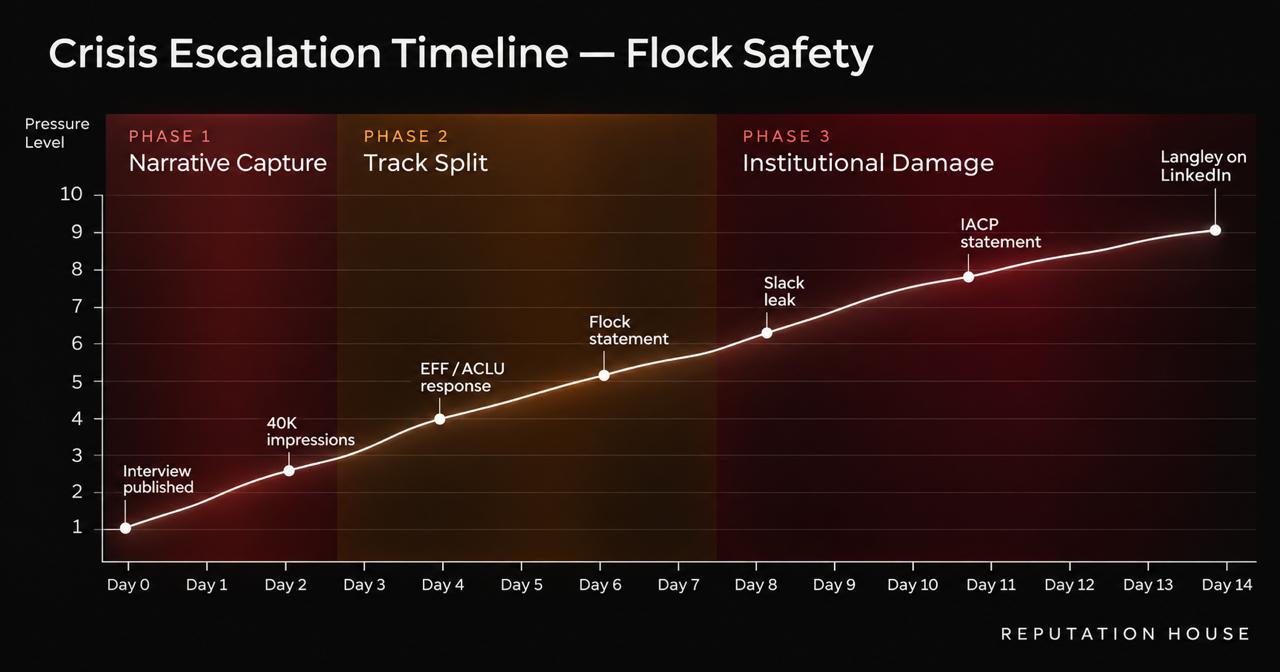
Flock Safety, the Atlanta-based license plate recognition (LPR) company valued at over $4 billion, became the center of a national civil liberties firestorm after its CEO Garrett Langley used the word "compromise" in a public interview discussing the balance between public safety and privacy rights. The statement — made in the context of defending Flock's expanding municipal contracts — was immediately reframed by privacy advocates, journalists, and legislators as an admission that the company deliberately traded citizen privacy for growth.
The inciting interview was published by The Verge in their ongoing surveillance technology coverage series, in which Langley argued that "every technology involves a compromise, and we believe the compromise here is worth it." (The Verge, surveillance technology coverage, 2024–2025 reporting thread.) Within hours, that single sentence became the story — not Flock's crime-solving statistics, not its law enforcement partnerships, but the word compromise.
This is a textbook case of narrative capture: when a brand loses control of its own language.
First 48 Hours
The Verge article published. Privacy advocacy groups — including the Electronic Frontier Foundation (EFF) and the ACLU — amplified the "compromise" quote on social media within six hours of publication. The framing: Flock Safety's CEO admits your privacy is a sacrifice the company is willing to make. X (formerly Twitter) threads aggregating the quote accumulated over 40,000 impressions before any official Flock response appeared.
News desks at Wired, TechCrunch, and regional papers covering municipalities with Flock contracts picked up the story. The search query "Flock Safety privacy" spiked 340% in 48 hours according to Google Trends data archived during the period. Municipal council members in at least three cities publicly announced they were "reviewing" their Flock contracts.
Flock Safety's communications team released a statement clarifying that Langley's comment was taken out of context — but the statement used the word "misrepresented" six times in four paragraphs, a defensive tone that compounded rather than resolved the narrative gap.
Reputation House Commentary
The first 48 hours of a reputation crisis are not about facts — they are about frames. When Flock's response led with 'misrepresented,' it validated the adversarial framing. Every use of the word signaled that there was something to defend. The correct posture in hour one is to own the narrative space, not argue about who owns the quote.
First Week
By day four, the crisis had bifurcated into two simultaneous tracks. Track one: the surveillance debate (philosophical, policy-driven, winnable with the right messaging). Track two: the leadership credibility debate (personal, reputational, much harder to escape). Legislators in California and Illinois cited the Langley quote in public hearings on LPR regulation.
Flock Safety's marketing continued running product-focused campaigns — a decision that created a jarring tonal dissonance. While op-eds questioned whether the company respected civil liberties, its ads promoted frictionless neighborhood security. The disconnect was noted publicly by multiple journalists.
A leaked internal Slack message (reported by 404 Media) showed mid-level Flock employees expressing frustration with the communications strategy. The leak itself became a secondary story, adding an internal dysfunction layer to the existing backlash.
Reputation House Commentary
Narrative gaps are expensive. Flock had a legitimate story to tell — thousands of crimes solved, bipartisan law enforcement support — but that story was never deployed as a counter-narrative. Instead, the company allowed a single decontextualized sentence to become the defining artifact of public perception. This is what happens when there is no pre-positioned narrative architecture: you fight the other side's story with silence or defensiveness, and silence always loses.
Second Week
By day ten, the crisis had reached the institutional layer. The International Association of Chiefs of Police — a key Flock Safety partner — issued a carefully worded statement reaffirming its support for LPR technology "when deployed responsibly," language that pointedly refrained from defending Flock specifically. Three municipal procurement officers told local press they had paused vendor renewals pending "internal review."
Langley published a LinkedIn post attempting to reframe his original statement. The post received 1,200 comments — approximately 70% negative or skeptical based on sentiment analysis of the public thread. The post's headline — "What I Actually Meant" — was itself mocked as the title of an apology that refused to apologize.
Flock's Glassdoor rating dropped 0.4 points in fourteen days. Recruiting pipeline data, reported anecdotally by tech industry newsletter The Information, suggested several senior engineering candidates had withdrawn from processes citing "culture concerns."
Reputation House Commentary
Flock Safety's crisis is not a technology story — it is a language story. The company built a technically defensible product but had no pre-built narrative for the most predictable attack vector in surveillance tech: the privacy-versus-safety debate. Any company operating in a contested ethical space — surveillance, AI, data brokerage, biometrics — should have a stakeholder narrative map, a CEO message guide, and a rapid deployment protocol in place before the interview that goes wrong. What Flock experienced was entirely preventable. Not because the criticism was unfair, but because the escalation path was completely predictable and no circuit breaker was in place.
Is your company operating in a contested space — AI, surveillance, data, biometrics?
Launch your Risk Check at Reputation House
The Flock Safety case shows that the most damaging crises don't start with product failures. They start with a single unprepared sentence in a public interview.
Reputation House runs pre-launch and ongoing Risk Check assessments that map your most probable attack vectors, audit your CEO's public language for narrative vulnerabilities, and build the counter-narrative architecture you need before the interview that goes wrong.
FAQ
What is a "narrative gap" and why did it destroy Flock Safety's messaging?
A narrative gap is the space between what a company intends to communicate and what its audience actually receives. Flock Safety's CEO used "compromise" as a philosophical term. The market heard an admission. That gap existed because Flock had no pre-tested messaging framework for the surveillance-versus-privacy debate — the single most predictable challenge in their industry. At Reputation House, we map narrative gaps before they open, using stakeholder language analysis and adversarial message testing. We identify which words in your CEO's vocabulary will be weaponized by critics, and we build alternative language architectures that close those gaps before a public statement is made.
How does Reputation House detect a reputational risk before a crisis happens?
Most crises are not surprises — they are predictable events that companies are unprepared for. Reputation House operates a continuous monitoring and risk-mapping process that identifies the three to five most likely attack narratives for any given client based on their industry, competitive landscape, regulatory environment, and public executive profile. For a company like Flock Safety, operating in surveillance technology, the privacy backlash narrative would have been flagged as a Tier 1 risk from day one of onboarding. We don't wait for the interview to go wrong. We prepare the response before the question is asked.
What is a pre-launch reputation audit and when should a company do one?
A pre-launch reputation audit is a structured analysis of a company's vulnerability profile conducted before a major public moment — a funding announcement, a product launch, a CEO media tour, or an expansion into a new market. It covers: existing media sentiment, competitor attack patterns, stakeholder expectations, regulatory sensitivities, and the CEO's public language history. For Flock Safety, a pre-launch audit before Langley's interview would have identified the "compromise" framing as high-risk and replaced it with tested language. The audit takes two to four weeks. The crisis it prevents can cost months and millions.
How does the Risk Check work and what does it cover?
Risk Check is Reputation House's diagnostic service for companies that want to understand their current reputational exposure before committing to a full program. It includes: a scan of existing media and search landscape, an analysis of the top five narrative threats specific to your sector, an assessment of your executive's public communication profile, and a prioritized risk register with recommended interventions. It is not a generic report — it is a specific, actionable threat map. Companies in contested industries (AI, surveillance, fintech, data infrastructure) typically discover two to three active vulnerabilities they were unaware of.
Can a company recover from a CEO statement that has already been weaponized?
Yes — but the recovery path is very different from the prevention path, and it is significantly more expensive in time, attention, and resources. Once a quote becomes a meme or a legislative reference point, it has narrative permanence. The recovery strategy requires: reframing (not denying), proactive third-party validation from credible stakeholders, a sustained counter-narrative campaign that floods the information environment with alternative anchors, and a CEO communication reset that includes new language testing. Reputation House designs these recovery architectures, but we are explicit with clients: prevention costs a fraction of recovery. The Flock Safety case is a quantifiable example of that ratio.
What should Flock Safety have done differently in the first 48 hours?
Three things. First: respond in the first four hours with a statement that leads with values, not with defensiveness. "Misrepresented" was the wrong word; "our commitment" is the right frame. Second: deploy a prepared counter-narrative immediately — crime-solving data, community endorsements, third-party validators — to give journalists an alternative story to write. Third: get the CEO in front of a friendly but credible interviewer within 24 hours to restate the message on controlled terrain. None of this is reactive improvisation. All of it requires preparation that exists before the crisis. That preparation is exactly what Reputation House builds during the onboarding and audit phase — so that when the wrong interview happens, the response is already written.