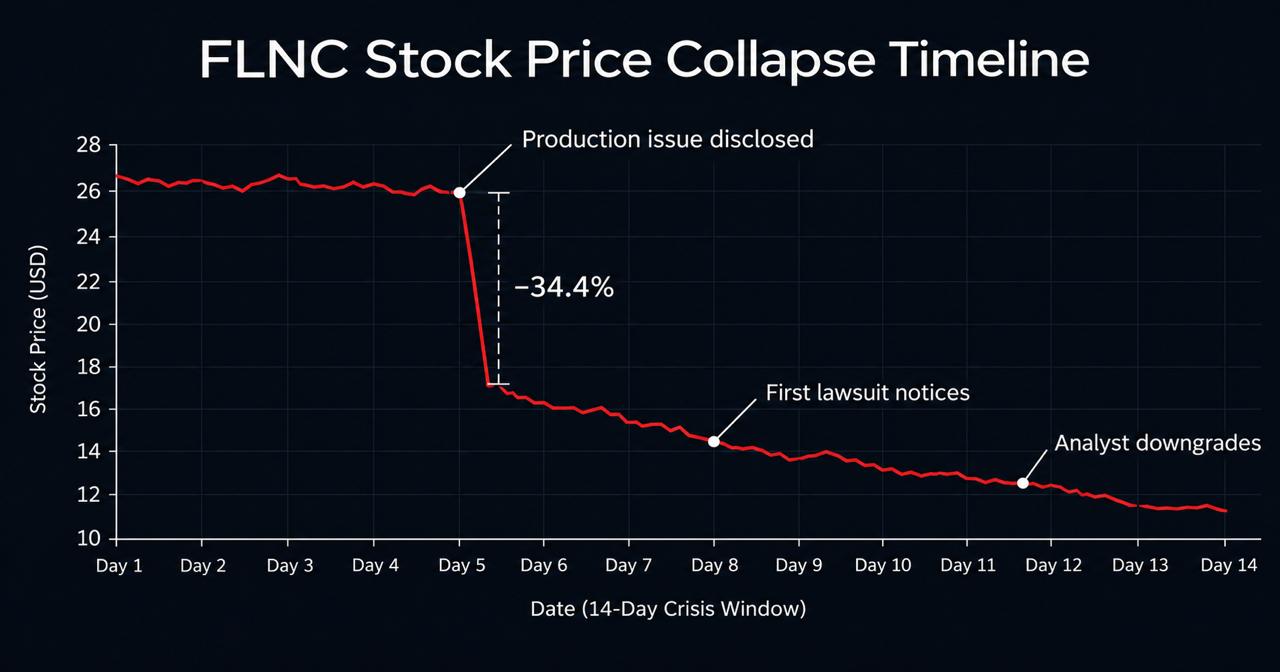
In late 2024, Fluence Energy (NASDAQ: FLNC) — a joint venture between Siemens and AES Corporation specializing in battery energy storage systems — disclosed that it had identified significant manufacturing defects in its battery modules. The company had been aware of quality control issues for months before formal disclosure. When the information finally became public, the stock collapsed by 34.4% in a single session, erasing hundreds of millions in market capitalization. Multiple securities fraud investigations were subsequently opened by law firms including Pomerantz LLP and Levi & Korsinsky, citing the temporal gap between when management allegedly knew about production failures and when investors were informed.
Sources: Reuters coverage of FLNC stock collapse, Pomerantz LLP securities investigation announcement, SEC EDGAR filings FLNC Q4 2024
Sources: Reuters coverage of FLNC stock collapse, Pomerantz LLP securities investigation announcement, SEC EDGAR filings FLNC Q4 2024
First 48 Hours
Fluence Energy released an earnings update acknowledging "manufacturing execution issues" with battery hardware components. The disclosure was buried in financial guidance revisions — revenue projections were slashed, project delivery timelines extended. Markets responded immediately and brutally: FLNC dropped 34.4% intraday. Trading volume spiked to 12× the 30-day average. By end of day one, multiple law firms had issued public notices announcing securities fraud investigations on behalf of shareholders who purchased stock during the period when, allegedly, management held undisclosed knowledge of the defects.
Reputation House Commentary
The 34.4% single-session drop is not a market reaction to a production problem — it's a market reaction to an information asymmetry problem. Investors can price in operational risk. They cannot tolerate learning that management knew something they didn't. The moment a disclosure gap becomes public, the narrative shifts from 'company with a problem' to 'company that hid a problem.' These are categorically different reputation states, and the second one triggers legal exposure on top of reputational damage.
First Week
Analyst downgrades cascaded across the following five trading days. Three major institutional holders filed disclosure of reduced positions. Social and financial media amplified the securities fraud angle — not the operational failure itself — because it carried a stronger narrative hook. Fluence's communications team issued a follow-up statement emphasizing remediation steps and management's commitment to transparency, but the framing had already been set by plaintiff law firms and financial journalists. The company was now playing defense inside a narrative it did not control.
Search volume for "Fluence Energy lawsuit," "FLNC fraud," and "Fluence Energy investigation" increased by 400%+ over baseline within the first seven days. These queries began ranking in the top results for branded searches — meaning any investor, partner, or enterprise procurement lead searching the company name was immediately exposed to litigation framing.
Search volume for "Fluence Energy lawsuit," "FLNC fraud," and "Fluence Energy investigation" increased by 400%+ over baseline within the first seven days. These queries began ranking in the top results for branded searches — meaning any investor, partner, or enterprise procurement lead searching the company name was immediately exposed to litigation framing.
Second Week
By the second week, the reputational damage had migrated from financial media into industry press covering the energy storage sector. Project partners and potential enterprise clients began citing due diligence concerns in procurement conversations. The company's pipeline — already disrupted by the production issue itself — now faced a secondary obstruction: reputational uncertainty in B2B sales cycles where trust is a procurement criterion. A competitor analysis piece in PV Tech noted Fluence's disclosure timeline as a cautionary example for the sector.
Reputation House Commentary
What makes this case structurally dangerous is the two-vector damage pattern. Vector one: the production defect, which is a manageable operational crisis with a defined remediation path. Vector two: the information gap narrative, which has no clean technical fix — it lives in perception, in legal filings, in Google search results, and in the minds of procurement decision-makers. Our monitoring work consistently shows that narrative contamination in B2B contexts outlasts the original incident by 18–36 months. The FLNC case follows this pattern exactly.
The Information Vacuum Mechanism
The core mechanism here is what reputation risk analysts call a narrative gap — the space between when an organization knows something material and when that information becomes public. In Fluence's case:
This is a predictable failure mode for companies in capital-intensive hardware sectors where: (a) production issues are discovered gradually, (b) legal and IR teams advocate for delayed disclosure pending full assessment, and (c) the "full assessment" period creates an information asymmetry that plaintiff attorneys treat as evidence of intent.
- Production defects identified internally → weeks or months of internal handling
- Guidance revision and public disclosure → single earnings event
- Securities litigation framing → within 24 hours of disclosure
This is a predictable failure mode for companies in capital-intensive hardware sectors where: (a) production issues are discovered gradually, (b) legal and IR teams advocate for delayed disclosure pending full assessment, and (c) the "full assessment" period creates an information asymmetry that plaintiff attorneys treat as evidence of intent.
The Prevention Point
The prevention point was not at disclosure — it was 60–90 days before disclosure, when internal signals of production quality deviation first appeared in operational data.
A pre-disclosure reputation audit at that stage would have identified:
A pre-disclosure reputation audit at that stage would have identified:
- Disclosure timeline risk — the legal and reputational cost of phased vs. simultaneous disclosure
- Narrative pre-positioning — building a documented public record of proactive quality management before any forced disclosure
- Search landscape mapping — identifying what queries would spike in a worst-case scenario and pre-populating those result pages with authoritative content
- Stakeholder sequencing — determining which institutional investors, analysts, and key clients needed direct contact prior to any public filing
Reputation House Commentary
We conduct pre-launch and pre-disclosure reputation audits specifically to identify this window. Companies routinely spend months on legal review of disclosure language and zero time on the reputational architecture around that disclosure. The result is technically compliant announcements that are reputationally catastrophic. The Fluence case is a clean illustration: the press release language was careful; the perception outcome was devastating. Those two things coexist because legal compliance and reputation management operate on entirely different logic.
The Cost of Inaction
- Market cap loss (single session): ~$400M+
- Securities litigation exposure: Ongoing / unquantified
- Analyst coverage downgrades: 3+ firms within 7 days
- B2B pipeline disruption: Unquantified / multi-quarter
- Search narrative contamination: 18–36 month remediation horizon
- Cost of pre-disclosure reputation audit: Fraction of one day's market cap loss
Your company's production data, disclosure timeline, and search landscape already contain signals of reputation risk — most leadership teams never see them until it's too late.
Run a Risk Check with Reputation House before the narrative gap opens
FAQ
What is a narrative gap, and why is it more dangerous than the underlying business problem?
A narrative gap is the period between when an organization possesses material information and when that information enters the public domain. During this window, the organization operates with knowledge that external stakeholders — investors, partners, clients, journalists — do not have. When the gap closes (through forced disclosure, leaks, or regulatory filing), the gap itself becomes the story. Markets and media don't just price the operational problem; they price the concealment. At Reputation House, we map these windows as part of pre-disclosure audits, identifying the exact moment when silence transitions from prudent to legally and reputationally toxic. The gap is manageable if identified early. It becomes unmanageable once it's discovered externally.
How does Reputation House detect reputation risk before a crisis becomes public?
We operate continuous monitoring across financial media, legal filing databases, analyst research, social platforms, and search query patterns. For companies in capital-intensive sectors, we track anomaly signals: spikes in branded negative queries, emergence of litigation-adjacent language in financial forums, shifts in analyst tone before formal downgrades. These signals consistently appear 30–90 days before a public crisis event. Our pre-crisis detection work is designed to give leadership teams a decision window — not just an alert. Detection without actionable intelligence is noise. We provide the intelligence architecture to act on what we find.
What is a pre-launch or pre-disclosure reputation audit, and what does it actually produce?
A pre-disclosure reputation audit is a structured analysis of the reputational landscape surrounding a planned disclosure event — earnings release, product launch, regulatory filing, or executive transition. It produces four outputs: (1) a search narrative map showing what queries will spike and what content currently owns those results; (2) a stakeholder risk matrix identifying which audiences are most exposed to narrative contamination; (3) a disclosure sequencing recommendation specifying which stakeholders need direct contact before public filing; and (4) a content pre-positioning plan that establishes authoritative narrative presence in anticipation of scrutiny. Companies that commission this work before a forced disclosure consistently experience materially shorter recovery timelines than those that don't.
How does Reputation House's Risk Check work, and what does a company receive?
Risk Check is our entry-point diagnostic — a structured assessment of a company's current reputation exposure across search, media, legal, and social vectors. It identifies active risks (existing negative narratives in ranked positions), latent risks (signals that indicate emerging threats not yet visible in mainstream coverage), and structural vulnerabilities (disclosure patterns, communication gaps, or search landscape weaknesses that create predictable crisis pathways). The output is a prioritized risk register with specific remediation recommendations, not a generic report. It's designed for decision-makers who need to understand their actual exposure, not a theoretical overview of what reputation risk is.
Could Fluence Energy's reputational damage have been prevented, or only mitigated?
In our assessment, the B2B pipeline disruption and search narrative contamination were largely preventable. The market cap loss from the operational disclosure itself was probably unavoidable — markets reprice on material information. But the securities fraud narrative, the litigation framing, and the 18–36 month search contamination horizon were products of the information gap, not the battery defect. A pre-disclosure strategy that established a documented public record of proactive quality management, combined with controlled stakeholder communication sequencing, would have materially changed the framing available to plaintiff attorneys and financial journalists. Prevention is about changing the narrative architecture before the crisis event — not about controlling the news after it breaks.
What makes reputation risk in B2B contexts different from consumer-facing reputation damage?
In B2B contexts — particularly enterprise sales, infrastructure procurement, and capital equipment — trust is an explicit procurement criterion. Buyers conduct diligence on vendors; procurement committees review publicly available information; legal teams search for litigation history. This means that negative search results and litigation narratives directly interfere with pipeline conversion at a structural level, not just at the level of general brand perception. A consumer brand can survive a news cycle; a B2B vendor with "securities fraud investigation" ranking in branded search results faces a 12–36 month headwind in every enterprise sales conversation. Reputation House's B2B reputation work is calibrated specifically for this dynamic — we focus on the search and information environments that procurement decision-makers actually use.