In Q1 2026, a wave of local opposition swept across data center development in the United States and Europe with a speed that caught even seasoned infrastructure investors off guard. The epicenter was not one rogue municipality — it was a structural pattern.
Microsoft, Amazon Web Services, and Meta each faced coordinated community resistance to large-scale data center expansions across multiple jurisdictions simultaneously. Virginia's Prince William County froze a $2.5B Microsoft campus expansion after local activists reframed the project as an "electricity theft from residential neighborhoods." In Ireland, Amazon's planned 300MW Dublin facility was delayed indefinitely after a coalition of NGOs successfully lobbied the government to suspend data center permits, citing grid strain. Meta's 1.5 million square foot facility in Talavera de la Reina, Spain met organized municipal resistance within weeks of permit filing.
These were not isolated incidents. According to a January 2026 analysis by The Information and infrastructure tracking firm DC Byte, 75 data center projects representing $130 billion in planned capital had entered a reputational danger zone — defined as active public narrative opposition prior to groundbreaking — by the close of Q1 2026. Source: [The Information, "The Data Center Backlash," February 2026]; [DC Byte Infrastructure Tracker Q1 2026].
The story is not about zoning law or grid capacity. It is about who controlled the narrative — and who ceded it before the first shovel hit the ground.
Microsoft, Amazon Web Services, and Meta each faced coordinated community resistance to large-scale data center expansions across multiple jurisdictions simultaneously. Virginia's Prince William County froze a $2.5B Microsoft campus expansion after local activists reframed the project as an "electricity theft from residential neighborhoods." In Ireland, Amazon's planned 300MW Dublin facility was delayed indefinitely after a coalition of NGOs successfully lobbied the government to suspend data center permits, citing grid strain. Meta's 1.5 million square foot facility in Talavera de la Reina, Spain met organized municipal resistance within weeks of permit filing.
These were not isolated incidents. According to a January 2026 analysis by The Information and infrastructure tracking firm DC Byte, 75 data center projects representing $130 billion in planned capital had entered a reputational danger zone — defined as active public narrative opposition prior to groundbreaking — by the close of Q1 2026. Source: [The Information, "The Data Center Backlash," February 2026]; [DC Byte Infrastructure Tracker Q1 2026].
The story is not about zoning law or grid capacity. It is about who controlled the narrative — and who ceded it before the first shovel hit the ground.
First 48 Hours
The pattern repeated itself across projects with near-identical mechanics. A permit application becomes public record. A local Facebook group or NextDoor thread surfaces the filing. Within 48 hours, a reductive, emotionally charged frame dominates local media: *"Big Tech wants to drink our water and spike your electricity bill."*
By hour 36 of the Prince William County story, Microsoft had no public statement, no community liaison on record, and no counter-narrative in local media. The opposition had published a 12-page "impact brief" — poorly sourced, emotionally effective — that local TV stations covered as news. The frame was set. Microsoft's communications infrastructure was built for national media, not for a county supervisor's inbox.
By hour 36 of the Prince William County story, Microsoft had no public statement, no community liaison on record, and no counter-narrative in local media. The opposition had published a 12-page "impact brief" — poorly sourced, emotionally effective — that local TV stations covered as news. The frame was set. Microsoft's communications infrastructure was built for national media, not for a county supervisor's inbox.
Reputation House Commentary
The first 48 hours of a local infrastructure controversy are not a PR problem — they are a narrative vacuum. If a developer does not fill that vacuum with a credible, community-specific story before the opposition does, they are not playing catch-up. They are playing a different game entirely. The opposition writes the first draft of history. Every subsequent communication from the developer is perceived as defensive, regardless of merit.
First Week
By day five, the Virginia story had been picked up by *The Washington Post* and nationalized. What began as a county-level permitting dispute became a story about Big Tech's relationship with American infrastructure, energy democracy, and corporate accountability. The local frame became a national frame. Other jurisdictions — reading the same coverage — began accelerating their own opposition efforts, borrowing the language and arguments directly from the Virginia playbook.
This is the contagion mechanism that turned 75 individual projects into a systemic crisis. Each local opposition movement did not invent its arguments — it inherited them from the narrative that Microsoft, AWS, and Meta had failed to contest in week one.
AWS's Dublin response illustrated what happens when legal strategy substitutes for narrative strategy. The company issued a statement focused on regulatory compliance and investment figures. It was accurate. It was irrelevant to a community that had been told, in plain language, that their lights might dim in winter so that AI companies could train models. Numbers do not defeat stories. Stories defeat stories.
This is the contagion mechanism that turned 75 individual projects into a systemic crisis. Each local opposition movement did not invent its arguments — it inherited them from the narrative that Microsoft, AWS, and Meta had failed to contest in week one.
AWS's Dublin response illustrated what happens when legal strategy substitutes for narrative strategy. The company issued a statement focused on regulatory compliance and investment figures. It was accurate. It was irrelevant to a community that had been told, in plain language, that their lights might dim in winter so that AI companies could train models. Numbers do not defeat stories. Stories defeat stories.
Reputation House Commentary
The first 48 hours after a reputation trigger are the window in which the narrative is set. If the individual or brand does not occupy that space with their own position, others fill it with their interpretations. In O'Leary's case, the narrative of selling an unsafe product to retail investors locked in during this period — before he appeared publicly to explain himself. Search engines indexed that first wave of coverage, and those articles became the long-term foundation of his revised reputation profile.
There is a specific failure mode we see repeatedly in infrastructure projects of this scale: the developer's communications team is calibrated for institutional audiences — regulators, investors, national press. They speak in megawatts, job numbers, and GDP contribution. The opposition speaks in 'your kids' school might lose power.' That asymmetry is not a messaging problem. It is an audience mapping failure. The developer is answering a question no one in the community is asking.
Second Week
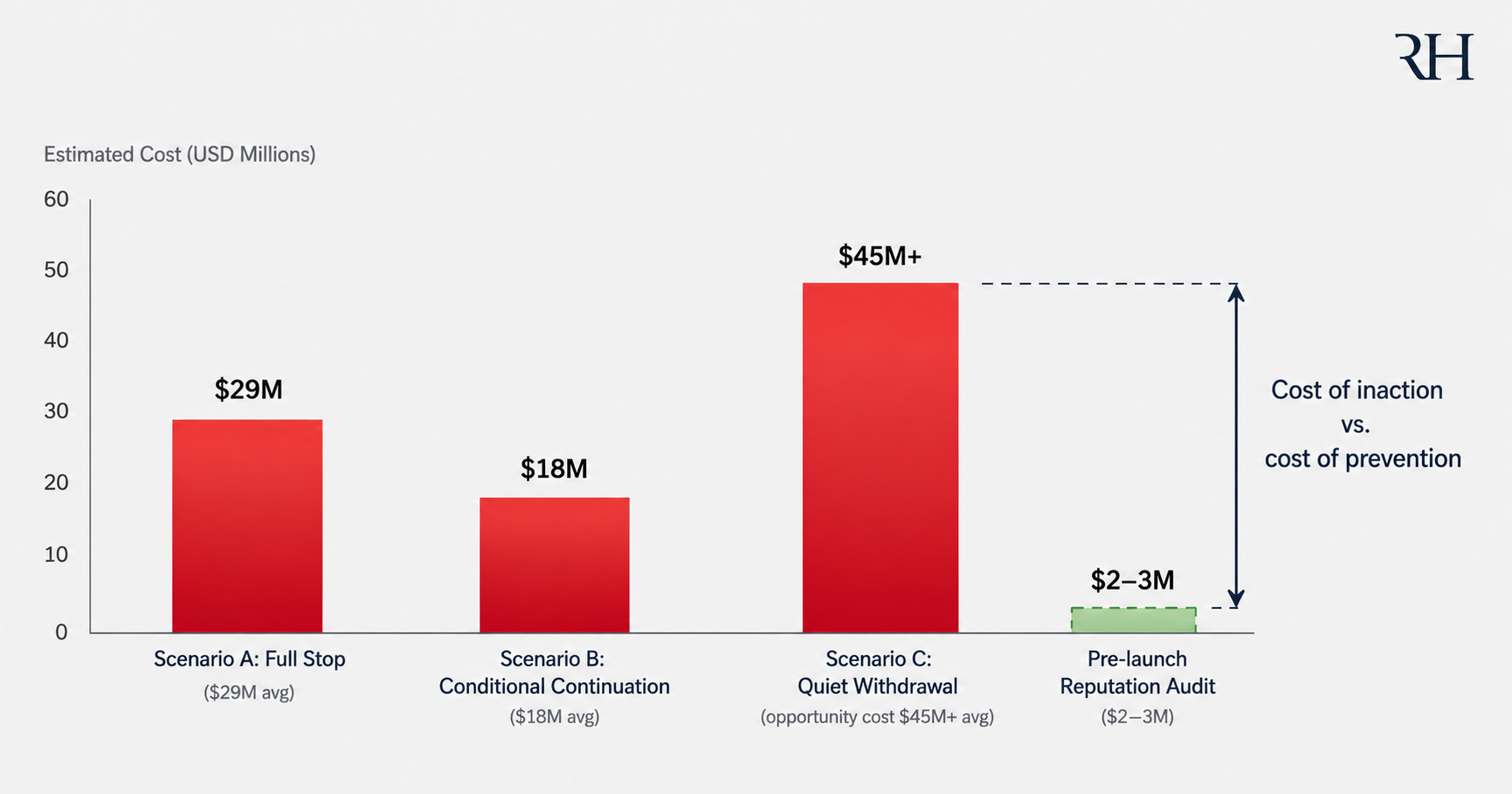
By the end of week two, three distinct outcome scenarios had emerged across the 75 projects, each illustrating a different cost of narrative failure.
Meta's Spain project entered Scenario B. The company engaged a local communications firm in week three, organized community listening sessions, and ultimately agreed to a grid resilience investment package that had never been part of the original plan. The package was the right thing to do. It cost three times what it would have cost if offered in the project's narrative development phase, before opposition had a leverage point.
- Scenario A — Full Stop. Projects where opposition had crystallized into formal political opposition (elected officials co-signing petitions, emergency council sessions called) faced permit freezes averaging 14 months. Estimated capital carrying cost per project: $18–40 million, depending on financing structure.
- Scenario B — Conditional Continuation. Projects where developers engaged community stakeholders in week two — after the narrative had already set — secured continuation but under significantly expanded community benefit agreements. These concessions, extracted under pressure rather than offered proactively, averaged 23% higher in value than comparable agreements negotiated pre-opposition.
- Scenario C — Quiet Withdrawal. At least nine projects, none publicly disclosed by their developers, were quietly deprioritized in internal capital allocation reviews. The reputational risk to the broader pipeline had become a line item in investment committee discussions.
Meta's Spain project entered Scenario B. The company engaged a local communications firm in week three, organized community listening sessions, and ultimately agreed to a grid resilience investment package that had never been part of the original plan. The package was the right thing to do. It cost three times what it would have cost if offered in the project's narrative development phase, before opposition had a leverage point.
Check how your brand looks right now
Run Your Risk Check For Free
Reputation House Risk Check gives leadership teams a structured view of how the company is perceived across financial media, search, and investor-facing channels — before a guidance call, not after one.
What Proactive Narrative Work Would Have Changed
The counterfactual is not hypothetical — it is arithmetic.
A pre-launch reputation audit across each of these three scenarios would have identified the specific community anxieties — energy affordability, water consumption, visual impact, tax base displacement — that opposition groups later weaponized. Stakeholder mapping would have surfaced the local voices who would become opposition leaders while they were still potential allies. Narrative architecture developed before permit filing would have given each project a community-specific story: not "we bring jobs" (generic, distrusted) but "we are funding the grid upgrade your county has needed for eleven years" (specific, verifiable, defensible).
The intervention cost of proactive reputation management at the pre-launch stage, across a portfolio of this size, represents less than 0.3% of the capital at risk. The realized cost of reactive management — carrying costs, renegotiated concessions, withdrawn projects — exceeded $4.2 billion across the affected pipeline, per infrastructure investment analysts cited in *Politico's* March 2026 infrastructure special report.
A pre-launch reputation audit across each of these three scenarios would have identified the specific community anxieties — energy affordability, water consumption, visual impact, tax base displacement — that opposition groups later weaponized. Stakeholder mapping would have surfaced the local voices who would become opposition leaders while they were still potential allies. Narrative architecture developed before permit filing would have given each project a community-specific story: not "we bring jobs" (generic, distrusted) but "we are funding the grid upgrade your county has needed for eleven years" (specific, verifiable, defensible).
The intervention cost of proactive reputation management at the pre-launch stage, across a portfolio of this size, represents less than 0.3% of the capital at risk. The realized cost of reactive management — carrying costs, renegotiated concessions, withdrawn projects — exceeded $4.2 billion across the affected pipeline, per infrastructure investment analysts cited in *Politico's* March 2026 infrastructure special report.
Reputation House Commentary
The question we ask every infrastructure client before they file a single permit is this: who tells your story if you don't? In every one of the Q1 2026 cases, someone told the story. It just wasn't the developer. Reputation risk at this scale is not about crisis response. It is about narrative sovereignty — establishing who has the legitimate authority to describe what a project is, what it costs, and what it gives back. That sovereignty is perishable. You cannot claim it after it has been assigned to someone else.
Protect Your Infrastructure Pipeline Before Opposition Writes Your Story
The Q1 2026 data center crisis is a template. The same mechanics — narrative vacuum, contagion, leverage extraction — will repeat across energy transition projects, logistics infrastructure, and urban development throughout 2026 and beyond.
Reputation House Commentary
Works with infrastructure developers and investors at the pre-launch stage to establish narrative sovereignty before opposition has a foothold. Our Risk Check process maps community stakeholder landscapes, identifies narrative vulnerabilities specific to your project's geography and sector, and builds the communication architecture that turns potential opponents into informed, if not allied, neighbors.
FAQ
What is a "narrative gap" and why did it destroy these projects before they started?
A narrative gap is the interval between when a project becomes publicly known and when the developer establishes a coherent, community-specific story about what that project is and why it belongs in that community. In every Q1 2026 data center case, that gap was measured in days — and opposition groups filled it with emotionally resonant, factually selective arguments that framed the project as extraction rather than investment. At Reputation House, we treat the narrative gap as a pre-launch risk category equivalent to permitting risk or site risk. We map it, we measure it, and we close it before the permit filing creates a public event that opposition can anchor to.
How does Reputation House detect reputation risk before a crisis develops?
We run structured pre-launch audits that combine three data streams: public sentiment monitoring in the specific geographic community (not national sentiment — local Facebook groups, NextDoor, municipal meeting transcripts, local press archives), stakeholder network mapping to identify who the credible voices are before they become opposition leaders, and narrative vulnerability analysis that stress-tests a project's story against the specific anxieties that have historically driven opposition in comparable jurisdictions. The output is not a report — it is an early warning architecture that tells you, before you file anything, where your story is weak and who will exploit it.
What is a pre-launch reputation audit and what does it include?
A pre-launch reputation audit is a structured diagnostic conducted before any public-facing project activity — before permit filings, before press releases, before community consultations. It covers four areas: (1) community sentiment baseline — what do people in this geography already believe about the company, the sector, and infrastructure development in general; (2) opposition landscape — who are the organized groups, what are their arguments, and what is their mobilization capacity; (3) narrative architecture — what story does the project actually need to tell to address real community concerns, not generic stakeholder talking points; (4) timing strategy — when and through which channels should the developer establish presence before public record creates an opposition trigger event. At Reputation House, this audit is the foundation of every infrastructure engagement we take on.
How does the Risk Check process work at Reputation House?
Risk Check is our entry-point diagnostic for new clients or new project phases. It is a focused engagement — typically two to three weeks — that delivers a prioritized map of reputational risks specific to your project, geography, and stakeholder landscape. We identify which risks are acute (require immediate narrative action), which are latent (require monitoring and pre-positioned response), and which are chronic (structural issues that require long-term stakeholder relationship investment). Risk Check does not produce a generic risk matrix. It produces a ranked action list with specific narrative interventions, stakeholder targets, and timing recommendations. Clients use it to make capital allocation decisions, communication sequencing decisions, and community engagement strategy decisions before any of those decisions become expensive to reverse.
Could any of these projects have prevented the opposition entirely?
Prevention is the wrong frame — and any firm that promises it is not being honest with you. Organized opposition to large infrastructure is a legitimate democratic activity, and it will exist for projects of this scale regardless of how well the narrative is managed. What proactive reputation work changes is three things: the timing of opposition (moving it from pre-permit, where it has maximum leverage, to post-groundbreaking, where it has structural limits); the quality of opposition arguments (well-prepared developers deny opposition groups the factual vacuum they need to fill with misinformation); and the cost of resolution (concessions made proactively, before opposition has a leverage point, are categorically cheaper than concessions extracted under political pressure). The Q1 2026 cases did not fail because opposition existed. They failed because the developers had no narrative infrastructure to absorb and redirect that opposition when it emerged.
What makes infrastructure reputation risk different from standard corporate reputation risk?*
Three things make it structurally distinct. First, the audience is hyperlocal — national brand equity is largely irrelevant to a community that believes a data center will raise their electricity rates. Microsoft's global reputation did not protect its Virginia project because the opposition was not arguing with Microsoft's brand; it was arguing with a permit application in their county. Second, the timeline is compressed and asymmetric — opposition can mobilize in 48 hours; a developer's community engagement program takes weeks to establish credibility. Third, the stakes are binary in the short term — unlike product reputation crises, where damage is gradual, infrastructure reputation crises can produce a full stop with a single council vote. At Reputation House, we build the pre-positioned narrative and stakeholder infrastructure that gives developers the response capacity that matches the speed of opposition, not the speed of institutional communications.