In late 2022 and through 2023, Rackspace Technology — once the gold standard of managed cloud hosting — pivoted its entire public narrative around artificial intelligence. Press releases, earnings calls, and investor materials were saturated with AI-forward language: "AI-powered infrastructure," "intelligent cloud solutions," "the future of managed AI workloads." The pivot sounded ambitious. The financials told a different story.
When Rackspace reported Q3 2023 earnings, analysts and investors discovered that the AI narrative had no corresponding ROI architecture behind it. Revenue continued to decline. The company had simultaneously been navigating the fallout from a catastrophic ransomware attack in late 2022 that knocked its hosted Microsoft Exchange environment offline for weeks, affecting tens of thousands of customers. Rather than anchoring communications to recovery and rebuilt trust, Rackspace's leadership doubled down on AI-forward positioning — a narrative that its financial results simply couldn't support.
The result: shares dropped approximately 33% within a single week following earnings disclosure, erasing hundreds of millions in market capitalization.
First 48 Hours
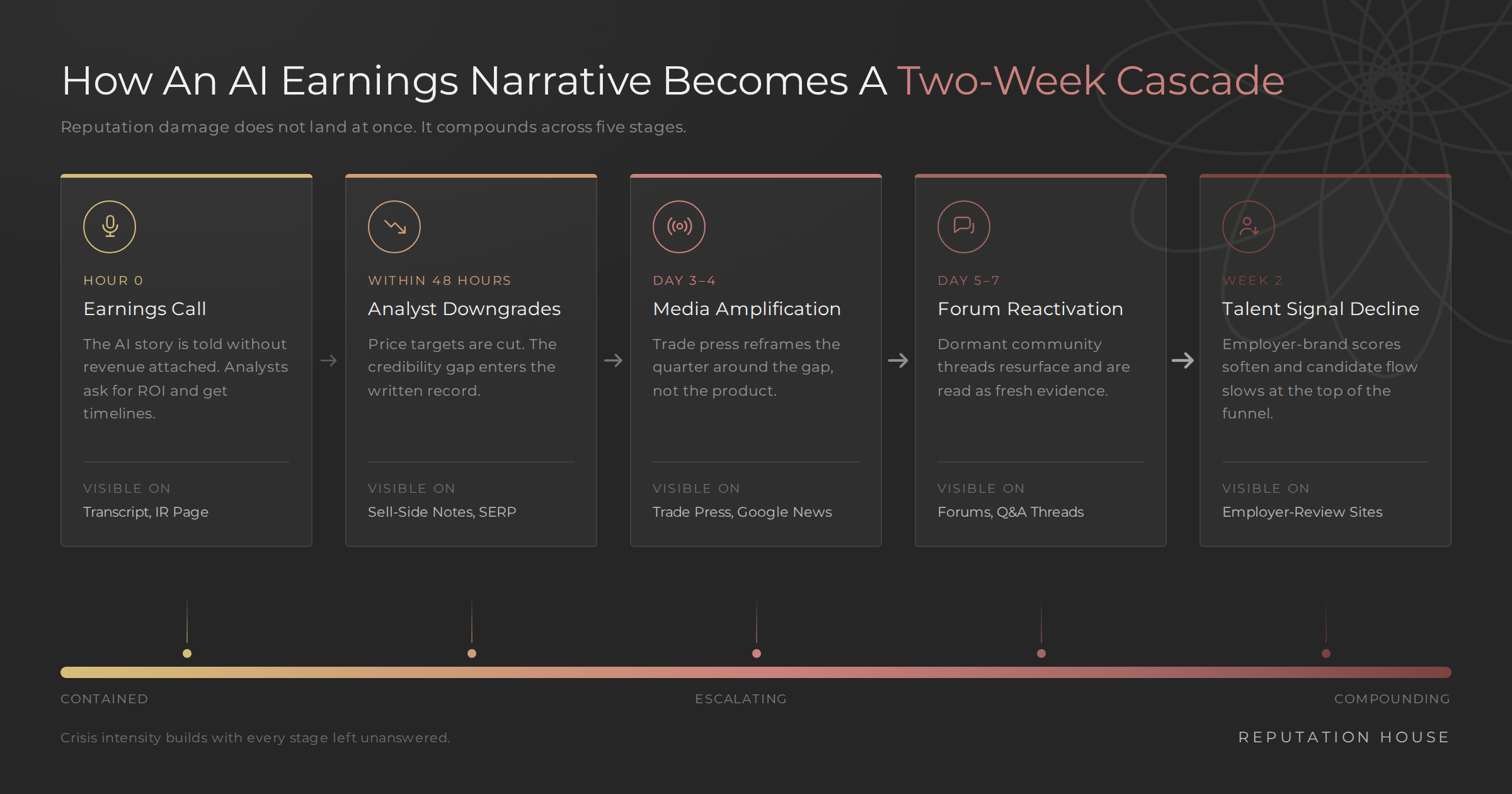
Rackspace released its Q3 2023 earnings after market close. Revenue figures missed analyst consensus. On the earnings call, executive language remained heavily AI-centric — management referenced AI opportunities no fewer than fourteen times in prepared remarks. Analysts pushed back in the Q&A: *Where is the revenue tied to AI initiatives? What is the timeline to monetization?* Answers were vague. Within hours of the call ending, financial media began publishing headlines framing the company's AI narrative as detached from commercial reality. Shares opened the following morning down over 18%.
Social sentiment on financial platforms — StockTwits, Reddit's r/investing, X/Twitter — shifted sharply negative. The phrase "AI narrative without numbers" began circulating. Short interest in Rackspace stock visibly increased in real-time tracking tools.
Reputation House Commentary
The first 48 hours of an earnings-driven reputation crisis are almost entirely determined by what was said in the 90 days before earnings. Rackspace had built an AI narrative that created investor expectations it couldn't meet. That's not a communications failure at the earnings call — it's a narrative architecture failure months earlier. The gap between the story told and the results delivered is what we call a narrative gap, and it compounds faster than any single negative headline.
First Week
By day three, institutional analysts began downgrading the stock. Wells Fargo, Citi, and other covered analysts revised price targets downward. Each downgrade came with language that specifically called out the disconnect between AI messaging and actual revenue contribution. The media cycle expanded: *The Wall Street Journal*, *Bloomberg*, and *TechCrunch* all ran pieces examining whether Rackspace's AI pivot was substance or spin.
Customer forums and IT community boards — Spiceworks, Reddit's r/sysadmin — reignited discussions about the 2022 ransomware incident, which had never been fully resolved in the court of public opinion. The AI narrative, far from distracting from past damage, appeared to many observers as an attempt to paper over it. Trust erosion compounded across two separate audiences simultaneously: investors and enterprise customers.
By end of week one, the stock had declined approximately 33% from pre-earnings levels.
Customer forums and IT community boards — Spiceworks, Reddit's r/sysadmin — reignited discussions about the 2022 ransomware incident, which had never been fully resolved in the court of public opinion. The AI narrative, far from distracting from past damage, appeared to many observers as an attempt to paper over it. Trust erosion compounded across two separate audiences simultaneously: investors and enterprise customers.
By end of week one, the stock had declined approximately 33% from pre-earnings levels.
Check how your brand looks right now
Run Your Risk Check For Free
Reputation House Risk Check gives leadership teams a structured view of how the company is perceived across financial media, search, and investor-facing channels — before a guidance call, not after one.
Second Week
Rackspace issued a supplementary investor communication attempting to clarify its AI roadmap and timeline. The release was technically detailed but arrived too late to interrupt the narrative already in motion. Financial media treated it as defensive. Analyst notes described it as "incremental" rather than substantive. No meaningful stock recovery occurred in the immediate term.
Internal signals emerged via LinkedIn and Glassdoor: employee sentiment data showed increased negative posts from current and former Rackspace staff referencing uncertainty about company direction. Talent platform signals reinforced the external narrative rather than counteracting it.
Internal signals emerged via LinkedIn and Glassdoor: employee sentiment data showed increased negative posts from current and former Rackspace staff referencing uncertainty about company direction. Talent platform signals reinforced the external narrative rather than counteracting it.
Reputation House Commentary
A supplementary investor release issued after a 33% drawdown is reactive crisis management at its most ineffective. The mechanism here is predictable: when a gap exists between narrative and evidence, and that gap becomes visible to the market, any subsequent communication is filtered through skepticism. Credibility, once spent, cannot be reclaimed by volume of words. What Rackspace needed was a pre-earnings narrative audit — a structured process that maps every public claim against available financial evidence, and identifies exposure before the call, not after.
What RH Would Have Done at Each Stage
- Pre-narrative launch (90 days before earnings): Conducted a pre-launch reputation audit mapping AI claims against verified revenue data, customer proof points, and analyst expectations. Any claim without three-point evidential support would have been flagged for revision or removal before publication.
- During the narrative build period: Monitored narrative gap indicators — tracking the spread between public AI messaging frequency and actual analyst sentiment scores. An early divergence signal would have triggered a recalibration brief to communications and IR teams.
- Pre-earnings: Prepared a structured Q&A matrix anticipating every ROI-related question, with honest, specific answers. No vague timelines. No unanswered analyst questions.
- Immediately post-earnings: Activated rapid-response sentiment monitoring across financial media, social platforms, and analyst notes. The first 6 hours post-call are when narratives crystallize. Intervention at that window, through targeted factual briefings to key analysts, can interrupt compounding.
Reputation House Commentary
Enterprise companies launching AI narratives in 2024–2026 face a specific and underappreciated risk: AI is now a credibility-tested claim, not a credibility-building one. Investors, analysts, and customers have seen enough AI pivots without revenue to be skeptical by default. If your AI story doesn't come with numbers, timelines, and customer proof points, the market will assign its own interpretation — and it won't be generous.
Is your company's AI narrative backed by evidence the market can verify?
Launch your Risk Check
Before your next earnings call, investor presentation, or product launch — run a structured exposure assessment.
The Rackspace Lesson
The Rackspace case is not primarily a story about a ransomware attack, or even about declining revenue. It is a story about what happens when a company builds a public narrative on terrain it cannot defend when pressure is applied. AI-forward positioning in 2023–2026 carries a specific credibility premium: the market has seen enough pivots to demand proof. When proof is absent, the narrative itself becomes the liability.
The 33% decline was not caused by one bad quarter. It was caused by the distance between what was promised and what was delivered — a distance that accumulated over months of unchecked narrative construction.
The 33% decline was not caused by one bad quarter. It was caused by the distance between what was promised and what was delivered — a distance that accumulated over months of unchecked narrative construction.
FAQ
What is a narrative gap, and how does it create financial risk?
A narrative gap is the measurable distance between what a company claims publicly and what its financial or operational results can substantiate. In Rackspace's case, the gap was between an AI-forward narrative and revenue figures that showed no AI-driven growth. Narrative gaps are not just a PR problem — they function as deferred credibility debt. The wider the gap grows, the more severe the correction when results are disclosed. At Reputation House, we quantify narrative gaps before they reach market visibility, mapping every public claim against three-point evidential support: financial data, customer proof points, and analyst alignment. Companies that audit this gap proactively can either close it with real evidence or recalibrate their narrative before exposure.
How does Reputation House detect reputation risk before a crisis like this occurs?
We run continuous narrative monitoring across financial media, analyst note databases, investor social platforms, and community forums relevant to a client's sector. Our detection model looks for divergence signals — moments when public narrative sentiment and financial signal sentiment begin moving in opposite directions. For an AI-positioned company, that means tracking how frequently AI claims are appearing in communications versus how frequently those claims are being challenged or left unaddressed in analyst Q&A. Early divergence — detected weeks or months before an earnings event — gives leadership time to act. Late detection, as Rackspace demonstrated, leaves only reactive options, which rarely work.
What is a pre-launch reputation audit, and when should a company do one?
A pre-launch reputation audit is a structured review of all planned public communications — press releases, investor materials, earnings scripts, product announcements — conducted before those materials are published. The audit maps every forward-looking or capability claim against available evidence, identifies the claims most likely to be challenged by analysts or journalists, and produces a risk-ranked exposure report. For companies pivoting to AI narratives, this is essential before any earnings call where AI is positioned as a growth driver. The ideal timing is 60–90 days before a major public communication event — early enough to make substantive changes, not just cosmetic ones.
How does the Risk Check at reputation.house work?
Risk Check is Reputation House's structured intake assessment for companies that want to understand their current reputation exposure before it becomes a crisis. It begins with a discovery review of your existing public narrative — website, press materials, recent media coverage, earnings transcripts — and maps it against your industry's current credibility benchmarks. You receive a scored exposure report identifying your highest-risk narrative claims, the platforms where those claims are most visible, and the scenarios under which they could become liabilities. For AI-positioned companies specifically, we assess ROI claim exposure, analyst sentiment alignment, and community forum risk. The process typically takes one to two weeks and produces an actionable brief, not a generic report.
Could this have been prevented entirely, or just mitigated?
Prevention was possible, but it required intervention at the narrative architecture stage — not the crisis response stage. The specific error Rackspace made was allowing an AI narrative to compound over multiple quarters without building the evidential foundation to support it. At the point of earnings disclosure, the gap was too wide to bridge with communications alone. Prevention would have meant either: (a) building genuine AI revenue proof points before making AI-forward claims at scale, or (b) calibrating the narrative to match the actual stage of AI integration — framing it as investment and roadmap rather than current capability. Mitigation, once the gap became public, would have required immediate, specific, credible data — not a supplementary release twelve days later.
What makes AI narratives specifically higher-risk than other technology pivots?
AI has crossed what we call the credibility threshold — it has been claimed so frequently, by so many companies with so few verifiable results, that investors and analysts now apply a default skepticism to AI-forward positioning that didn't exist for cloud, digital transformation, or mobile-first narratives in their early cycles. This means the evidentiary bar is higher. A claim that would have been accepted as forward-looking guidance in 2019 is treated as a testable assertion in 2025. Any company positioning AI as a growth driver — rather than a cost efficiency tool with specific, measurable savings — is operating in elevated narrative risk territory. Reputation House's AI narrative review specifically scores claims against this shifted credibility benchmark.