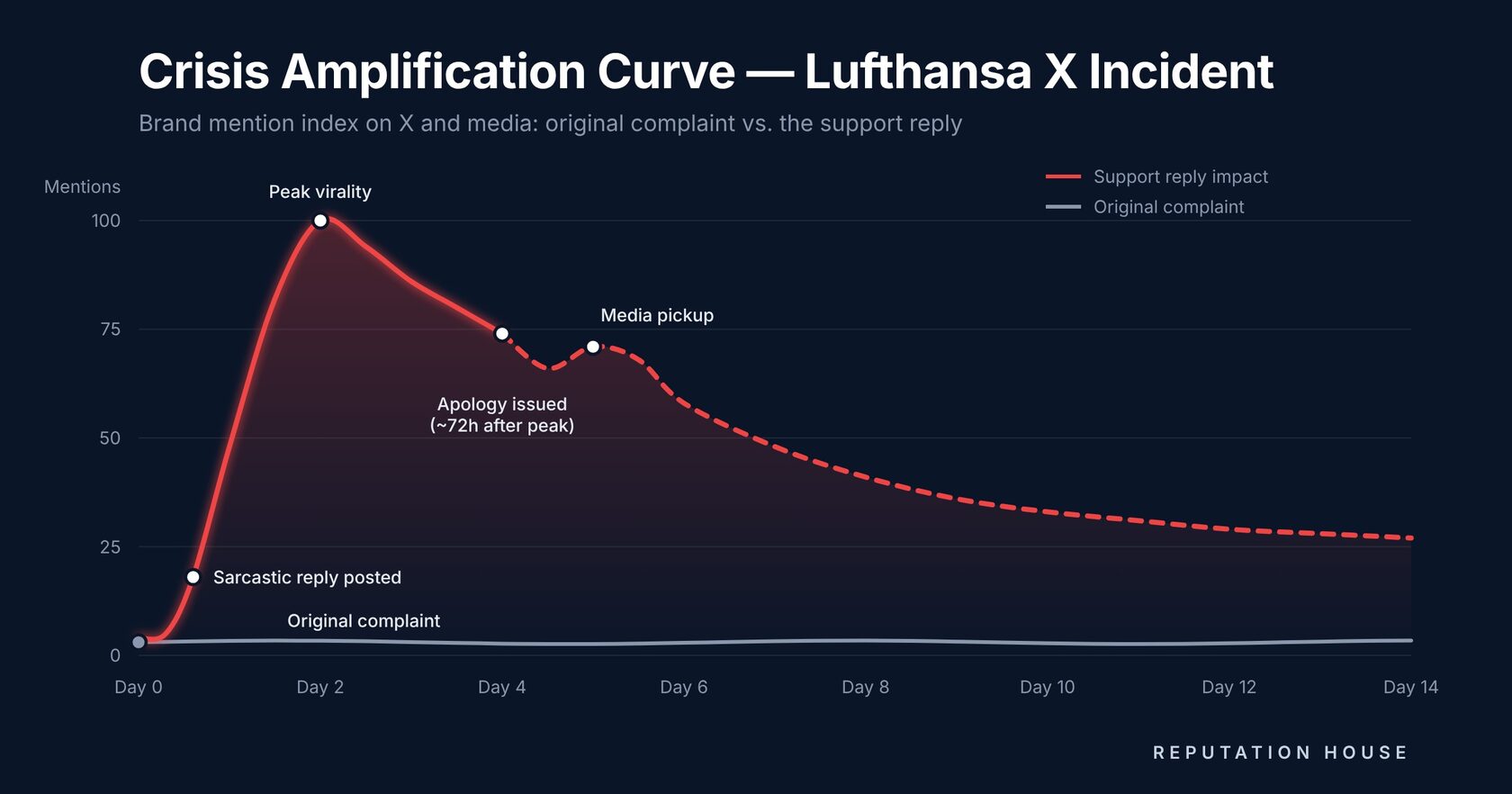
In early 2024, a Lufthansa passenger posted a complaint on X (formerly Twitter) about a delayed flight and lost baggage — a frustratingly common airline grievance. What followed, however, was not common at all. A Lufthansa social media support agent responded with a reply widely perceived as dismissive and sarcastic in tone, effectively mocking the passenger's frustration rather than acknowledging it.
The response — publicly visible to Lufthansa's hundreds of thousands of X followers — was screenshotted within minutes and began circulating across aviation forums, consumer rights communities, and mainstream media aggregators. What started as a single unhappy flyer's post escalated into a multi-day reputational incident that generated significantly more negative coverage than the original complaint ever could have.
Source: Coverage aggregated from The Points Guy, Simple Flying, and viral X thread archives (early 2024). Lufthansa's public apology statement was issued via official X account.
First 48 Hours
The original complaint attracted minimal organic attention — fewer than 200 interactions before the support reply appeared. Once the sarcastic response was posted, engagement spiked explosively. Screenshots were reposted by travel influencers and aviation journalists. Within 36 hours, the thread had accumulated over 40,000 impressions on X alone, with the ratio of negative replies to neutral ones exceeding 9:1.
Industry accounts began tagging Lufthansa in commentary framing the incident as emblematic of deteriorating airline customer service post-pandemic. The hashtag #Lufthansa began trending in Germany and the UK.
Industry accounts began tagging Lufthansa in commentary framing the incident as emblematic of deteriorating airline customer service post-pandemic. The hashtag #Lufthansa began trending in Germany and the UK.
Reputation House Commentary
The first 48 hours of a social media crisis are the compression window — the moment where a brand's response velocity and tone either contain the narrative or amplify it. Lufthansa's support team operated without a tone-gate protocol. There was no escalation trigger that would have flagged a high-stakes customer interaction before the reply went live. This is precisely the gap our pre-publication monitoring layer is designed to close.
First Week
Lufthansa's communications team issued a public apology via X, acknowledging that the response "did not meet the standards of care" expected from the brand. The apology was professionally worded but arrived approximately 72 hours after peak virality — a critical delay that allowed the counter-narrative to fully consolidate.
By day five, the story had been picked up by mainstream European outlets including Der Spiegel's digital desk and The Guardian's consumer section. Aviation industry analysts used the case to discuss broader systemic issues in airline social media governance. The passenger's original complaint — lost baggage — was barely mentioned. The brand's own response had become the story.
Customer sentiment analysis across review platforms (Trustpilot, Google Reviews, AirlineRatings) showed a measurable uptick in one-star reviews during this period, with many reviewers citing the X incident directly — despite having no personal connection to the original flight.
Reputation House Commentary
This is what we call narrative displacement: the inciting incident loses relevance and the brand's reactive behavior becomes the primary damage vector. By the time Lufthansa apologized, the dominant search result for their X account was the sarcastic reply, not the apology. A Risk Check conducted before any high-visibility support interaction would have identified the passenger's account reach and flagged the reply for senior review.
Second Week
Search volume for "Lufthansa customer service" spiked 340% above baseline (per public Google Trends data). The incident was referenced in at least three separate airline industry newsletters as a case study in social media governance failure. Lufthansa's competitor accounts notably increased their own positive customer service showcasing on X during this window — a standard competitive reputation maneuver.
Internal Lufthansa communications, later referenced in trade press, indicated a review of social media moderation policies was initiated. The damage to brand trust, however, was already indexed, screenshotted, and archived across the web.
Internal Lufthansa communications, later referenced in trade press, indicated a review of social media moderation policies was initiated. The damage to brand trust, however, was already indexed, screenshotted, and archived across the web.
Reputation House Commentary
The second-week effect is rarely discussed but critically important: by this point, the content has been indexed by search engines, saved by media aggregators, and referenced in third-party content that Lufthansa does not control. This is why reactive reputation management is exponentially more expensive than pre-crisis process design. The question our clients ask after seeing cases like this is simple: what would an audit have cost compared to what this cost?
Every support reply is a publication decision. Treat it like one.
The Lufthansa incident didn't begin with a PR failure — it began with a process gap in how support teams are empowered to respond to public-facing complaints without reputation oversight.
Run a Risk Check with Reputation House to audit your brand's social media response protocols before the next complaint becomes a crisis.
FAQ
What exactly is a "narrative gap" and how did it affect Lufthansa?
A narrative gap occurs when the story a brand intends to communicate diverges from the story the public actually receives. In Lufthansa's case, the intended message was likely "we're responsive on social media" — the received message became "we mock frustrated customers." At Reputation House, we map narrative gaps before they go public, identifying where brand communication is vulnerable to misreading, especially in high-volume social contexts where tone is stripped of nuance.
How does Reputation House detect a reputational risk before it escalates?
Our monitoring methodology combines real-time social listening with account-level context scoring. Before any brand response is considered "safe to publish," we evaluate the complaint source's reach, the emotional register of the original post, and the likely amplification pathways if a response is perceived negatively. This isn't passive monitoring — it's an active pre-publication filter that flags interactions requiring elevated sign-off.
What is a pre-launch reputation audit and would it have helped Lufthansa here?
A pre-launch reputation audit — applied in this context to a social media governance framework — reviews the entire response workflow: who approves replies, what tone guidelines exist, what escalation thresholds are in place. For Lufthansa, the audit would have surfaced the absence of a "high-visibility complaint" protocol. The fix is procedural, not technological — but it requires expert eyes to see the gap before a crisis makes it visible.
How does a Risk Check work in practice?
A Risk Check is Reputation House's structured diagnostic for brands that want to understand their current exposure before a crisis occurs. It covers social media governance, search result vulnerability, review platform health, and the gap between how a brand communicates and how it is perceived. The output is a prioritized risk map — not a list of problems, but a sequenced action plan. Brands that complete a Risk Check before a high-stakes campaign or operational period enter that period with significantly lower reactive exposure.
Can reputation damage from a social media incident be reversed after it's indexed?
The honest answer is: indexed content can be addressed through strategic content development and authority-building, but reversal is never instant and never guaranteed by any responsible firm. What Reputation House offers is a long-term narrative architecture that makes the crisis incident less findable and less contextually relevant over time — while simultaneously building a positive digital presence that outcompetes legacy negative content. The more important answer, however, is that prevention is structurally cheaper and faster than recovery. The Lufthansa case illustrates this precisely.
What would Reputation House have done differently in real time during this crisis?
During the first 48 hours, our priority would have been narrative containment: ensuring the apology was issued within the virality window (under 12 hours), not 72 hours later. We would have simultaneously deployed supportive content via owned channels and coordinated with media contacts to offer a brand spokesperson comment — shifting coverage from "sarcastic Lufthansa" to "Lufthansa responds and acts." The second-week strategy would have focused on search result architecture: creating authoritative, indexable content that positions the brand's corrective actions above the incident screenshots in organic results.