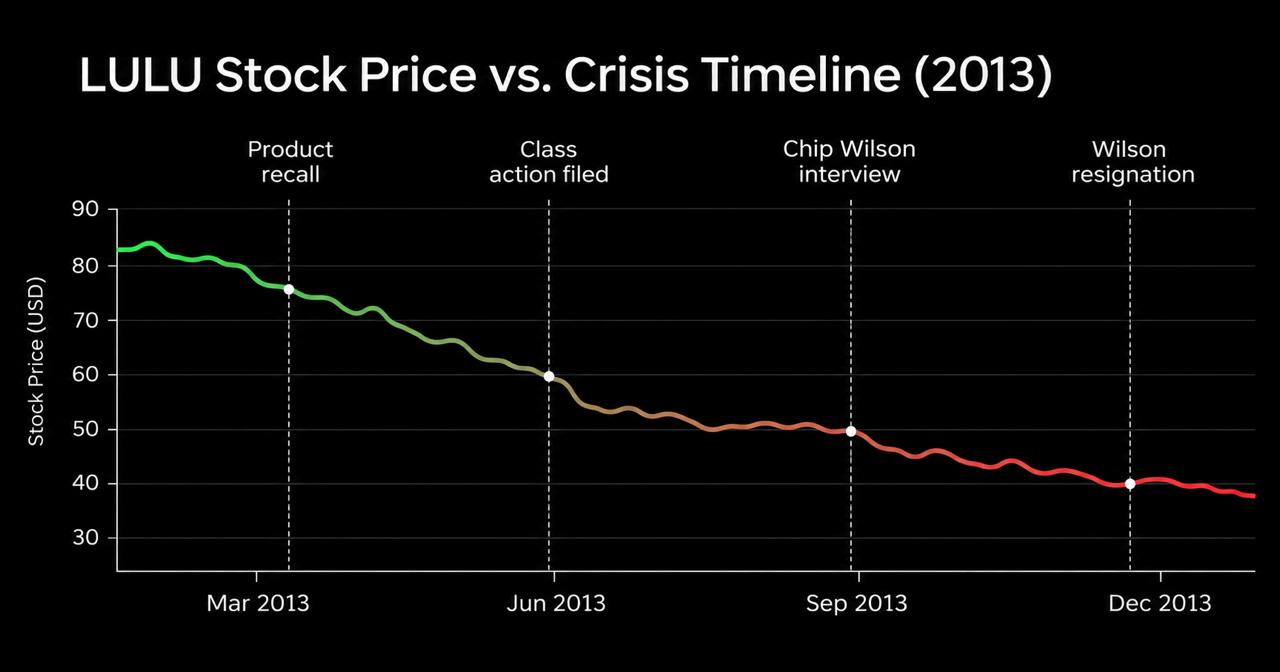
In March 2013, Lululemon Athletica — the Canadian activewear brand synonymous with $100 yoga pants and aspirational wellness culture — faced one of the most damaging public crises in retail history. The company was forced to recall approximately 17% of its entire yoga pants inventory after customers reported the black Luon fabric was see-through when stretched.
That product failure alone was embarrassing. What turned it into a securities fraud allegation was what came next.
Founder and chairman Chip Wilson made a series of public statements suggesting the problem was not the fabric — but women's bodies. "Frankly, some women's bodies just actually don't work for it," Wilson told Bloomberg TV in November 2013. The comment detonated across social media within hours.
But the legal dimension was already in motion. Shareholders filed a class action securities fraud lawsuit (filed in U.S. District Court, Southern District of New York), alleging that Lululemon executives had knowingly misrepresented the quality and integrity of their products to investors while insiders sold shares before the recall became public.
Sources: Reuters, March 2013; Bloomberg, November 2013; SEC filing records, PACER case archive.
That product failure alone was embarrassing. What turned it into a securities fraud allegation was what came next.
Founder and chairman Chip Wilson made a series of public statements suggesting the problem was not the fabric — but women's bodies. "Frankly, some women's bodies just actually don't work for it," Wilson told Bloomberg TV in November 2013. The comment detonated across social media within hours.
But the legal dimension was already in motion. Shareholders filed a class action securities fraud lawsuit (filed in U.S. District Court, Southern District of New York), alleging that Lululemon executives had knowingly misrepresented the quality and integrity of their products to investors while insiders sold shares before the recall became public.
Sources: Reuters, March 2013; Bloomberg, November 2013; SEC filing records, PACER case archive.
First 48 Hours
The recall announcement dropped on a Thursday. By Friday market close, LULU shares had fallen 6.4%, wiping approximately $450 million from market capitalization. Financial media immediately began asking the question that defines every securities scandal: who knew, and when did they sell?
Internal trading records — later surfaced in discovery — showed that several executives, including the CFO, had sold significant share positions in the weeks prior to the recall announcement. Retail investors who held through the announcement were left absorbing losses that insiders had apparently anticipated.
Social media response in the first 48 hours was not primarily about the lawsuit. It was about the product. The hashtag #LululemonRecall trended across Twitter. Fashion and fitness influencers — Lululemon's core brand ambassadors — began publicly distancing themselves. The narrative gap between "premium quality" and "see-through pants" was instantaneous and brutal.
Internal trading records — later surfaced in discovery — showed that several executives, including the CFO, had sold significant share positions in the weeks prior to the recall announcement. Retail investors who held through the announcement were left absorbing losses that insiders had apparently anticipated.
Social media response in the first 48 hours was not primarily about the lawsuit. It was about the product. The hashtag #LululemonRecall trended across Twitter. Fashion and fitness influencers — Lululemon's core brand ambassadors — began publicly distancing themselves. The narrative gap between "premium quality" and "see-through pants" was instantaneous and brutal.
Reputation House Commentary
The first 48 hours of this crisis illustrate a classic narrative gap failure. Lululemon had spent years building a brand identity around quality, exclusivity, and performance. The moment that identity was publicly contradicted by the product itself, every premium price point became a liability. Customers don't just feel disappointed — they feel deceived. That emotional charge is what fuels class action momentum.
First Week
By day five, three things were happening simultaneously — and none of them were under Lululemon's control.
1. Legal escalation. The class action filing gained co-plaintiffs. Institutional investors joined individual shareholders. The allegations crystallized: executives had made materially false statements about product quality in earnings calls and investor communications while possessing internal knowledge that quality control had deteriorated.
2. Media amplification. The story migrated from business pages to lifestyle media. Vogue, Glamour, and fitness publications ran pieces framing the crisis as a betrayal of the brand's core female customer base. The tone shifted from "product flaw" to "company culture problem."
3. Influencer defection. Lululemon's brand had been built substantially on instructor partnerships, studio affiliates, and social media fitness communities. Within the first week, multiple high-profile instructors publicly announced they were pausing or ending brand partnerships. This category of reputational damage — earned media turning hostile — is the type that advertising spend cannot reverse.
1. Legal escalation. The class action filing gained co-plaintiffs. Institutional investors joined individual shareholders. The allegations crystallized: executives had made materially false statements about product quality in earnings calls and investor communications while possessing internal knowledge that quality control had deteriorated.
2. Media amplification. The story migrated from business pages to lifestyle media. Vogue, Glamour, and fitness publications ran pieces framing the crisis as a betrayal of the brand's core female customer base. The tone shifted from "product flaw" to "company culture problem."
3. Influencer defection. Lululemon's brand had been built substantially on instructor partnerships, studio affiliates, and social media fitness communities. Within the first week, multiple high-profile instructors publicly announced they were pausing or ending brand partnerships. This category of reputational damage — earned media turning hostile — is the type that advertising spend cannot reverse.
Reputation House Commentary
What made this crisis structurally different from a standard product recall was the insider trading allegation. Once that enters the public narrative, every subsequent statement from company leadership is filtered through the question: 'Are they telling the truth, or protecting themselves?' That trust deficit compounds. Legal teams correctly advise minimal public comment during litigation — but reputationally, silence reads as guilt. This is the communication trap that pre-crisis reputation architecture is specifically designed to help navigate.
Second Week
Chip Wilson resigned as chairman in December 2013, nine months after the recall — but the damage arc had been established in that second week. The second week brought analyst downgrades: Goldman Sachs, Needham, and Piper Sandler (then Piper Jaffray) each revised LULU price targets downward. Total market cap erosion from the recall announcement through the Wilson resignation approached $1.6 billion.
The securities fraud lawsuit was eventually settled for $7.5 million in 2015 — without admission of wrongdoing, as is standard in such settlements. But the reputational cost was categorically larger than the legal settlement. The brand spent the next three years in recovery mode, rebuilding trust with both institutional investors and its consumer base.
The long-term damage metric that mattered most: comparable store sales growth fell from 16% pre-crisis to negative territory within six quarters.
The securities fraud lawsuit was eventually settled for $7.5 million in 2015 — without admission of wrongdoing, as is standard in such settlements. But the reputational cost was categorically larger than the legal settlement. The brand spent the next three years in recovery mode, rebuilding trust with both institutional investors and its consumer base.
The long-term damage metric that mattered most: comparable store sales growth fell from 16% pre-crisis to negative territory within six quarters.
Reputation House Commentary
A $7.5 million legal settlement sounds manageable for a company of Lululemon's scale. But that number is not the actual cost. The actual cost is the 18-month period where the brand could not credibly execute its premium positioning, the loss of influencer equity that took years to rebuild, and the drag on institutional investor confidence that suppressed the stock price well beyond what the underlying business fundamentals justified. Reputation damage has a duration that legal settlements do not.
Lululemon's crisis was not unforeseeable. The signals — quality control deterioration, insider trading patterns, brand-identity overextension — were present in the data months before the recall.
Run your Risk Check at Reputation House
Reputation House runs pre-crisis reputation audits that surface exactly these signal clusters before they become headlines.
FAQ
What is a "narrative gap" and why did it destroy Lululemon's credibility so fast?
A narrative gap is the measurable distance between what a brand claims to be and what the market verifiably experiences. Lululemon had invested years and hundreds of millions of dollars constructing a narrative around premium quality, functional performance, and aspirational identity. The see-through pants recall created an instantaneous, photogenic, socially shareable contradiction of every element of that narrative simultaneously. At Reputation House, we monitor narrative gaps as a leading indicator of crisis risk — not a lagging indicator. When a brand's public positioning outpaces its operational reality, that gap accumulates pressure. The Lululemon case shows what happens when that pressure releases in a single public event: the credibility loss is not proportional to the product flaw. It is proportional to the size of the narrative gap.
How would Reputation House have detected this risk before the recall went public?
The signals were present well before March 2013. Quality control complaints had been surfacing in consumer forums, instructor communities, and return data. Insider trading pattern analysis — the kind of signal mapping we apply across financial disclosure timelines — would have flagged unusual executive share disposals relative to earnings call cadence. Our pre-launch and ongoing monitoring protocols cross-reference operational signals (supply chain, QC complaints, return rates) with financial disclosure patterns and social sentiment velocity. When those three vectors move in the same direction simultaneously, that is a pre-crisis signature. The goal is not to predict the exact trigger — it is to compress the time between signal and response.
What is a pre-launch reputation audit and would it have helped Lululemon?
A pre-launch reputation audit is a structured assessment of a brand's reputational exposure across four dimensions: narrative consistency (does what you say match what you do), stakeholder sentiment mapping, earned media dependency risk, and legal/regulatory vulnerability flags. In Lululemon's case, a pre-crisis audit would have identified the brand's acute dependency on influencer goodwill as a single point of failure, the overextension of quality premium claims relative to supply chain capacity, and the insider trading risk that turned a product crisis into a securities fraud allegation. At Reputation House, we run these audits before major product launches, before investor roadshows, and as quarterly standing reviews for clients in high-visibility consumer categories. The cost of an audit is a rounding error relative to $1.6 billion in market cap erosion.
How does Reputation House's Risk Check work in practice?
Risk Check is a structured diagnostic that maps your brand's current reputational exposure across owned, earned, and legal dimensions. We analyze your public-facing narrative against live market signals: search sentiment trends, social velocity patterns, media coverage tone, and regulatory/litigation databases. The output is a tiered risk register — not a generic report — with specific signal clusters ranked by probability and potential impact. For clients in publicly traded companies or brands with significant investor relations exposure, we layer in financial disclosure cross-referencing. The process typically runs two to three weeks and delivers a prioritized action framework. You can initiate it at reputation.house.
Can reputation management actually prevent a securities fraud allegation, or does it only help after the fact?
Reputation management cannot prevent fraud — but it can prevent the specific communication failures that turn a product problem into a fraud allegation. The Lululemon case is instructive: the securities fraud claim rested substantially on the argument that executives made materially false statements in investor communications while possessing contradicting internal knowledge. A robust reputation governance framework includes investor communications review as a standing function — not a crisis response. At Reputation House, we work with legal and IR teams to ensure that public statements are stress-tested against known internal data before they are made. That discipline does not eliminate legal risk, but it significantly reduces the gap between what executives say publicly and what internal records later show they knew. That gap is where securities fraud allegations live.
Lululemon recovered eventually — so does reputation damage really have lasting business impact?
Lululemon did recover — but the recovery took approximately four years, required a CEO change, a chairman resignation, a $7.5 million legal settlement, and a complete rebuilding of influencer and institutional investor relationships. The stock did not sustainably reclaim its pre-crisis valuation trajectory until 2017. For a brand operating in a trend-sensitive, loyalty-dependent consumer category, four years is an eternity. The more precise question is: what did the recovery cost, and could that cost have been compressed? At Reputation House, our position is that reputational crises are not binary — you don't simply have one or not have one. They exist on a severity and duration spectrum. Effective pre-crisis reputation architecture does not make companies immune. It compresses duration and reduces peak severity. In Lululemon's case, even a 50% reduction in recovery time would have represented hundreds of millions of dollars in preserved market cap and avoided legal cost.