Early this year, Meta made a quiet but consequential policy adjustment to its content moderation framework in India — relaxing certain automated flagging thresholds for political and religious content ahead of the general election cycle. The decision was framed internally as a calibration to reduce over-moderation complaints from Indian political parties across the spectrum.
Within 72 hours, it became anything but quiet.
Screenshots of content that had previously been removed — sectarian rhetoric, coordinated inauthentic posts, targeted harassment of minority journalists — began circulating on Indian Twitter (now X) with captions explicitly noting the content "survived Meta's new settings." Digital rights organizations flagged the pattern. Indian media picked it up. By the time Meta's communications team in Mumbai and Menlo Park coordinated a response, the narrative had already been written by someone else.
The story was no longer about content thresholds. It was about whether Meta had deliberately opened the floodgates before the world's largest democratic election.
The story was no longer about content thresholds. It was about whether Meta had deliberately opened the floodgates before the world's largest democratic election.
First 48 Hours
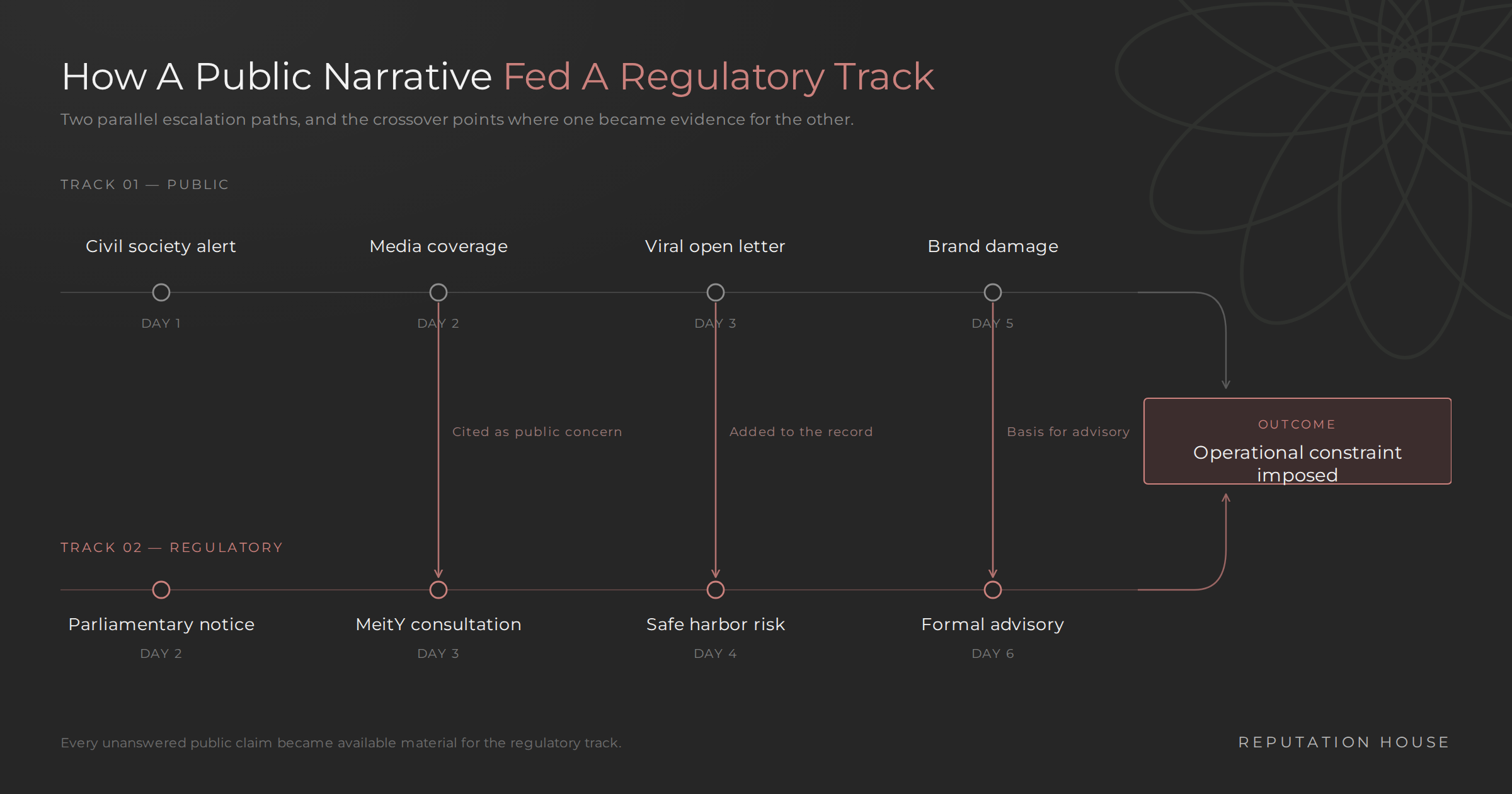
The initial signal came not from a press inquiry but from a civil society coalition — the Internet Freedom Foundation and the Editors Guild of India — who published a joint statement citing documented instances of reinstated harmful content. Indian tech journalists at *The Wire* and *Medianama* ran parallel investigations within hours of each other. By hour 36, the Parliamentary Standing Committee on Communications and IT had issued a formal notice requesting Meta India's head of policy to appear within two weeks.
The critical failure in this window: Meta issued no proactive statement. Their public affairs team operated on a "monitor and assess" posture, waiting for the news cycle to clarify. It did not clarify. It accelerated.
The critical failure in this window: Meta issued no proactive statement. Their public affairs team operated on a "monitor and assess" posture, waiting for the news cycle to clarify. It did not clarify. It accelerated.
Reputation House Commentary
The first 48 hours of a narrative crisis are not a waiting period — they are the period when the dominant frame gets established. Meta's silence didn't buy them time. It ceded authorship of the story to civil society actors who had both credibility and documentation. By hour 48, Meta was already playing catch-up on a narrative they could have shaped at hour four.
First Week
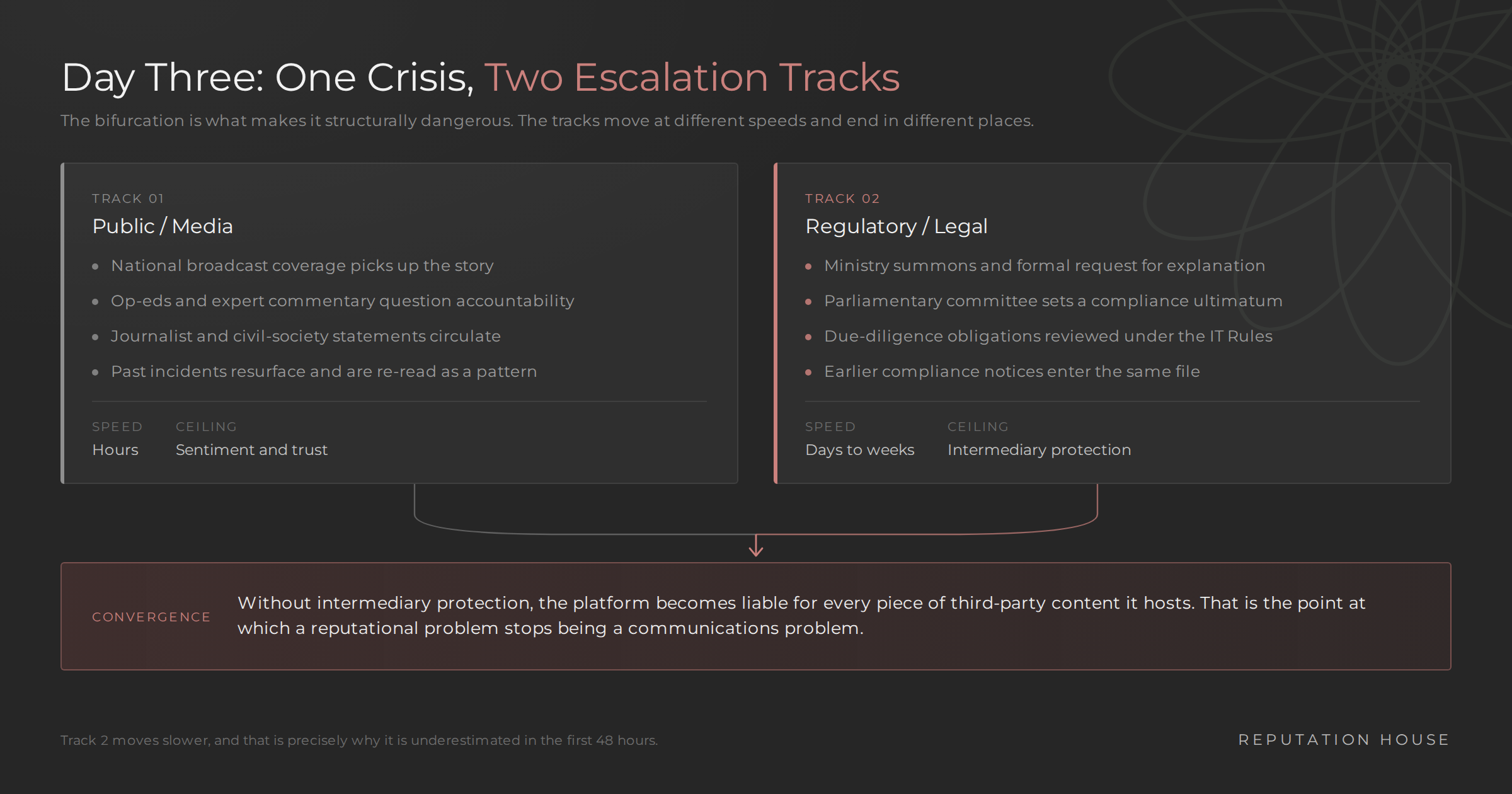
By day three, the crisis had bifurcated into two parallel tracks — and that bifurcation is what made it structurally dangerous.
Under India's IT Rules 2021, platforms retain intermediary liability protection — safe harbor — conditional on demonstrating "due diligence" in content moderation. Any evidence that Meta had reduced moderation rigor, even temporarily, created a direct legal exposure: if MeitY ruled the change a breach of due diligence obligations, Meta's safe harbor status could be suspended or revoked. Without safe harbor, Meta India would be legally liable for every piece of third-party content on its platforms — a position that is operationally untenable at scale.
The reputational crisis had become a legal-existential crisis, and the escalation path ran directly through the narrative vacuum Meta had created in the first 48 hours.
- Track 1 — Public/Media: National television coverage, op-eds from former Election Commission officials questioning Meta's commitment to electoral integrity, and a viral open letter signed by 200+ Indian journalists demanding accountability.
- Track 2 — Regulatory/Legal: The Ministry of Electronics and Information Technology (MeitY) began informal consultations with legal counsel about whether Meta's content policy change constituted a violation of the Intermediary Guidelines under the IT Rules 2021. This is the track that threatened safe harbor.
Under India's IT Rules 2021, platforms retain intermediary liability protection — safe harbor — conditional on demonstrating "due diligence" in content moderation. Any evidence that Meta had reduced moderation rigor, even temporarily, created a direct legal exposure: if MeitY ruled the change a breach of due diligence obligations, Meta's safe harbor status could be suspended or revoked. Without safe harbor, Meta India would be legally liable for every piece of third-party content on its platforms — a position that is operationally untenable at scale.
The reputational crisis had become a legal-existential crisis, and the escalation path ran directly through the narrative vacuum Meta had created in the first 48 hours.
Reputation House Commentary
This is a textbook example of what we call a narrative gap becoming a legal vector. Meta's policy decision created an ambiguity — why were thresholds adjusted, who authorized it, what oversight existed. That ambiguity was never filled by Meta's own communication. So regulators, journalists, and parliamentary staff filled it themselves, with the most adversarial interpretation available. The gap didn't just hurt reputation. It became the evidentiary basis for a potential compliance challenge.
Second Week
Meta's India policy head testified before the Parliamentary committee. The testimony was technically competent — explaining the calibration rationale, citing data on over-removal rates, committing to a review. It moved the needle in the committee room. It did not move the needle publicly.
By this point, the narrative had structural momentum: "Meta loosened rules before India's election" was indexed, cited, and cross-referenced across hundreds of articles. Meta's testimony created no counter-narrative of equivalent reach. They answered the regulatory question but left the public question unanswered.
MeitY ultimately did not revoke safe harbor status, but issued a formal advisory — a documented warning that any future policy changes affecting content moderation must be preceded by regulatory notification. This was a new operational constraint, extracted entirely by a crisis that originated from a single unaudited content policy decision.
By this point, the narrative had structural momentum: "Meta loosened rules before India's election" was indexed, cited, and cross-referenced across hundreds of articles. Meta's testimony created no counter-narrative of equivalent reach. They answered the regulatory question but left the public question unanswered.
MeitY ultimately did not revoke safe harbor status, but issued a formal advisory — a documented warning that any future policy changes affecting content moderation must be preceded by regulatory notification. This was a new operational constraint, extracted entirely by a crisis that originated from a single unaudited content policy decision.
Reputation House Commentary
A formal MeitY advisory is not a fine. But it is a precedent — and precedents in regulatory relationships compound. What Meta now carries is not just reputational damage but a documented compliance history that will be referenced in every future regulatory interaction in India. A pre-launch narrative audit on the policy change — mapping stakeholder perception risk before rollout — would have identified the electoral timing as a critical amplifier. That's not hindsight. That's what the audit exists to catch.
Meta India's crisis was not caused by a bad policy decision. It was caused by a policy decision made without mapping its narrative risk surface — and then compounded by a communication posture that ceded the dominant frame at the moment it mattered most.
The regulatory outcome was not inevitable. It was constructed, step by step, from a narrative vacuum that a pre-launch audit would have identified, and that a 48-hour response protocol would have contained.
The regulatory outcome was not inevitable. It was constructed, step by step, from a narrative vacuum that a pre-launch audit would have identified, and that a 48-hour response protocol would have contained.
Is your next market decision mapped for narrative risk before it ships?
Run Your Risk Check For Free
Reputation House Risk Check gives leadership teams a structured view of how the company is perceived across financial media, search, and investor-facing channels — before a guidance call, not after one.
FAQ
What is a narrative gap, and how did it factor into the Meta India crisis?
A narrative gap is the space between what a company communicates and what stakeholders need to understand — a vacuum that gets filled by the most adversarial interpretation available. In Meta India's case, the company never explained *why* moderation thresholds were adjusted, *what* oversight existed, or *who* authorized the change. That silence allowed civil society, journalists, and regulators to author their own explanations — each progressively more damaging. At Reputation House, we map narrative gaps before a policy, product, or market decision goes live, identifying every stakeholder group that will ask a question the brand hasn't yet answered, and building pre-emptive communication architecture to close those gaps before they become crises.
How does Reputation House detect reputational risk before a crisis begins?
Our pre-launch narrative audit combines three analytical layers: (1) stakeholder perception mapping — who will be affected, what priors they hold, and what frames they'll apply; (2) regulatory and media environment scanning — what stories are already active in the space that could absorb and amplify your decision; and (3) timing and context analysis — what external conditions (elections, regulatory cycles, social tensions) make this decision land differently than it would in neutral conditions. Meta's February 2024 decision ticked every risk indicator in that third layer. An audit would have surfaced the electoral timing as a critical amplifier before the policy shipped.
What is a pre-launch reputation audit, and when should a company run one?
A pre-launch reputation audit is a structured assessment of how a pending decision — a policy change, product launch, market entry, executive appointment — will be received across the full stakeholder landscape, including media, regulators, civil society, and the public. It is run *before* the decision is announced or implemented, not after signals of trouble appear. The output is a risk-ranked narrative map: which aspects of the decision are most likely to generate adverse framing, which stakeholders are most likely to drive escalation, and what communication architecture is needed to establish the preferred narrative first. For companies operating in complex regulatory markets like India, this is not optional infrastructure — it is operational risk management.
How does the Risk Check from Reputation House work?
Risk Check is Reputation House's entry-point diagnostic for brands that want to understand their current reputational exposure before committing to a fuller audit or monitoring engagement. It covers: search landscape analysis (what narratives are currently active about your brand), stakeholder sentiment mapping (who is saying what, and with what reach), regulatory mention monitoring (are you appearing in policy discussions you don't know about), and narrative gap identification (where your public communication is failing to answer questions that are already being asked). The output is a prioritized risk register — actionable, not theoretical. For brands in high-stakes markets or at a decision inflection point, Risk Check is the 48-hour version of what a full audit delivers over weeks.
Could Meta have preserved its safe harbor status with better communication?
The safe harbor risk was not primarily a legal question — it was a narrative question that became a legal question. MeitY's concern was whether Meta's policy change violated "due diligence" obligations under the IT Rules 2021. That determination was informed, in part, by the public record: hundreds of media reports characterizing the change as a deliberate loosening of election-period oversight. If Meta had established the counter-narrative early — explaining the calibration rationale, citing the over-removal data, demonstrating regulatory consultation — the public record that informed MeitY's assessment would have looked different. Reputation House works on exactly this intersection: ensuring that the narrative environment in which regulators make decisions reflects the brand's actual position, not the adversarial default.
What stops a crisis like this from happening to a company that already has a communications team?
Most communications teams are built to respond — to draft statements, manage press inquiries, coordinate spokesperson availability. They are not structurally designed to conduct the kind of pre-decision narrative risk assessment that would have caught Meta India's crisis at the source. The function that was missing was not media relations — it was narrative intelligence: the ability to model how a decision will land across a complex stakeholder ecosystem *before* it lands, and to build communication architecture around it proactively. Reputation House operates as that function — either as an external audit capability or as an embedded intelligence layer — specifically for decisions where the reputational downside is material and the timing is irreversible once the decision ships.