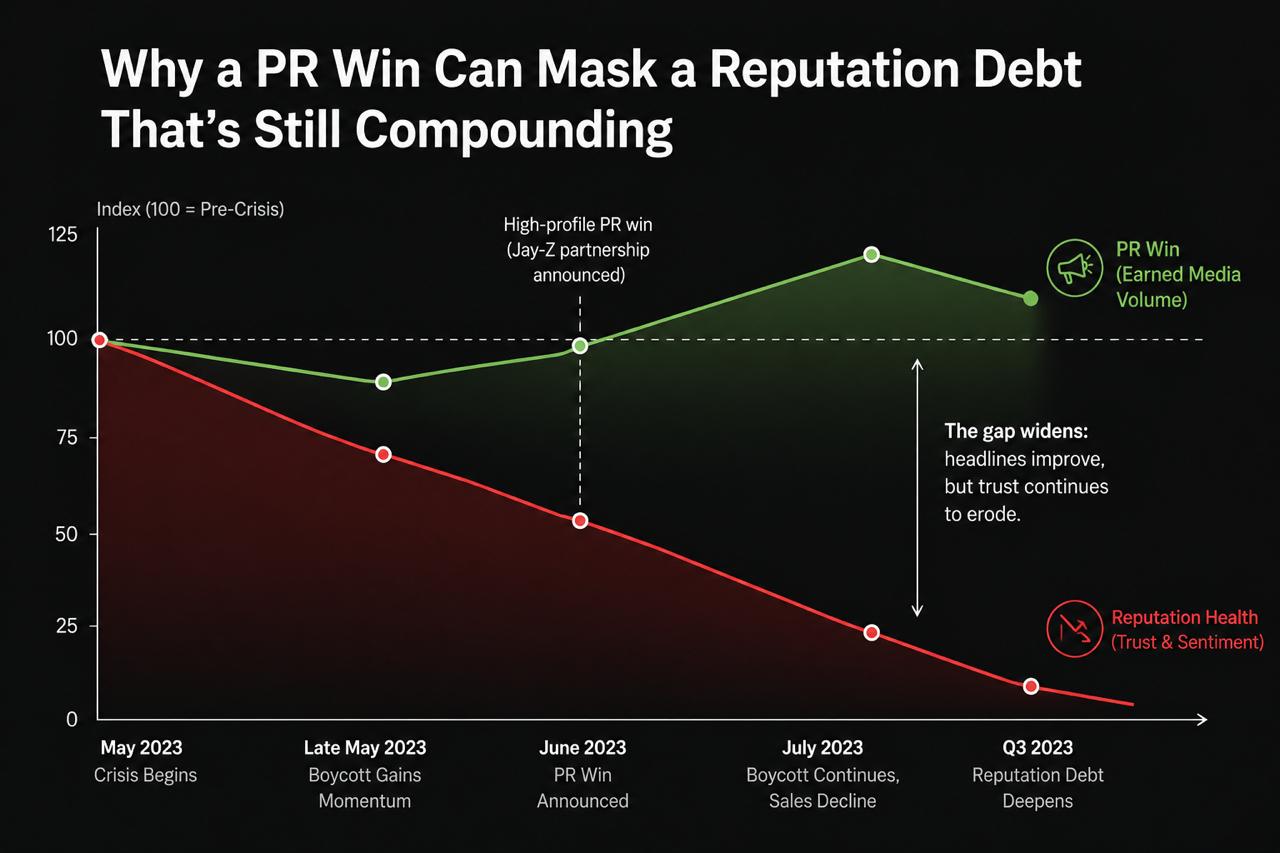
In June 2023, Target Corporation faced one of the most damaging consumer boycotts in its modern history. After rolling back several DEI-linked merchandise lines — most visibly LGBTQ+ Pride collections — following pressure from conservative activist groups, the retailer triggered a simultaneous backlash from progressive consumers, institutional shareholders, and cultural commentators.
The backlash metastasized when Target attempted to reframe its position through a series of cultural partnerships, most notably a high-profile collaboration announcement involving Jay-Z's Armand de Brignac champagne label and a curated music and lifestyle activation for the 2023 holiday season. The implicit narrative: *Target is still culturally aligned, still a brand that moves with culture, still a safe space for diverse communities.*
The market disagreed. Target's Q2 2023 net sales declined 4.9% year-over-year — its worst quarterly result in six years. Foot traffic analytics from Placer.ai showed sustained store visit declines through Q3. The hashtag #BoycottTarget accumulated over 1.2 billion impressions on X (formerly Twitter) between May and October 2023.
The backlash metastasized when Target attempted to reframe its position through a series of cultural partnerships, most notably a high-profile collaboration announcement involving Jay-Z's Armand de Brignac champagne label and a curated music and lifestyle activation for the 2023 holiday season. The implicit narrative: *Target is still culturally aligned, still a brand that moves with culture, still a safe space for diverse communities.*
The market disagreed. Target's Q2 2023 net sales declined 4.9% year-over-year — its worst quarterly result in six years. Foot traffic analytics from Placer.ai showed sustained store visit declines through Q3. The hashtag #BoycottTarget accumulated over 1.2 billion impressions on X (formerly Twitter) between May and October 2023.
First 48 Hours
When Target's initial merchandise rollback was reported by conservative media on May 17, 2023, the brand's social listening infrastructure registered a spike in negative sentiment. However, the company's public response was delayed and framed primarily around "team member safety concerns" — a statement that, while factually grounded, created a **narrative vacuum**. Progressive consumers heard a brand capitulating to pressure; conservative consumers heard a brand that had overstepped in the first place. Neither constituency felt addressed. In 48 hours, Target had managed to alienate both flanks simultaneously.
Reputation House Commentary
The first 48 hours of a values-based crisis are not a communications problem — they're an architecture problem. The moment a brand signals inconsistency between its stated values and its operational decisions, it creates what we call a *narrative gap*: a space where external narratives fill faster than any internal messaging can correct. Target's initial response didn't close the gap. It widened it.
Check how your brand looks right now
Run Your Risk Check For Free
Reputation House Risk Check gives leadership teams a structured view of how the company is perceived across financial media, search, and investor-facing channels — before a guidance call, not after one.
First Week
By May 24, internal communications obtained by multiple outlets confirmed that Target was selectively removing Pride merchandise from stores, particularly in Southern U.S. regions. This geographic stratification — pulling merchandise in some markets but not others — was read by consumers as further evidence of inconsistency. Social media volume on #BoycottTarget tripled. Institutional investors began filing queries. The brand's Earned Media Value for the week turned sharply negative, with sentiment ratios tracked by Sprinklr and Brandwatch showing 73% negative coverage across earned and owned channels.
The Jay-Z partnership activation, announced during this same week as part of a broader cultural calendar, was covered by entertainment and lifestyle media — but the juxtaposition was damaging. Fast Company, *AdAge*, and *The Atlantic* all ran pieces questioning whether high-profile cultural partnerships could function as reputational offsets when the underlying trust infrastructure had been compromised.
The Jay-Z partnership activation, announced during this same week as part of a broader cultural calendar, was covered by entertainment and lifestyle media — but the juxtaposition was damaging. Fast Company, *AdAge*, and *The Atlantic* all ran pieces questioning whether high-profile cultural partnerships could function as reputational offsets when the underlying trust infrastructure had been compromised.
Second Week
By June 1, the narrative had structurally shifted. This is the mechanism that makes this case particularly instructive: the story was no longer about the merchandise decision. It had become a story about whether Target's brand identity was coherent at all. Searches for "Target values," "Target boycott why," and "Target DEI rollback" hit peak velocity on Google Trends. Analysts at Morgan Stanley downgraded the stock. The boycott was no longer a social media event — it had become a financial event.
Reputation House Commentary
What happened in week two is what we call crisis phase transition: the moment a reputational event exits the social layer and begins registering in analyst reports, investor calls, and foot traffic data. Once a crisis crosses that threshold, a celebrity partnership announcement doesn't function as a counter-narrative. It functions as evidence. Evidence that the brand is attempting to substitute cultural currency for the trust it actually owes its audience. Audiences — especially values-driven audiences — are sophisticated enough to read that substitution accurately.
The Jay-Z activation generated approximately 340 million earned media impressions in entertainment verticals. Zero of those impressions reached the consumer cohort that had initiated the boycott. The campaign had been optimized for reach in the wrong demographic layer entirely.
Reputation House Commentary
The Target case is a textbook example of what we call *formal resolution risk* — the moment a brand declares a crisis over because a positive PR event has landed, while the underlying reputation debt continues to compound invisibly. Our early detection systems track not just sentiment velocity but *cohort-specific trust metrics*: are the consumers who initiated the boycott re-engaging? Are they searching for the brand in purchase intent contexts or in activist contexts? In Target's case, three weeks before Q2 earnings, those signals were already divergent. The PR activation had generated impressions. It had not generated re-engagement from the damaged cohort. That divergence is the signature of a crisis that has gone underground — and underground crises are the most expensive kind.
The Target case demonstrates that the most expensive reputation crises are not the ones that make headlines — they are the ones that appear to end while continuing to compound beneath the surface.
Run a Risk Check with Reputation House
If your brand has recently navigated a controversy, rebranded, or executed a high-profile cultural partnership, the question is not whether the crisis is over. The question is whether your trust metrics in the relevant consumer cohorts have actually recovered — or whether you are holding a reputation debt that hasn't been priced yet.
FAQ
What is a "narrative gap" and why is it more dangerous than negative press coverage?
Negative press coverage is visible — it can be tracked, responded to, and contextualized. A narrative gap is structural: it's the space between what a brand says it stands for and what its recent decisions demonstrate. Unlike a negative article, a narrative gap doesn't close when the coverage stops. It remains open in the consumer's cognitive model of the brand, actively filling with any new evidence that confirms the inconsistency. Reputation House identifies narrative gaps before they become visible in press coverage by monitoring the divergence between brand communication signals and behavioral data — search intent, engagement quality, and cohort-specific sentiment. By the time a narrative gap appears in mainstream coverage, it has already been open for weeks.
How does Reputation House detect a crisis that has "gone underground" after an apparent resolution?
Formal resolution — a positive PR event, a celebrity partnership, a leadership statement — changes what is being covered. It does not change what consumers remember or how they behave. Our monitoring systems track post-resolution cohort behavior: are the consumers who disengaged during the crisis returning? Are they engaging in purchase-intent contexts or continuing to engage in activist or skeptical contexts? Are foot traffic leading indicators recovering in the specific demographics affected? These signals diverge from headline sentiment in the weeks following a PR activation. That divergence is the signature of an unresolved trust debt — and it typically appears 2–4 weeks before it registers in financial results.
What is a pre-launch reputation audit and when should a brand conduct one?
A pre-launch reputation audit is a structured assessment conducted before a major brand activation — a partnership, a campaign, a product launch, a market entry — that maps the current state of brand trust in relevant consumer cohorts and identifies any existing reputation debt that the activation might inadvertently amplify. In Target's case, a pre-launch audit of the Jay-Z partnership would have flagged immediately that the activation was optimized for entertainment-vertical impressions in a demographic that had not initiated the boycott, while generating zero touchpoints with the cohort whose trust had actually been compromised. Reputation House conducts pre-launch audits as a standard component of campaign planning for clients in consumer-facing verticals, typically 3–6 weeks before a major activation.
How does the Risk Check at Reputation House work, and what does it produce?
The Risk Check is a diagnostic process that assesses the current state of a brand's reputation across the channels and cohorts that are most relevant to its business. It produces a structured output: a map of active and latent risk signals, a cohort-level trust assessment, an identification of any existing narrative gaps, and a prioritized list of the signals that, if they develop further, would indicate a crisis phase transition from the social layer to the financial layer. The output is designed to be operationally actionable — not a general report, but a specific set of monitoring triggers and response protocols that a brand's communications and strategy teams can implement immediately.
Can a high-profile cultural partnership actually make a reputation crisis worse?
Yes — and the mechanism is specific. A high-profile partnership generates impressions and media coverage. If the brand's trust deficit with the relevant consumer cohort has not been structurally addressed, that coverage is read by the damaged cohort as evidence of substitution: the brand is spending on cultural capital rather than doing the work of rebuilding trust. This reading is not irrational — it is often accurate. The net effect is that the partnership amplifies the original signal of inconsistency rather than countering it. Reputation House advises clients that cultural activations function as trust accelerators, not trust builders. They amplify the existing state of brand-consumer trust. If that state is negative, the activation amplifies the negative. The sequence matters: trust infrastructure first, amplification second.
What metrics should a brand track to know whether a crisis has genuinely resolved — or just gone quiet?
The metrics that indicate genuine resolution are different from the metrics that indicate media cycle closure. Media coverage declining is not the same as trust recovering. Reputation House tracks five categories post-crisis: cohort re-engagement rates (are affected consumers returning to purchase contexts?), sentiment quality (are positive mentions substantive or superficial?), search intent signals (what are affected consumers searching for in relation to the brand?), peer recommendation indicators (are brand advocates re-activating?), and leading foot-traffic or conversion signals in the specific demographics affected. A crisis is genuinely resolved when these metrics show sustained positive movement across at least three of the five categories for a minimum of four consecutive weeks. Until that threshold is met, the crisis is in a latent state — which is operationally more dangerous than an active state, because it receives no management attention.