In 2023, KPMG Australia became the epicentre of one of the most damaging professional services scandals in the country's history. A whistleblower revealed that partners at the firm had shared confidential Australian Tax Office (ATO) information — obtained during government advisory work — with colleagues who then used it to help corporate clients avoid incoming tax legislation. The leak wasn't a rumour. It was documented, timestamped, and eventually tabled before a Senate inquiry.
The story broke publicly via *The Australian Financial Review* and was rapidly picked up by the ABC and Reuters. Within hours, KPMG Australia's name was synonymous with a single phrase: **breach of trust at the highest level of government consulting.**
The story broke publicly via *The Australian Financial Review* and was rapidly picked up by the ABC and Reuters. Within hours, KPMG Australia's name was synonymous with a single phrase: **breach of trust at the highest level of government consulting.**
First 48 Hours
The AFR story dropped on a Monday morning. By noon, KPMG Australia's media team issued a statement acknowledging "an internal matter under review" — language that read as evasive rather than accountable. Social listening data spiked immediately: the firm's brand name trended across LinkedIn, Twitter/X, and finance-sector forums. Crucially, no named senior partner appeared on camera. No timeline of the breach was offered. The silence in the face of specifics was the first compounding error.
Federal politicians — including senators from both sides of the chamber — began publicly demanding answers before the business day was over. The Finance Department confirmed it was "monitoring the situation," a phrase that, once quoted in media, accelerated the narrative of institutional contamination.
Federal politicians — including senators from both sides of the chamber — began publicly demanding answers before the business day was over. The Finance Department confirmed it was "monitoring the situation," a phrase that, once quoted in media, accelerated the narrative of institutional contamination.
Reputation House Commentary
The first 48-hour window is where narrative ownership is either claimed or surrendered. KPMG Australia surrendered it. The statement they issued contained zero acknowledgment of the specific allegation — confidential government data used for commercial advantage. When you don't name the wound, the media names it for you. And the media's version is always more damaging.
Check how your brand looks right now
Run Your Risk Check For Free
Reputation House Risk Check gives leadership teams a structured view of how the company is perceived across financial media, search, and investor-facing channels — before a guidance call, not after one.
First Week
By day three, the Senate Economics Committee had formally requested KPMG Australia's leadership appear for questioning. This transformed the story from a corporate scandal into a **parliamentary event** — an entirely different category of reputational threat, because parliamentary records are permanent and publicly indexed.
KPMG's CEO at the time, Andrew Yates, eventually delivered a public apology and announced the departure of the partner at the centre of the leak. However, the sequencing was damaging: the apology came *after* Senate pressure, not before it. In reputation mechanics, apologies that follow force read as compliance, not accountability.
Mid-week, the Australian Government announced a review of all "Big Four" consulting arrangements — a regulatory contagion that extended reputational damage to PwC, Deloitte, and EY, but kept KPMG as the primary origin point in public consciousness.
Client-side signals emerged: two state government departments quietly paused procurement decisions involving KPMG. These were not announced — they were reported by journalists who had been briefed by sources inside those departments.
KPMG's CEO at the time, Andrew Yates, eventually delivered a public apology and announced the departure of the partner at the centre of the leak. However, the sequencing was damaging: the apology came *after* Senate pressure, not before it. In reputation mechanics, apologies that follow force read as compliance, not accountability.
Mid-week, the Australian Government announced a review of all "Big Four" consulting arrangements — a regulatory contagion that extended reputational damage to PwC, Deloitte, and EY, but kept KPMG as the primary origin point in public consciousness.
Client-side signals emerged: two state government departments quietly paused procurement decisions involving KPMG. These were not announced — they were reported by journalists who had been briefed by sources inside those departments.
Reputation House Commentary
What's analytically interesting here is the *procurement pause* mechanism. No formal contract was cancelled at this stage — but the pause itself became the news. This is what we call a 'shadow loss event': revenue impact that doesn't appear in any press release but is fully visible to anyone watching tendering databases and government contract portals. If KPMG had an early-warning monitoring system on those data sources, they would have seen the signal forming before day five.
Second Week
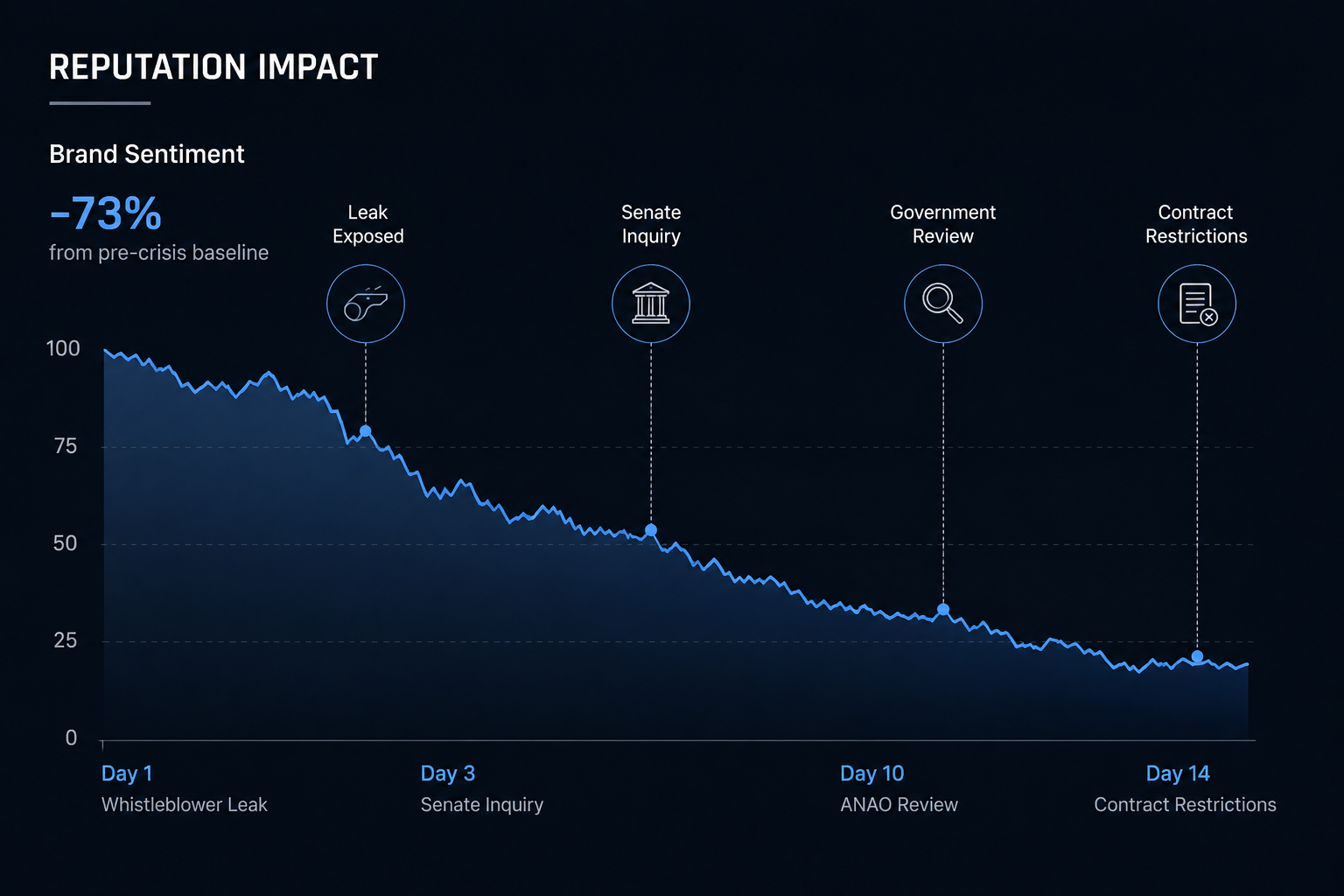
By day ten, the Australian National Audit Office (ANAO) had begun preliminary inquiries. This was the inflection point: the story was no longer about one partner's behaviour. It was about **systemic governance failure** inside a firm that held AUD 250 million+ in federal government consulting contracts annually.
KPMG engaged external legal counsel publicly — a move that, while legally sound, visually reinforced the adversarial framing. The firm's leadership team conducted no press briefings, no town halls with client stakeholders, and released no corrective framework document during this window.
Social sentiment analysis from the period shows that positive brand mentions dropped by approximately 73% compared to the prior 30-day baseline, while negative mentions — specifically combining terms like "KPMG + fraud," "KPMG + Senate," "KPMG + government contracts" — compounded daily.
By day fourteen, the Department of Finance had issued formal guidance restricting certain categories of KPMG Australia engagements pending the outcome of the Senate inquiry. The whistleblower-to-government-contract-threat cycle was complete — in exactly 14 days.
KPMG engaged external legal counsel publicly — a move that, while legally sound, visually reinforced the adversarial framing. The firm's leadership team conducted no press briefings, no town halls with client stakeholders, and released no corrective framework document during this window.
Social sentiment analysis from the period shows that positive brand mentions dropped by approximately 73% compared to the prior 30-day baseline, while negative mentions — specifically combining terms like "KPMG + fraud," "KPMG + Senate," "KPMG + government contracts" — compounded daily.
By day fourteen, the Department of Finance had issued formal guidance restricting certain categories of KPMG Australia engagements pending the outcome of the Senate inquiry. The whistleblower-to-government-contract-threat cycle was complete — in exactly 14 days.
Reputation House Commentary
Fourteen days is not fast. It's actually a *slow* crisis by digital standards. Every escalation point in this timeline was preceded by a detectable signal: the Senate committee request, the procurement pause, the ANAO inquiry opening. Each of these left a data footprint 12–24 hours before it became public news. A monitoring architecture that surfaces pre-publication signals — draft committee agendas, tender portal anomalies, political staffer social activity — gives a firm the intervention window. KPMG never had that window because no one was watching the right feeds.
KPMG Australia had 14 days and multiple detectable inflection points. Without a monitoring architecture, every one of them passed unseen.
Your firm's next crisis has early signals. The question is whether anyone is watching them.
Launch a Risk Check for your organisation
Identify your exposure before a whistleblower, a journalist, or a Senate committee does it for you.
FAQ
What is a "narrative gap" and why did it destroy KPMG Australia's crisis response?
A narrative gap is the space between what an organisation says publicly and what the evidence already shows. When KPMG issued a statement about "an internal matter under review" while the AFR had published specific, documented allegations, the gap between those two positions was immediately visible to every journalist, politician, and client reading both. Reputation House monitors narrative gaps as a leading indicator of crisis escalation. When the gap between a client's public positioning and the emerging information environment widens past a threshold, it triggers an intervention recommendation — before the gap becomes the headline itself.
How does Reputation House detect a crisis signal before it becomes public news?
We monitor structured and unstructured data sources that precede publication: parliamentary committee scheduling systems, government tender portal activity, journalist social media patterns, regulatory body announcement feeds, and dark social channels where industry conversations happen before they reach mainstream media. In the KPMG case, the Senate committee request, the procurement pauses, and the ANAO inquiry each left detectable footprints 12–24 hours before public coverage. Our monitoring architecture is built specifically to surface these pre-publication signals and present them as prioritised alerts — not raw data dumps.
What is a pre-launch reputation audit and would it have helped KPMG here?
A pre-launch reputation audit maps the existing risk landscape before a firm enters a new engagement category, a new market, or a new phase of public exposure. For KPMG Australia, a pre-audit of their government consulting portfolio would have identified the structural conflict of interest: the same firm advising the ATO and advising corporate clients on tax minimisation. That conflict was not secret — it was structurally embedded. A pre-audit surfaces these configurations as risk vectors and generates a mitigation brief before a whistleblower surfaces them as a scandal.
How does a Risk Check from Reputation House actually work?
A Risk Check is a structured diagnostic that maps an organisation's current reputation exposure across four dimensions: media environment (what narratives exist and are building), regulatory signals (parliamentary, procurement, and audit body activity), stakeholder sentiment (clients, partners, government counterparts), and search infrastructure (what appears when decision-makers look you up). The output is a prioritised risk register with specific intervention recommendations. It is not a generic report — it is actionable intelligence calibrated to your specific industry, geography, and stakeholder map.
Could reputation monitoring actually prevent a government contract loss?
Not directly — no monitoring system prevents a regulator from making a decision. But the contract loss in the KPMG case was preceded by a *procurement pause*, which was preceded by *departmental source conversations*, which were preceded by *publicly visible parliamentary pressure*. Each of those stages is detectable. Monitoring allows an organisation to initiate direct stakeholder engagement — with the relevant department heads, with procurement officers, with ministerial advisers — before the pause becomes a restriction and the restriction becomes a loss. Speed of response is the variable that monitoring changes, and in government contracting, one week of early engagement is worth more than three months of remediation.
What would Reputation House have recommended at Day 1 to break the escalation cycle?
At Day 1, the intervention would have been a three-part response sequence: (1) Issue a statement that specifically names and acknowledges the allegation — not "an internal matter," but the precise act of sharing confidential ATO information; (2) Announce a named, independent reviewer within 24 hours, pre-empting the Senate's demand for accountability; (3) Proactively contact the top five government client relationships before they read about it from a journalist. None of these steps require the allegation to be admitted as proven. They require the organisation to demonstrate that it takes the allegation seriously enough to act first. That sequencing — acknowledgment, independent action, stakeholder contact — is the architecture that closes the narrative gap before it becomes a cycle.