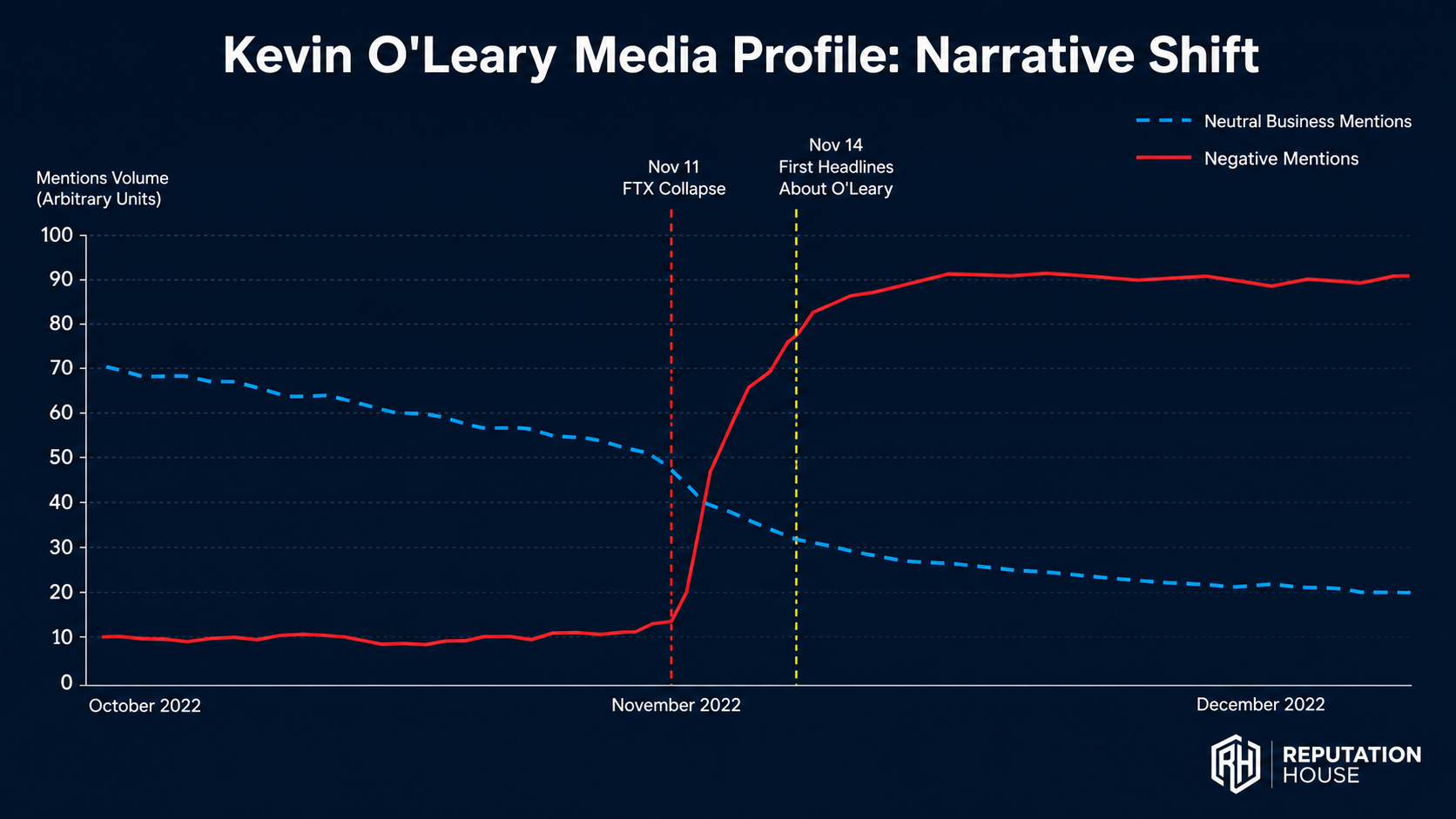
In November 2022, Kevin O'Leary — investor, Shark Tank television personality, and public face of several major fintech brands — found himself at the center of one of the year's most damaging reputation crises. When crypto exchange FTX filed for bankruptcy, it emerged that O'Leary had served as a paid ambassador for the platform, receiving approximately $15 million to promote it publicly. In numerous interviews and sponsored appearances, he had described FTX as "the most regulated exchange in the world" and recommended it to retail investors as a safe, trustworthy vehicle.
When FTX declared bankruptcy on November 11, 2022, and founder Sam Bankman-Fried was arrested on fraud charges, O'Leary's archived statements immediately became evidence — not in a courtroom, but in the media arena. Journalists, social media users, and regulators all converged on the same question: did he not know, or did he choose not to?
No pre-partnership reputation audit existed. No crisis communications framework had been prepared. No agreed narrative was in place for the event of a partner's collapse. It was this absence of system — not the fact of the FTX association itself — that determined the scale of the damage.
When FTX declared bankruptcy on November 11, 2022, and founder Sam Bankman-Fried was arrested on fraud charges, O'Leary's archived statements immediately became evidence — not in a courtroom, but in the media arena. Journalists, social media users, and regulators all converged on the same question: did he not know, or did he choose not to?
No pre-partnership reputation audit existed. No crisis communications framework had been prepared. No agreed narrative was in place for the event of a partner's collapse. It was this absence of system — not the fact of the FTX association itself — that determined the scale of the damage.
First 48 Hours
The moment FTX announced bankruptcy on November 11, 2022, journalists went straight to the archive: O'Leary's promotional videos, his tweets urging followers to use FTX, his on-camera interviews praising the platform's regulatory transparency. Social media responded within hours. His name entered the trending topics on Twitter in both the United States and Canada, and the tone was unambiguous. The audience did not distinguish between O'Leary the ambassador and O'Leary the investor-victim. The narrative — "he was selling something he didn't believe in" — formed and calcified before he had issued any official statement.
By the end of the second day, searches for "Kevin O'Leary FTX" and "Kevin O'Leary scam" were trending. The first wave of Forbes, Business Insider, and CNN coverage quoted his archived statements directly, without editorial softening, and without his current position placed alongside them.
By the end of the second day, searches for "Kevin O'Leary FTX" and "Kevin O'Leary scam" were trending. The first wave of Forbes, Business Insider, and CNN coverage quoted his archived statements directly, without editorial softening, and without his current position placed alongside them.
Reputation House Commentary
The first 48 hours after a reputation trigger are the window in which the narrative is set. If the individual or brand does not occupy that space with their own position, others fill it with their interpretations. In O'Leary's case, the narrative of selling an unsafe product to retail investors locked in during this period — before he appeared publicly to explain himself. Search engines indexed that first wave of coverage, and those articles became the long-term foundation of his revised reputation profile.
Check how your brand looks right now
Run Your Risk Check For Free
Reputation House Risk Check gives leadership teams a structured view of how the company is perceived across financial media, search, and investor-facing channels — before a guidance call, not after one.
First Week
Within the first week, several of O'Leary's major commercial partners publicly distanced themselves or paused their relationships with him. His media positioning came under sustained pressure: a number of outlets began routinely appending "former FTX ambassador" to every mention of his name. The search results page for "Kevin O'Leary" transformed within seven days — coverage of his FTX involvement displaced his business profiles, Shark Tank content, and earlier investment projects from the top positions.
O'Leary gave multiple interviews during this period, but his communications approach was inconsistent. In some appearances he positioned himself as a victim of Bankman-Fried's fraud. In others he attacked regulators and FTX competitors, notably Binance. This contradictory signaling reinforced the audience's perception of unpreparedness and lack of candor. Each new interview generated a fresh cycle of coverage with headlines including "doubles down," "defends FTX," and "faces backlash" — adding additional layers to an already deeply negative search profile.
O'Leary gave multiple interviews during this period, but his communications approach was inconsistent. In some appearances he positioned himself as a victim of Bankman-Fried's fraud. In others he attacked regulators and FTX competitors, notably Binance. This contradictory signaling reinforced the audience's perception of unpreparedness and lack of candor. Each new interview generated a fresh cycle of coverage with headlines including "doubles down," "defends FTX," and "faces backlash" — adding additional layers to an already deeply negative search profile.
Reputation House Commentary
This is the classic mechanism of a narrative gap — the distance between how a person had positioned themselves (independent expert, defender of the retail investor) and what the facts revealed (a $15 million paid contract from the same platform). The longer that gap goes unaddressed by coordinated communications, the deeper the reputation damage becomes. A narrative gap does not dissolve on its own: it gets indexed by media, and it begins to function as a standalone fact — independent of what actually happened.
Second Week
By the end of the second week, the situation had taken on an institutional dimension. The U.S. Senate Banking Committee summoned O'Leary to testify. This formally moved him from the category of "media-facing investor" to "subject of regulatory inquiry." Every subsequent publication carried a different legal and reputational weight.
Simultaneously, the media environment entered the second-phase dynamic typical of prolonged reputation crises: journalists and users surfaced archived O'Leary statements from entirely unrelated contexts — earlier Shark Tank episodes, his previous commentary on cryptocurrency, his February 2022 remarks on the Russian invasion of Ukraine. A single incident had become the entry point for reinterpreting his entire public history. Search results reinforced this pattern as new articles linked back to older ones, constructing a self-reinforcing content network.
By the close of the second week, the reputation damage had moved beyond a single media episode and become structural.
Simultaneously, the media environment entered the second-phase dynamic typical of prolonged reputation crises: journalists and users surfaced archived O'Leary statements from entirely unrelated contexts — earlier Shark Tank episodes, his previous commentary on cryptocurrency, his February 2022 remarks on the Russian invasion of Ukraine. A single incident had become the entry point for reinterpreting his entire public history. Search results reinforced this pattern as new articles linked back to older ones, constructing a self-reinforcing content network.
By the close of the second week, the reputation damage had moved beyond a single media episode and become structural.
What Could Have Been Prevented
The O'Leary case is not a story about a bad actor making a bad decision. It is a story about the systemic absence of reputation preparation at each of three distinct stages: before signing the contract, during the partnership, and at the moment of a partner's crisis.
- Before the partnership: a pre-launch reputation audit would have surfaced FTX's regulatory profile, existing public complaints against the platform, and the specific reputation risks of a high-profile association with it. That analysis would have taken days. Managing the consequences took months.
- During the partnership: ongoing media monitoring around FTX would have identified early instability signals — giving O'Leary time to adjust his public position or exit the contract before the crisis became public.
- At the moment of crisis: a unified communications strategy with agreed messaging, developed before any media appearance, would have changed the narrative of the first 48 hours — and therefore everything that followed.
Reputation House Commentary
Risk Check is not a post-crisis audit. It is a tool for identifying vulnerabilities before a public appearance or commercial commitment: what content already exists in search results, which topics carry trigger potential, how resilient the current reputation profile is to a single unguarded statement or a partner's collapse. In O'Leary's case, that analysis would have taken a few days. Rebuilding the search profile took considerably longer.
Take Action
Run a Risk Check with Reputation House
If this case pattern is familiar — an upcoming partnership, a pending public appearance, or an existing media presence you haven't pressure-tested — the time to act is before the trigger, not after it.
FAQ
What is a narrative gap, and why is it the central mechanism in this case?
A narrative gap is the measurable distance between how a person or brand has positioned themselves publicly and what documented facts reveal about them. In O'Leary's case, the gap had two dimensions: he presented himself as an independent expert protecting retail investors, while simultaneously holding a $15 million paid contract with the platform he was recommending. Neither fact was secret — but they had never been placed in direct comparison before the crisis made that comparison unavoidable. Reputation House maps narrative gaps as part of its pre-engagement analysis: identifying where a client's stated positioning is vulnerable to factual contradiction, and building communications frameworks that close or acknowledge those gaps before they become public liabilities.
How does Reputation House detect a reputation risk before it becomes a crisis?
The approach combines structured search landscape analysis, sentiment monitoring across media and social platforms, and a review of what content already exists — and in what context — before any public move is made. In practice, this means identifying which topics are already associated with a person or brand in search results, which of those topics carry escalation potential, and whether any existing partners, affiliates, or associations carry unexamined risk profiles. In the O'Leary scenario, a standard pre-engagement sweep would have surfaced existing regulatory concerns around FTX, prior user complaints on public forums, and the specific reputational exposure that a high-profile endorsement contract would create. That information existed publicly before the collapse. It was not assembled.
What is a pre-launch reputation audit, and when is it necessary?
A pre-launch reputation audit is a structured analysis conducted before a significant public commitment — a brand partnership, a product launch, a media campaign, an IPO, or a major speaking engagement. It answers three questions: what does the current search and media environment look like for the person or brand, what does it look like for the proposed partner or context, and what is the realistic risk profile of the association. It is not a background check. It is a forward-looking assessment of how a proposed action will interact with existing content, audience expectations, and potential trigger scenarios. Reputation House conducts pre-launch audits as a standard component of engagement preparation, and the output is always actionable: not a list of concerns, but a set of specific adjustments to timing, messaging, or structure.
How does Risk Check work, and what does it produce?
Risk Check is Reputation House's diagnostic tool for assessing the current state of a reputation profile and its vulnerability to foreseeable stress events. It examines the existing search landscape, identifies content clusters with negative or trigger potential, maps the gap between current positioning and public perception, and produces a prioritized assessment of where intervention is most needed. The output is not a report for a shelf. It is a working document that drives the next decision — whether that is adjusting a public narrative, preparing crisis-ready messaging, or identifying a specific piece of content that requires attention before it surfaces in the wrong context. Risk Check can be initiated before a partnership, before a public appearance, or as a standing periodic review for high-profile individuals and brands.