A Nike Anti-Case Study By Reputation House
April 2026
April 2026
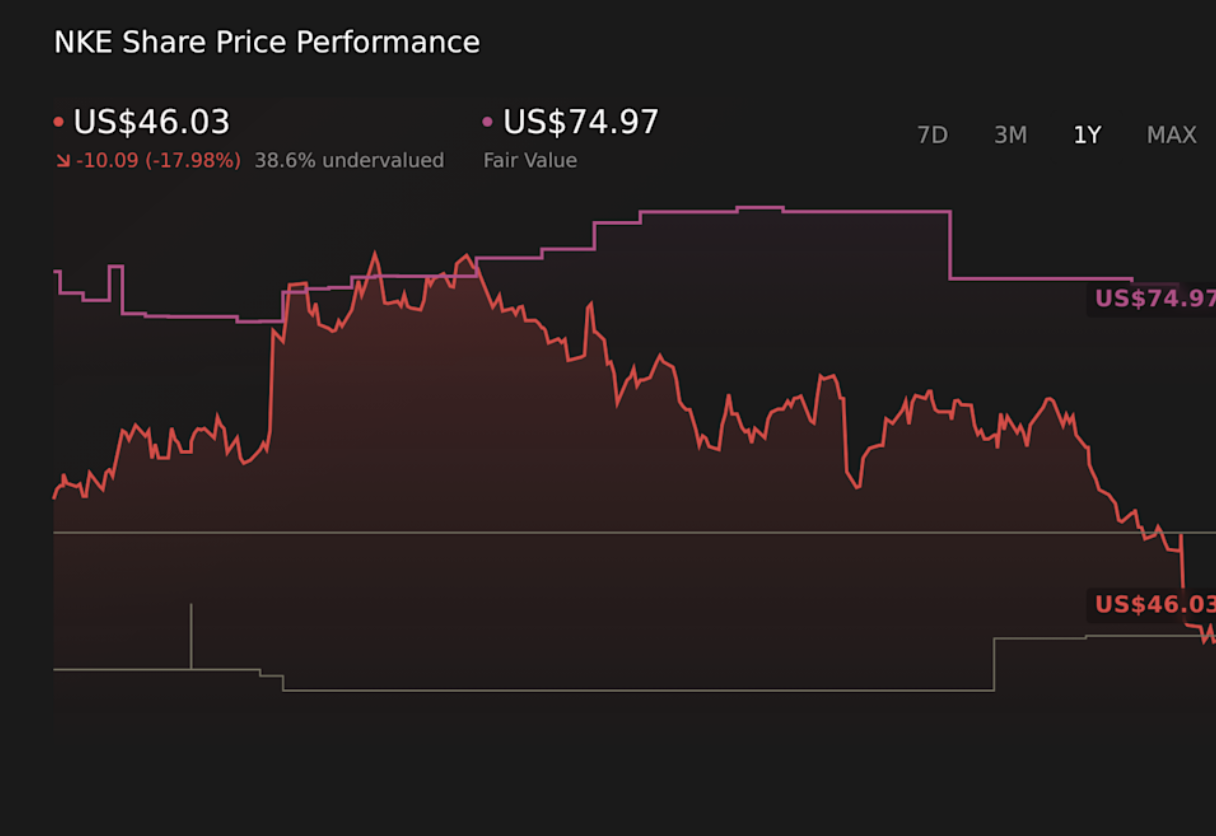
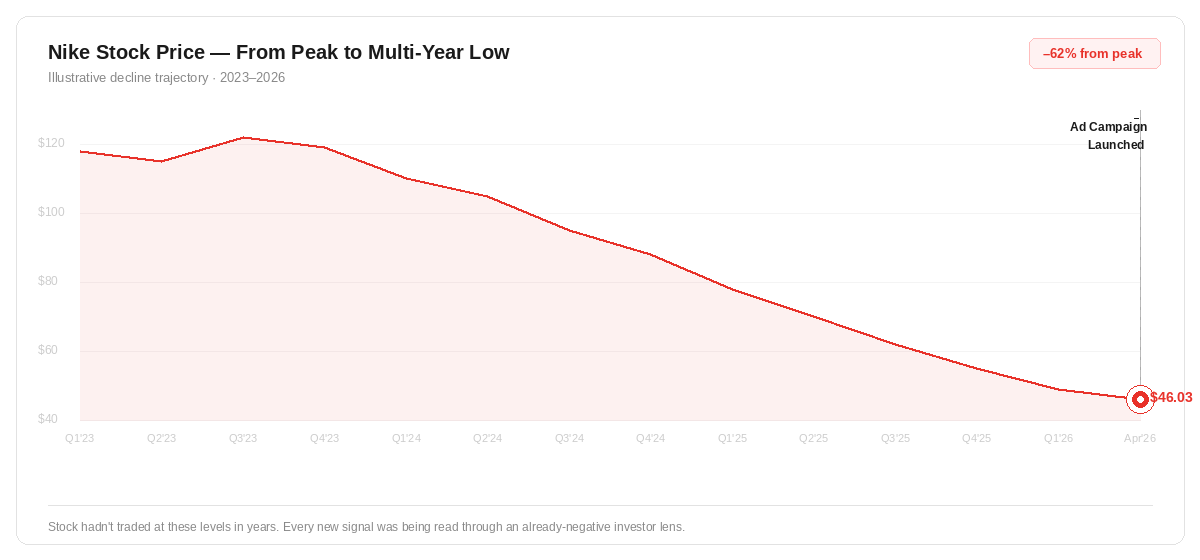
By April 2026, Nike was already deep into a difficult chapter. The company had announced a sweeping restructuring, leadership was under scrutiny, and shares had been sliding toward multi-year lows — closing at $46.03, territory the stock hadn't seen in years. Investors were watching every signal. Analysts were building narratives. The information environment around the brand was anything but neutral.
It was into this environment that Nike released a new advertising campaign tied to the Boston market.
The creative details of the campaign were quickly overtaken by something else entirely: the reaction to it.
It was into this environment that Nike released a new advertising campaign tied to the Boston market.
The creative details of the campaign were quickly overtaken by something else entirely: the reaction to it.
Reputation House Commentary
Most marketing teams evaluate launch timing as a logistics question: Is the creative approved? Are media buys confirmed? Is production on schedule? Reputational context rarely appears on this checklist.
But for a publicly traded company navigating active restructuring and investor skepticism, the information environment is never neutral. When share price is depressed and institutional confidence is already fragile, analysts are watching for narrative signals — and any new development gets absorbed into the story they're already telling, not evaluated independently.
The decision to launch wasn't wrong because the campaign was bad. It was wrong because no one asked: what will this campaign mean, given everything the market already believes about us right now?
Know what signal your brand is sending right now.
Run a Risk Check by Reputation House for Free
before your next public move.
Within hours of the campaign going live, backlash spread across social media. The conversation shifted fast — away from what the ad was saying, toward what running it said about Nike's judgment at this particular moment.
Yahoo Finance picked up the story the same day it broke. The headline framing was telling: the scandal "raises fresh questions" about management — not about the creative, not about the campaign. About management. The story had already been recontextualized.
Yahoo Finance picked up the story the same day it broke. The headline framing was telling: the scandal "raises fresh questions" about management — not about the creative, not about the campaign. About management. The story had already been recontextualized.
Reputation House Commentary
This reframing is not accidental — it's structural. Financial media and investor communities don't process brand news in isolation. They continuously update the narrative they're building about a company. When new negative information arrives during a period of pressure, it doesn't get evaluated on its own merits. It gets integrated into the existing thesis.
In a stable period, ad backlash is processed as a cultural event — noise that fades within a news cycle. During a period of reputational deficit, that same backlash becomes confirming evidence of a broader pattern. Same content, different context — completely different damage profile.
This credibility discount mechanism is what drove the Medpace Holdings collapse — seven corrective disclosures on the same pattern, each one retroactively discrediting everything the company had said before.
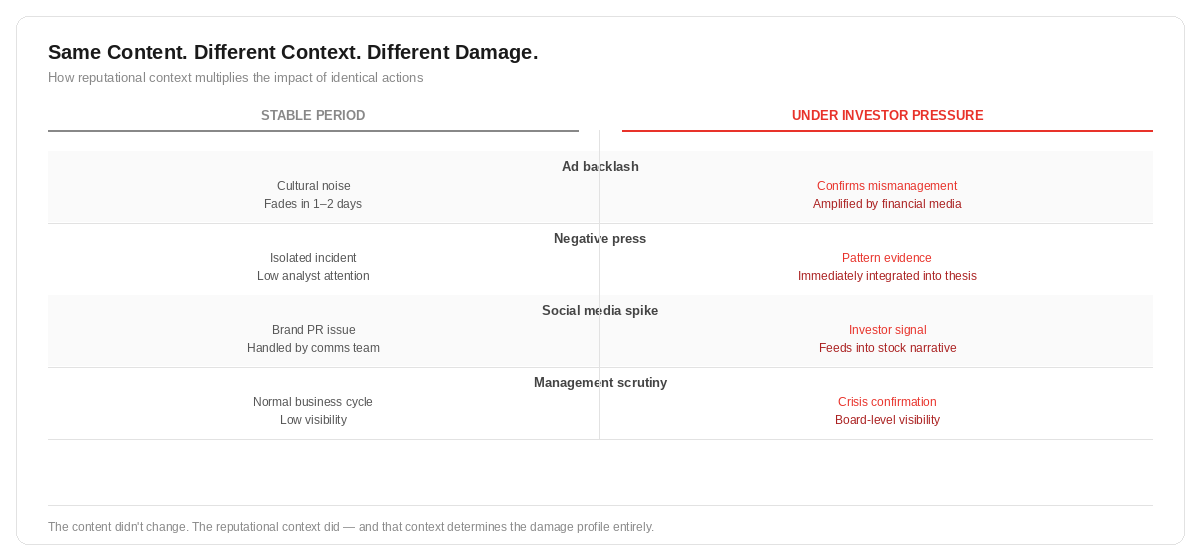
The timing made it worse in a specific, compounding way. Nike's stock was already near multi-year lows. Institutional confidence in leadership was already fragile. The backlash didn't create a new problem — it amplified an existing one. Every new signal of mismanagement, in this environment, is read not as a single incident but as further evidence that something is structurally broken.
The ad scandal didn't cause the stock decline. But it fed it. And in a period of investor scrutiny, feeding a narrative is a material act.
The ad scandal didn't cause the stock decline. But it fed it. And in a period of investor scrutiny, feeding a narrative is a material act.
Reputation House Commentary
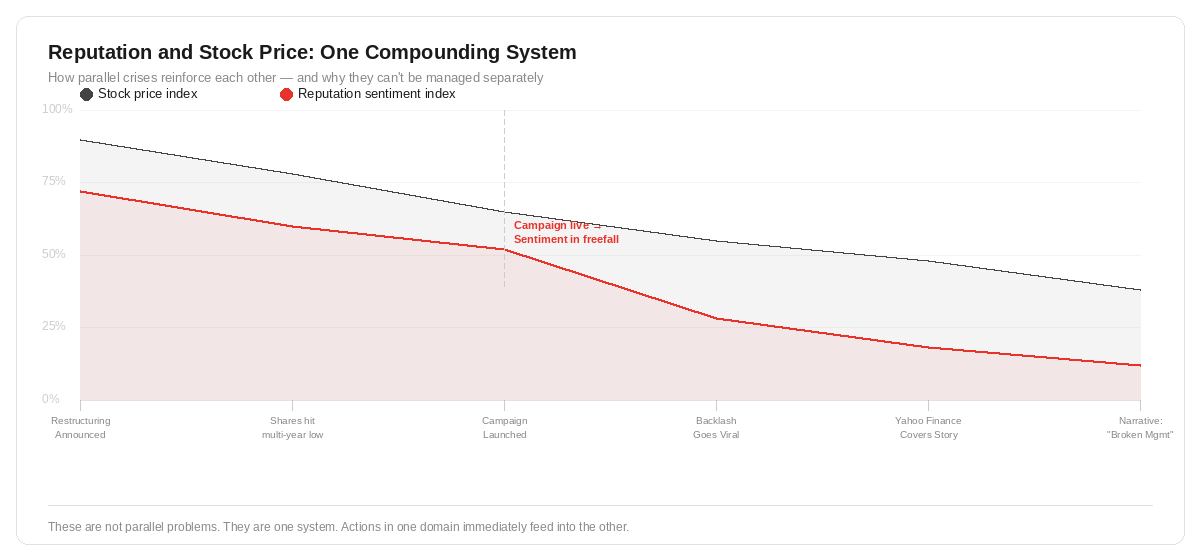
There's a principle that gets systematically underweighted in corporate communications: a reputational crisis and a stock decline are not two parallel problems to be managed in separate workstreams. They are one system.
Actions taken in one domain — creative direction, campaign timing, spokesperson choice — immediately feed into the other. Marketing teams that operate without real-time awareness of investor sentiment and media narrative aren't just missing information. They're making decisions with a fundamentally incomplete model of risk.
HBR has documented that 80% of CEOs don't trust or are unimpressed with their CMOs. That gap in confidence becomes particularly costly when a marketing misstep compounds a broader investor relations problem. When the C-suite is already questioning marketing leadership, a public campaign failure isn't just a campaign failure. It becomes a leadership failure.
What would have changed things? Not necessarily a different campaign. Possibly just a different moment — or a different decision process before launch.
A pre-launch contextual audit would have surfaced several things: the current dominant narrative in financial and social media, the specific pressure points investors and critics were already activated around, and the likely framing of any backlash given the story already in circulation about Nike's management.
None of this is speculative. It's structured information gathering. It produces a launch decision with real risk parameters attached — rather than a decision based on creative confidence alone.
Without it, reputational damage doesn't just follow the crisis — it embeds itself into the brand's digital record and keeps surfacing long after the headlines move on.
A pre-launch contextual audit would have surfaced several things: the current dominant narrative in financial and social media, the specific pressure points investors and critics were already activated around, and the likely framing of any backlash given the story already in circulation about Nike's management.
None of this is speculative. It's structured information gathering. It produces a launch decision with real risk parameters attached — rather than a decision based on creative confidence alone.
Without it, reputational damage doesn't just follow the crisis — it embeds itself into the brand's digital record and keeps surfacing long after the headlines move on.
Reputation House Commentary
The lesson isn't to stop communicating. It's to stop treating communication decisions as separate from reputation management.
In a period of investor scrutiny, every public move is a reputation move. Every campaign is also a signal. And if you haven't audited what signal you're actually sending — relative to the story the market is already telling about you — you're not running a campaign. You're adding fuel.
The speed at which that fuel ignites is documented in the SES AI case — a 37% drop in a single session, a class-action filed within days, and a narrative that escaped internal control before markets closed.
Know what signal your brand is sending right now.
Run a Risk Check by Reputation House for Free
before your next public move.
Frequently Asked Questions
How did Nike's ad campaign become a stock decline amplifier?
Nike launched a Boston-market advertising campaign while the company was navigating restructuring, leadership scrutiny, and a stock price at $46.03 — multi-year lows. When social media backlash emerged within hours, financial media did not evaluate the campaign on creative merit. Yahoo Finance reframed coverage as raising "fresh questions about management judgment." The backlash fed existing investor loss-of-confidence narratives rather than being absorbed as isolated brand noise. Same content, different context — completely different damage profile.
Are a reputational crisis and a stock decline two separate problems?
No. According to the analysis, a reputational crisis and a stock decline are one system, not two parallel problems. Marketing decisions feed investor relations outcomes directly. When a company is under financial pressure, every public action is processed by investors and financial media within the frame of the existing narrative — not evaluated independently. A campaign backlash during a stable period is temporary. The same backlash during a period of investor skepticism becomes evidence of deeper management failure.
What is a pre-launch contextual audit and why does it matter?
A pre-launch contextual audit assesses the current information environment before any major public action — campaign, announcement, or executive statement. It surfaces: the dominant narratives in financial and social media at that moment, specific pressure points already activating investors and critics, and the likely framing of any backlash given existing market stories. The output is a launch decision with real risk parameters attached — not a decision based on creative confidence alone. Without it, companies make timing decisions as if the information environment is neutral. It never is.
What questions should a CMO ask before launching a campaign during a period of financial pressure?
Three questions determine whether a campaign is safe to launch:
(1) What narrative is financial media currently telling about our company — and does this campaign confirm or contradict it?
(2) If this campaign generates backlash, how will it be framed given what investors already believe about us? (3) Is now the right moment, or does delaying by 60–90 days change the risk profile entirely?
The question is not "is the creative good?" — it is "what will this campaign mean, given everything the market already believes about us right now?"
(1) What narrative is financial media currently telling about our company — and does this campaign confirm or contradict it?
(2) If this campaign generates backlash, how will it be framed given what investors already believe about us? (3) Is now the right moment, or does delaying by 60–90 days change the risk profile entirely?
The question is not "is the creative good?" — it is "what will this campaign mean, given everything the market already believes about us right now?"
Why do 80% of CEOs distrust their CMOs on reputation decisions?
Harvard Business Review research shows 80% of CEOs don't trust or are unimpressed with their CMOs — a gap that reflects a structural misalignment. CMOs are trained to evaluate campaigns on creative merit, audience resonance, and brand metrics. They are rarely equipped to assess how a campaign will be processed by financial media, investor relations teams, or regulatory audiences during periods of elevated scrutiny. Reputation and investor relations cannot be managed as separate functions. When they are, the result is decisions that are creatively correct and strategically catastrophic.
Know what signal your brand is sending right now.
Run a Risk Check by Reputation House for Free
before your next public move.