In 2023, Cracker Barrel Old Country Store — a 54-year-old American restaurant and retail chain synonymous with Southern comfort food, rocking chairs, and a loyal older-rural customer base — announced a sweeping brand refresh. New logo. Modernized store design. A menu pivot toward "contemporary" offerings. And a high-profile partnership with pop-culture figures intended to signal that Cracker Barrel was "evolving."
The intent was legitimate: attract younger demographics, counter declining foot traffic, and reposition the brand for the next decade. The execution was a textbook case of launching transformation without first auditing who you're transforming *away from*.
The result: a social media revolt from the chain's core audience, cratering sentiment scores, a stock decline, and — by the end of 2023 — the departure of CEO Sandra Cochran after 12 years at the helm.
The intent was legitimate: attract younger demographics, counter declining foot traffic, and reposition the brand for the next decade. The execution was a textbook case of launching transformation without first auditing who you're transforming *away from*.
The result: a social media revolt from the chain's core audience, cratering sentiment scores, a stock decline, and — by the end of 2023 — the departure of CEO Sandra Cochran after 12 years at the helm.
First 48 Hours
When the rebrand visuals leaked and then officially dropped, the reaction from Cracker Barrel's core demographic was immediate and visceral. Social platforms, Facebook above all, the primary home of their 50+ base, flooded with negative commentary. Phrases like "you've abandoned us", "this isn't the Cracker Barrel we loved", and "woke makeover" dominated organic reach. The hashtag #OldCrackerBarrel trended regionally across Southern states.
The brand's social team responded with templated positive messaging, which only amplified the perception of a tone-deaf corporate machine. Within 36 hours, national media had picked up the story not as a rebrand announcement, but as a customer revolt.
The brand's social team responded with templated positive messaging, which only amplified the perception of a tone-deaf corporate machine. Within 36 hours, national media had picked up the story not as a rebrand announcement, but as a customer revolt.
Reputation House Commentary
The first 48 hours of a brand transformation are a sentiment stress test. When the loudest voices in your audience are your most loyal customers — and they're saying 'you don't know us anymore' — that's not pushback to manage. That's a signal that pre-launch audience mapping was never done. A structured reputation audit before the campaign would have surfaced this narrative gap in weeks, not in a live crisis.
First Week
By day four, financial analysts began revising sentiment. Cracker Barrel's stock dropped approximately 6% in the week following the rebrand rollout, as investor concern mounted not just about the campaign but about strategic direction. Earnings call transcripts from Q3 2023 show analysts pressing leadership on customer retention metrics.
Internal contradictions surfaced publicly: store managers reported customers walking out upon seeing updated decor; franchise operators quietly voiced concerns to trade press. The chain attempted a partial course correction — re-emphasizing "heritage" in its messaging — but this read as reactive rather than confident, deepening the credibility wound.
The media narrative shifted from "Cracker Barrel is changing" to "Cracker Barrel doesn't know what it is."
Internal contradictions surfaced publicly: store managers reported customers walking out upon seeing updated decor; franchise operators quietly voiced concerns to trade press. The chain attempted a partial course correction — re-emphasizing "heritage" in its messaging — but this read as reactive rather than confident, deepening the credibility wound.
The media narrative shifted from "Cracker Barrel is changing" to "Cracker Barrel doesn't know what it is."
Check how your brand looks right now
Run Your Risk Check For Free
Reputation House Risk Check gives leadership teams a structured view of how the company is perceived across financial media, search, and investor-facing channels — before a guidance call, not after one.
Second Week and Beyond
By week two, the story had mutated into a broader corporate governance conversation. Board pressure over strategic execution — reportedly building since prior quarters of traffic decline — intensified. The rebrand crisis became the visible breaking point in a longer pattern of misalignment between leadership decisions and brand identity.
In November 2023, Sandra Cochran announced her retirement. Industry observers were direct: the rebrand had accelerated a board confidence crisis. A successor, Julie Masino, was brought in with an explicit mandate to reconnect the brand to its core audience.
In November 2023, Sandra Cochran announced her retirement. Industry observers were direct: the rebrand had accelerated a board confidence crisis. A successor, Julie Masino, was brought in with an explicit mandate to reconnect the brand to its core audience.
Reputation House Commentary
What makes this case instructive isn't that the rebrand was a bad idea — it's that the decision was made inside a narrative vacuum. Leadership was optimizing for an audience they wanted, while the audience they had was monitoring every signal for evidence of abandonment. A pre-launch reputation audit maps that tension explicitly: it shows you who is watching, what they're watching for, and which moves trigger which emotional responses. That's not a creative brief. That's risk architecture.
What a Pre-Launch Audit Would Have Caught
The Cracker Barrel crisis followed a pattern RH identifies as a narrative gap event: the moment when a brand's internal story about itself diverges publicly from the story its audience is telling. Three specific failure points were auditable in advance:
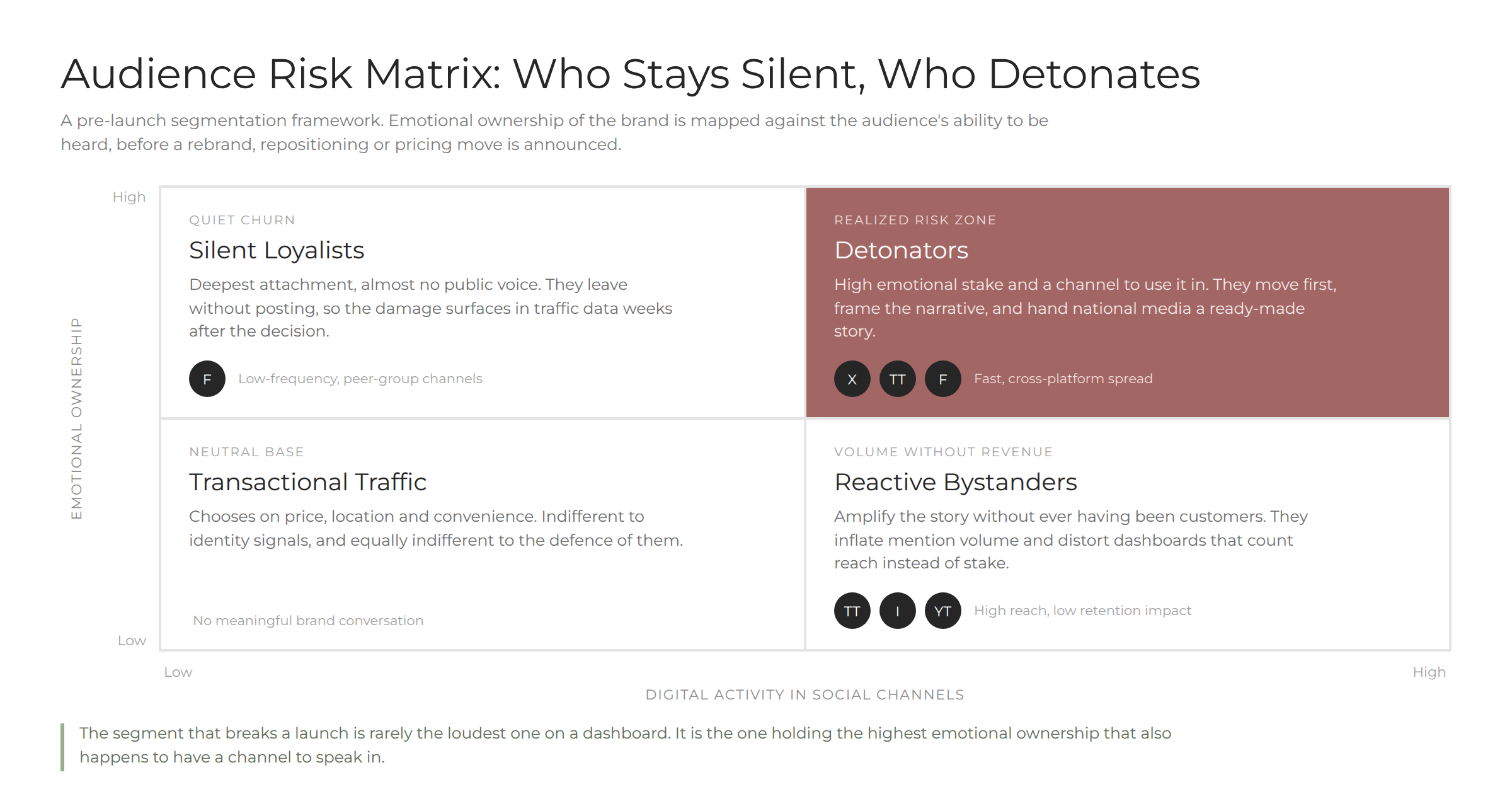
- Audience identity lock-in. Cracker Barrel's core customer had an unusually high emotional ownership of the brand. Sentiment mapping would have quantified how much symbolic weight that audience placed on visual and menu consistency.
- Platform-specific risk concentration. The revolt lived on Facebook, not Twitter/X or Instagram. A channel-level risk analysis would have flagged that the most reactive segment was most active on a platform where negative posts have long organic shelf-life among peer groups.
- Trigger vocabulary. Phrases like "modernize," "evolve," and "contemporary" had prior negative association in this demographic's brand conversations. Lexical analysis of owned and earned media would have surfaced this pre-launch.
Reputation House Commentary
Risk Check is where we start every brand transformation engagement. It's not a sentiment dashboard, it's a structured diagnostic that identifies which audiences will move against you, which narratives are already forming in the dark, and what the cost-of-inaction looks like before a dollar is spent on the campaign. Cracker Barrel didn't have a bad strategy. They had an unaudited one.
Ready to know what your audience will do before you move?
Run a Risk Check with Reputation House before your next brand decision
Reputation House Risk Check gives leadership teams a structured view of how the company is perceived across financial media, search, and investor-facing channels — before a guidance call, not after one.
FAQ
What is a "narrative gap" and how does it apply to the Cracker Barrel case?
A narrative gap is the measurable distance between the story a brand tells about itself and the story its audience is already telling in public channels. In Cracker Barrel's case, leadership's internal narrative was "responsible evolution toward new demographics." The audience narrative — already forming in Facebook groups, Reddit threads, and customer reviews months before the rebrand — was "our brand is being taken from us." Reputation House maps narrative gaps as part of every pre-launch diagnostic. We identify where those two stories diverge, how wide the gap is, and which audiences will move to close it aggressively. A narrative gap isn't a PR problem — it's a strategic misalignment that becomes a PR problem when you launch without knowing it exists.
How does Reputation House detect reputation risk before a crisis happens?
Our Risk Check diagnostic analyzes three layers simultaneously: owned content and messaging (what you're saying), earned media and social conversation (what audiences are saying), and dark signal data (what's forming in low-visibility channels before it reaches mainstream platforms). We cross-reference these against your planned campaign or strategic move to identify which audiences are most likely to react, on which platforms, and with which emotional intensity. In Cracker Barrel's case, the highest-risk signal was concentration of negative brand-identity language in Facebook communities — detectable weeks before the rebrand launched. We build risk maps, not just dashboards.
What is a pre-launch reputation audit and what does it actually deliver?
A pre-launch reputation audit is a structured diagnostic run before a significant brand move — rebrand, product launch, executive appointment, market entry, pricing change. It delivers four outputs: (1) an audience segmentation by emotional stake in your brand, (2) a platform-level risk concentration map, (3) a trigger vocabulary analysis identifying which words and visual cues activate negative response in your core segments, and (4) a scenario matrix showing likely narrative trajectories under different execution choices. It's not research — it's decision architecture. The output tells leadership not just *what* audiences think, but *what they will do* when you move.
How does Risk Check work and what does the process look like?
Risk Check is Reputation House's entry-point engagement for brands considering a significant strategic move. It runs over a defined window — typically two to four weeks — and combines automated signal monitoring with expert analyst interpretation. The process: intake session to define the scope of the planned move → signal collection across search, social, news, and forum layers → expert analysis and pattern identification → delivery of a Risk Map with prioritized threat scenarios and recommended decision gates. It's designed to answer one question before you spend: "What will happen to our reputation if we do this?" We don't just tell you there's a risk. We tell you which audience moves first, how fast, and what the realistic cost looks like if you proceed without mitigation.
Could Cracker Barrel have kept the rebrand and still avoided the crisis?
Yes — and this is the critical MOFU insight. The crisis wasn't caused by the decision to rebrand. It was caused by the absence of audience sequencing in the execution. A pre-launch audit would likely have recommended a phased rollout: test new design language in low-emotional-stakes markets first, segment messaging so that core audiences received heritage-forward communication while new demographic targets received the contemporary messaging, and establish a listening cadence to catch early negative signal before it reached critical mass. Reputation House works with brands on exactly this kind of execution architecture — not to kill bold moves, but to route them around the audience landmines that sink them.
Why is the cost of inaction higher than the cost of working with Reputation House?
Because a crisis compounds. The Cracker Barrel case shows four distinct cost layers that activated sequentially: immediate sentiment collapse → stock impact → operational disruption (customer churn, store-level confusion) → executive transition cost. Each layer is more expensive than the last, and each one was triggered by the absence of a single upstream input: audience risk mapping. Reputation House's engagement cost is fixed and front-loaded. Crisis cost is variable, cascading, and arrives at the worst possible moment — when your brand is most exposed and your team is least prepared. The math is straightforward. The harder question is why organizations consistently underestimate the cost of not knowing.